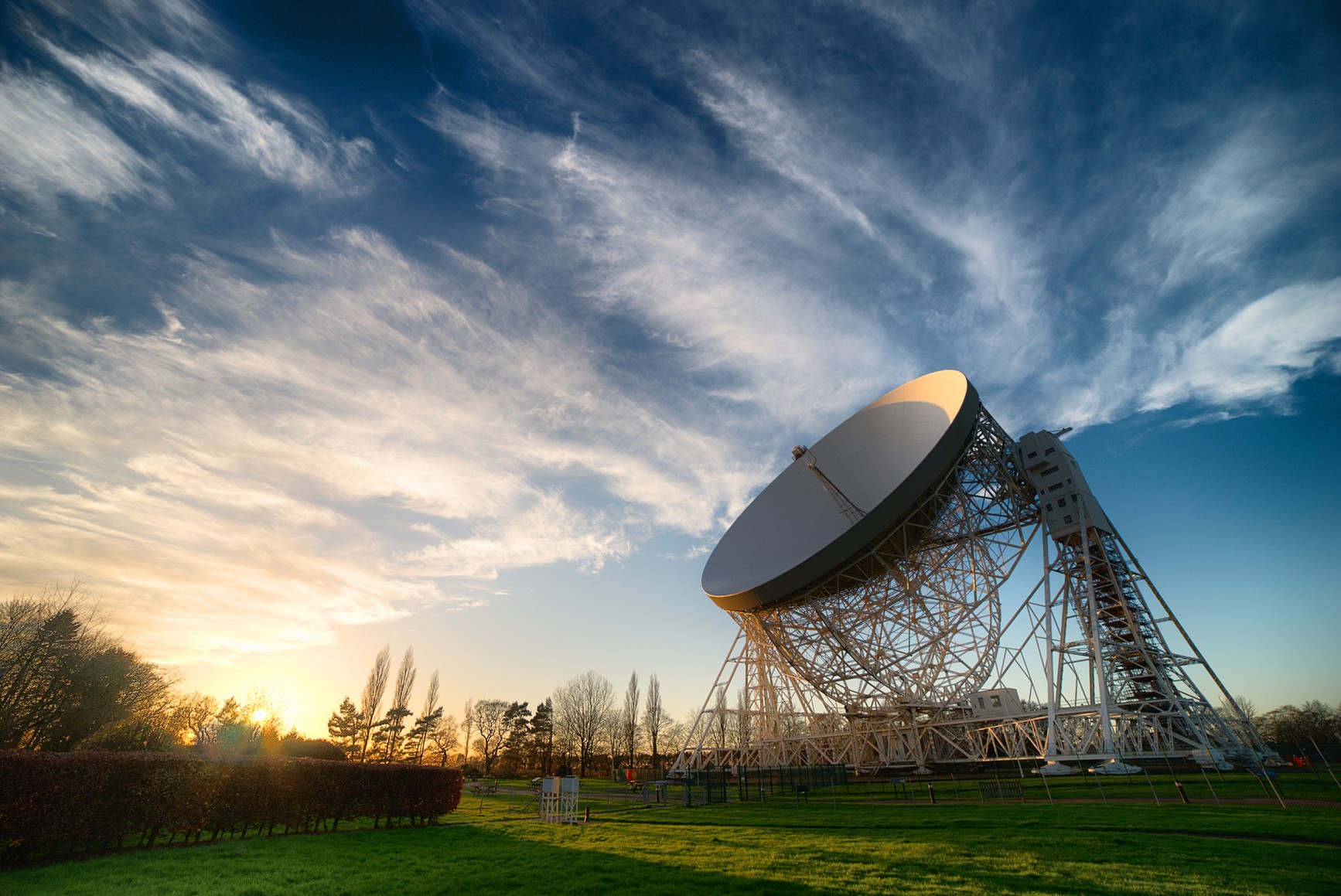
Radio astronomers and radar experts have teamed up to demonstrate how powerful radio telescopes, including the 76-m Lovell Telescope and e-MERLIN antennas operated by the University of Manchester at Jodrell Bank, can be used to improve our capabilities for tracking satellites and space debris in orbit.
This new Long Baseline Multistatic Radar (LBMR) capability for real-time space object characterization transforms existing radio-frequency infrastructure, including radio telescopes and satellite communications antennas, into a powerful dual-use system for Space Domain Awareness.
As the number of satellites being launched every year grows towards the tens of thousands, space is becoming increasingly congested. At the same time our reliance on services provided from space is becoming increasingly clear. For these reasons it is essential to boost our capabilities of monitoring, tracking and characterising objects in orbit.
Radar is a powerful tool for monitoring objects in orbit, but observing distant regions such as geostationary orbit (36,000 km) requires high power transmitters and the most sensitive receivers. Radio telescopes like the Lovell Telescope and e-MERLIN are designed to detect the faint natural radio emissions from stars and galaxies, while large deep-space communications antennas routinely receive extremely weak signals from distant spacecraft. By using these assets as geographically distributed radar receivers, the sensitivity of existing radar systems can be increased by more than tenfold ,enabling the detection of smaller objects at much greater distances.
To make this capability useful for space operations, the radar echoes received at the radio telescopes need to be collected, processed and analysed in real time. This has now been demonstrated in a new project funded by the UK Space Agency at a live event recently held at the European Space Agency at Harwell, in the UK.