A small capsule could change how we study the microbiome of the small intestine. A team, led by researchers at the University of Tokyo, has created a compact capsule device designed to take samples from the small intestine using a tiny extendable brush. Still in the early stages of development, they have demonstrated that the device could be magnetically controlled to move through extracted pig intestines and sweep useful samples from the intestinal surface. In the future, this type of device could provide a more comfortable and complementary option to current endoscopic procedures.
Endoscopes are indispensable when doctors need to review the gastrointestinal (GI) tract, whether it’s to take photos, samples, or provide treatments such as removing polyps. Typical scopes go either from the mouth to the beginning of the small intestine (an upper endoscopy), or through the large intestine (a colonoscopy). Exploring much of the long and narrow small intestine is considerably more challenging.
One examination method is a capsule endoscopy. The patient swallows a small capsule containing a camera which sends images to an external recorder as it passes through their GI system. While capsule endoscopy is very helpful for diagnosing and monitoring some conditions, commercially available capsules are mainly designed for imaging and do not routinely collect samples.
Now, a team at the University of Tokyo has tested the prototype for a new type of controllable capsule, which is designed to take samples from the surface of the small intestine.
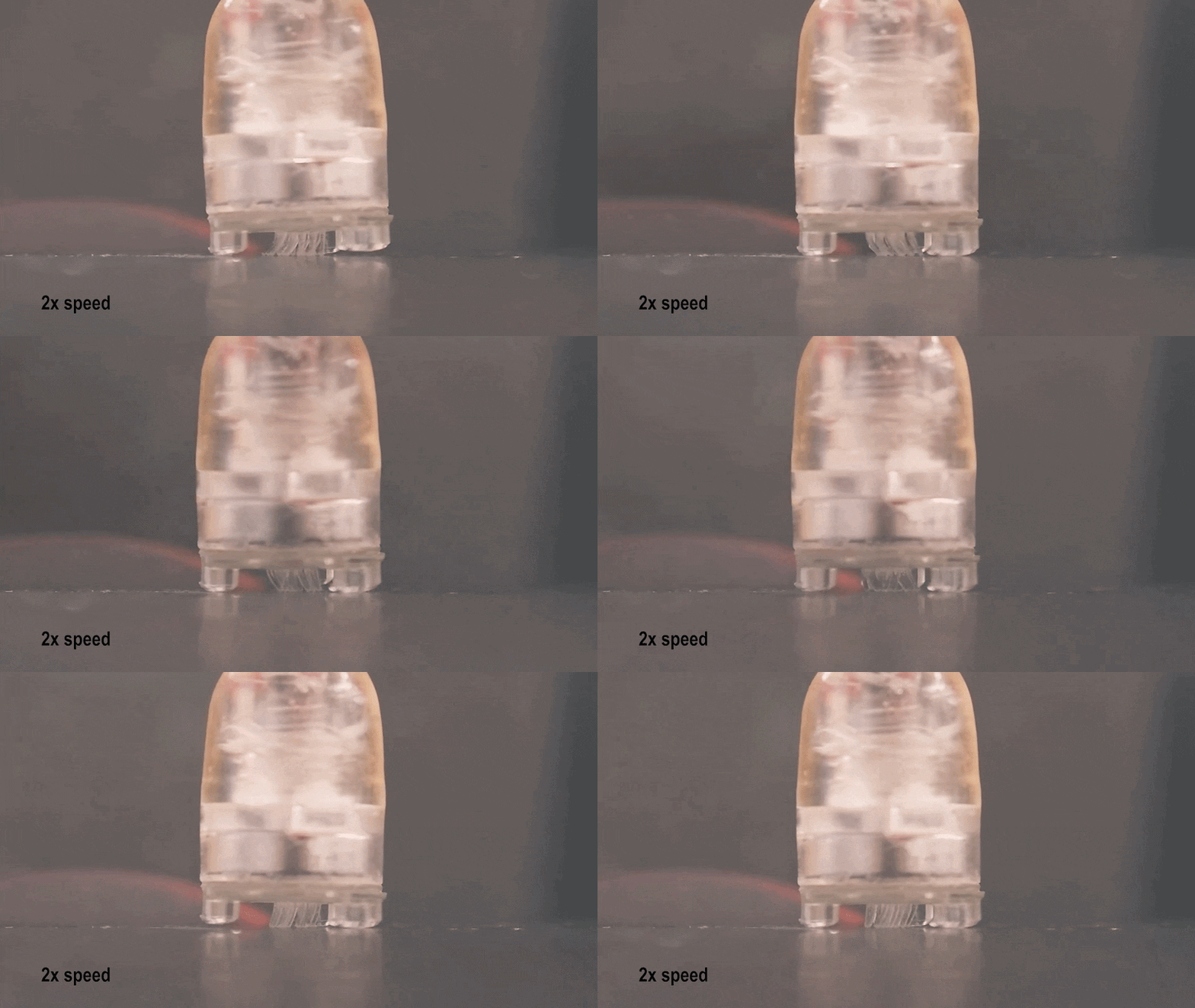
“In this early-stage study, we have demonstrated a capsule that can actively collect useful biological samples from the intestinal surface using a magnetically controlled retractable brush,” said postdoctoral researcher Yuguo Dai from the Graduate School of Engineering at the University of Tokyo. “The collected samples were suitable for 16S rRNA gene sequencing, a method commonly used for microbiome analysis.”
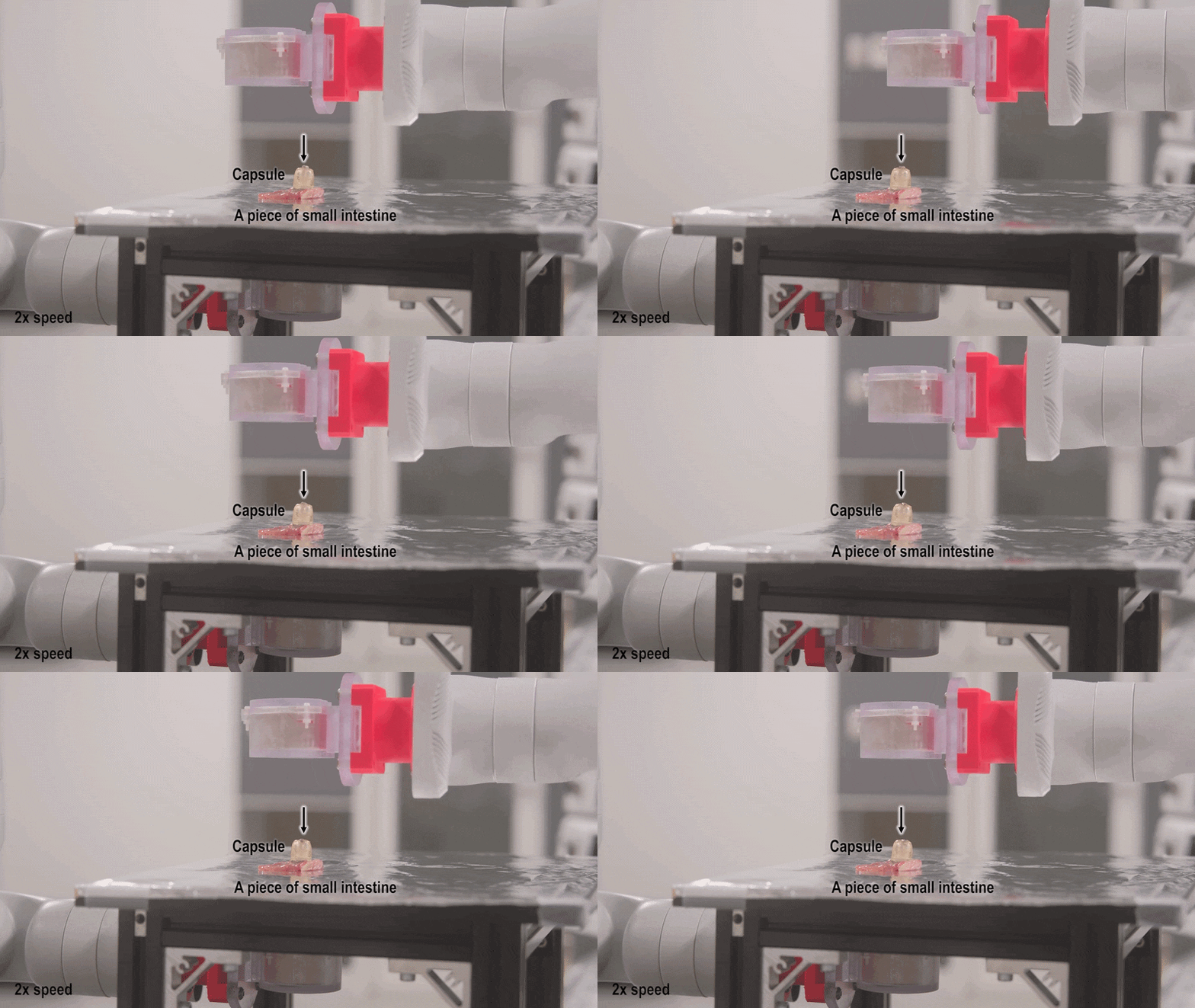
The capsule is a compact device which encases a flexible brush, a screw mechanism and magnets. The team tested the capsule in the lab on extracted small intestines from pigs. Two robotic arms with external magnets were used to control the internal magnets in the capsule without making contact. One stabilized the capsule near the target area, and the other operated its internal screw to extend a brush, sweep up a sample and retract it back inside.
“We see this technology as a potential complement to existing clinical sampling methods, particularly for patients who need sampling from difficult-to-access regions, or who may benefit from a less invasive and less uncomfortable procedure,” said Dai.
As patient comfort is a main concern, further miniaturization of the capsule will be necessary to reduce any issues with ingestion, or any hindrance to the capsule moving smoothly through the GI system.
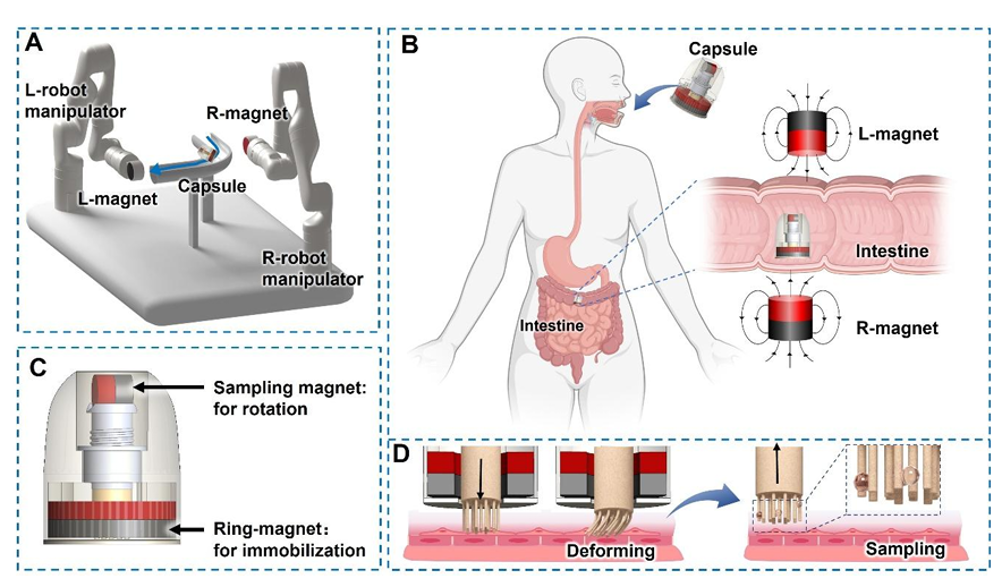
Another challenge is the limitations of the magnet operating distance. In tests, the external magnets were positioned close to the intestine, but for this to work with the shape of the human body, the distance would need to be greatly extended.
“For now, our initial results are encouraging and we are happy to be able to demonstrate that the basic concept is feasible. Our next steps are to overcome the challenges of size, operating distance and ensuring that collected samples are protected,” said Dai.
“In the future, if the capsule can eventually be clinically validated, this approach could complement other endoscopic procedures, potentially offer a more comfortable approach to intestinal sampling, and possibly help reveal how microbial communities vary at different locations within the human intestine. This could provide us with new information for studying the diversity of the intestinal environment and how it relates to our health.”