FIFA President Gianni Infantino is a highly controversial figure – yet his position appears remarkably secure. Würzburg sports scientist Tobias Thune Jacobsen identifies three reasons why Infantino seems to survive every crisis.
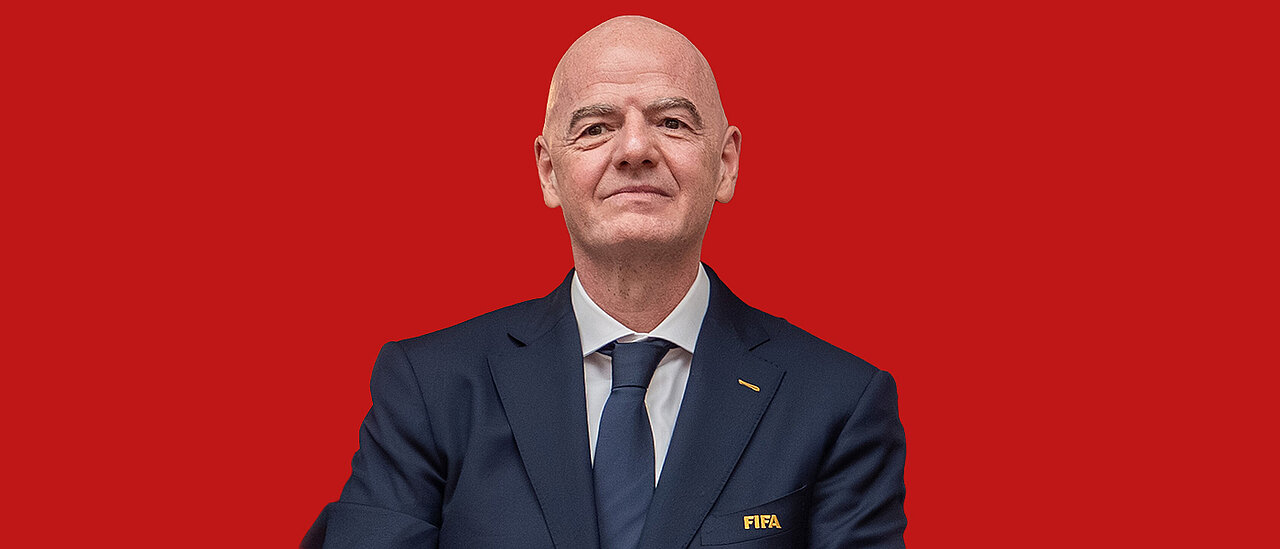
For ten years, Italian Gianni Infantino has been at the helm of the Fédération Internationale de Football Association, better known as FIFA.
He is not only one of the most powerful figures in world sport, but also one of its most heavily criticised – and yet few sports officials appear as secure in their position as he does.
That position is currently being put to the test once again. His overly familiar relationship with US President Donald Trump during the World Cup, including alleged interference in the sporting competition, had already drawn criticism. But that controversy pales in comparison with the plans Infantino unveiled shortly after the tournament: the partial sale of commercial rights to the World Cup. Yet this crisis, too, is unlikely to bring him down.
Tobias Thune Jacobsen, a sports scientist at Julius-Maximilians-Universität Würzburg (JMU), identifies three reasons why. Jacobsen’s research focuses in particular on power struggles in sport .
The original article was recently published by the popular science news outlet VIDENSKAB DK.
Mechanism one: Infantino speaks to those who vote – not to us
Many fans and media outlets talk about football as the sport of the “people”, as something that should belong to fans, local clubs and national teams – not to those at the top of international governing bodies.
Infantino, however, does not depend on what spectators think. He depends on the votes of the 211 national football associations that make up FIFA.
When he promises more World Cup places for Africa and Asia , more development funding for smaller associations and more tournaments, he is speaking directly to those who decide his political fate.
A national association can be deeply concerned about the human rights situation in a host country while at the same time being financially and professionally dependent on FIFA.
At the same time, through the FIFA Forward programme and plans for new commercial ventures, Infantino has promised member associations significantly increased development funding: billions of additional dollars for sports facilities, talent development and national team activities – a golden opportunity for those who vote for him.
In practice, this means that Infantino can be unpopular in Europe and among the wider public while still enjoying solid support among the associations that actually have a vote.
It is classic organisational logic: the inner circle takes priority over the external image.
If Infantino wants to retain his power, his attention is therefore focused first and foremost on the associations whose votes he will need at the next election – not on what European newspapers write or how fans in stadiums and on social media feel about him.
UEFA versus FIFA: a battle over morals or power?
The current conflict between FIFA and UEFA over the sale of future World Cup rights to a new FIFA commercial entity illustrates precisely this logic.
Infantino recently presented plans to establish a company in which external investors could acquire stakes in the rights to future World Cups and other tournaments. The plan met with fierce opposition from UEFA and several other associations. It has since been abandoned.
UEFA even threatened to boycott FIFA tournaments in response and publicly warned that the plan would “sell the soul of football” to private investors.
Behind the rhetoric, however, lie some very tangible interests. The Champions League and other European club competitions are financial goldmines, and UEFA has a strong interest in retaining control over them.
If a commercial entity gave FIFA even greater control over global rights and revenue streams, this could weaken UEFA’s own position and business model in the long term. UEFA’s criticism of FIFA is therefore not only about moral values; to a considerable extent, it is also about defending its own commercial monopolies.
This makes it less likely that the criticism alone will lead to fundamental change. It is as much part of a power struggle between two commercially powerful players as it is a challenge to the system itself.
The current conflict therefore reveals both Infantino’s strategy and UEFA’s counter-strategy. At the same time, it underlines that the battle for the “soul” of football is, to a considerable extent, also a battle over money and control.
Mechanism two: more football as the answer to criticism
Whether the issue is corruption or sportswashing, whenever FIFA comes under criticism, Infantino’s answer is often very simple: more football, more matches, bigger tournaments.
And that is an appealing prospect – after all, who does not want more football?
Above all, however, it is also an effective way of shifting attention away from critical questions – about host countries and governance, for example – and towards the sport itself, as well as new opportunities to participate and generate revenue. At the same time, the FIFA president promises rewards for the associations that support him.
After his re-election in 2023, for example, Infantino declared that there needed to be “way more football and not less competitions”, while presenting both the expanded World Cup finals and a new 32-team Club World Cup as a “fantastic opportunity” for more countries and clubs around the world.
Here, Infantino is exploiting the basic logic of soft power in sport. The prospect of playing at a World Cup, gaining greater visibility or receiving more funding for facilities and talent development often makes it difficult for national officials to say “no” – despite their own reservations or criticism from the media and fans.
Mechanism three: actively exploiting conflict
It may sound paradoxical, but even fierce criticism does not necessarily weaken Infantino. On the contrary, he can actively exploit it and turn it to his advantage. It becomes a resource he can use to rally the rest of the world behind him against Europe.
When European media, major clubs and politicians criticise FIFA, Infantino can position himself as the man defending “global football” against a European elite that wants to call the shots.
He can frame the criticism as a power struggle between wealthy European top clubs and the rest of the world, thereby mobilising support among associations that feel overlooked.
This was evident, for example, in his speech ahead of the 2022 World Cup in Qatar , when he described European criticism as “hypocrisy” and called on Europe to apologise “for the next 3,000 years”. In doing so, he portrayed himself and FIFA as defenders of the rest of the world against a moralising European elite.
He creates a narrative in which the criticism becomes a power struggle between rich and poor associations, between Europe and the rest of the world.
In his research on sportswashing and soft power, Tobias Thune Jacobsen also examines how criticism of major sporting events can do more than simply harm host countries and organisations.
It can also be used to mobilise internal support by creating an “us versus them” narrative.
Jacobsen describes this process as ” reverse sportswashing “: external criticism is transformed into an argument for internal unity and loyalty, ultimately strengthening those being criticised rather than weakening them.
Infantino is adept at exploiting these tensions. The greater the conflict between European football and FIFA, the easier it becomes for him to build loyalty in other regions that feel overlooked or underrepresented.
Fans and the media have power – but indirectly
Does that mean fans and journalists are irrelevant? No. Public criticism can …
- … make it politically more costly for democratic governments to support problematic host countries.
- … put pressure on sponsors to change their strategies.
- … influence national associations concerned about reputational damage.
However, criticism rarely affects Infantino directly. Instead, it travels through several stages: from fans and the media to politics, sponsors and associations – and only then, at best, to the top of FIFA. As a result, FIFA and Infantino can face massive public opposition while continuing to enjoy strong support within the organisation itself.
The current conflict between FIFA and UEFA illustrates just how limited the scope for action often is.
The rhetoric may be fierce, but both sides are deeply dependent on one another, financially and in sporting terms.
UEFA needs FIFA tournaments, and FIFA needs European clubs and their stars. It is therefore more realistic to expect the conflict to end in a compromise over the distribution of revenue than in genuine reform of the power structures in world football.
In other words, both Infantino and his critics are tied to the same system – and that limits the extent to which criticism can shift the balance of power.
What does this mean for the future?
Infantino, then, is not simply a “villain” in a sports-political thriller. He is also a product of a system in which the global growth of football, commercial interests and political power are closely intertwined.
The way he survives crises reveals something fundamental about the role of sport as an instrument of soft power. It also shows how sportswashing and reverse sportswashing have become established parts of the political toolkit in international football.
Anyone seeking to change the system therefore needs to do more than replace the person at the top. There needs to be a broader debate about how FIFA and international sports organisations distribute power, money and votes – and about the role fans, players and national associations should play in the future governance of football.
Otherwise, the next FIFA president will have many of the same tools at their disposal that Infantino uses today to weather crises. And the story of the “most criticised yet most secure man in football” will repeat itself.