Key Facts:
Australia is currently experiencing a surge in RSV cases as winter arrives, with 52,383 notifications of the virus recorded so far this year, outnumbering both COVID-19 (41,036) and influenza (34,204) notifications.
There have been 6,526 RSV cases notified in those 75 years and older.
RSV and ‘flu’ shots seen as equally important by nearly two-thirds of older Australians
Older Australians are embracing the opportunity to protect themselves against RSV (respiratory syncytial virus), with a new survey revealing strong momentum behind the new federally funded RSV vaccination program.
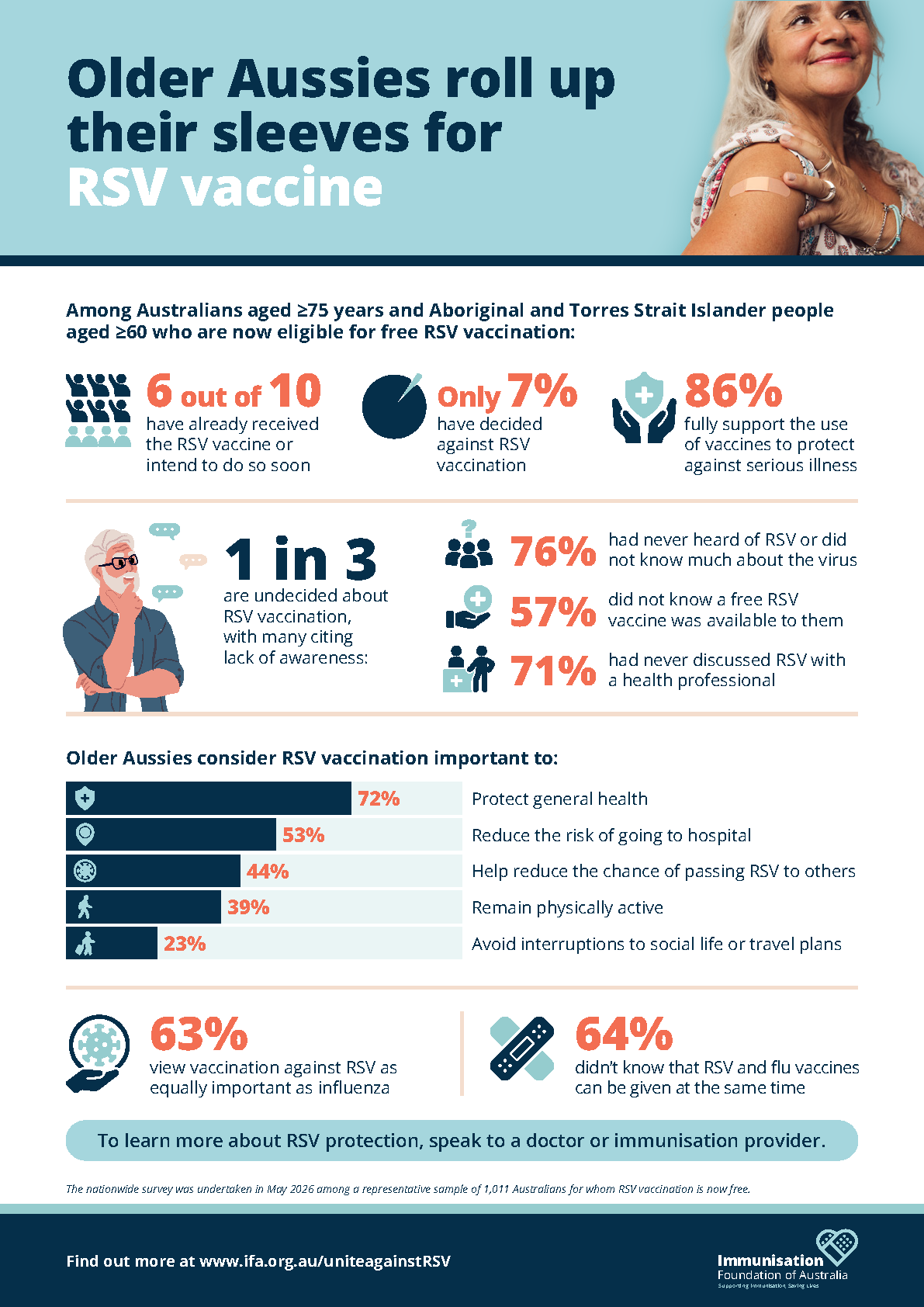
Just three weeks into the program, 60% of Australians eligible for free RSV vaccination (those aged 75 years or over and Aboriginal and Torres Strait Islander people aged 60 years or over) have either already received the vaccine or intend to do so soon, according to an Immunisation Foundation of Australia survey released to mark RSV Awareness Week.
The nationwide survey of 1,011 people eligible for the free RSV vaccine also shows that RSV vaccination is already seen as an important part of the winter health routine, with 63% of respondents viewing vaccination against RSV as equally important as influenza.
Among the one-third of respondents undecided about being vaccinated against RSV, lack of awareness was a major factor. Before completing the survey, three quarters (76%) of those who were undecided had either never heard of RSV or did not know much about the virus, while 57% had not known that a free RSV vaccine was now available to them.
Only 7% of respondents had decided against receiving RSV vaccination; half of whom confirmed they “don’t support the use of vaccines” in general.
Catherine Hughes AM, Founder and Executive Director of the Immunisation Foundation of Australia, said the findings show that “older Australians are ready for RSV protection”.
“What’s holding many back isn’t reluctance, it’s simply not knowing the vaccine exists or that it’s now free. That’s something we can fix,” she said.
Ms Hughes said that “RSV vaccination is a new opportunity for older Australians, and it is encouraging to see so many people embracing it. These findings show that older Australians understand the value of RSV protection and are open to taking steps to protect their health.”
RSV is a common and highly contagious respiratory virus that can cause cold-like symptoms in many people but can lead to serious illness in older adults. 1 People aged 75 years and over, and those with chronic heart or lung issues, are at increased risk of severe RSV illness. 2
In 2025, there were 21,178 RSV notifications among people aged 75 years and over. 3 Severe RSV was associated with nearly 500 deaths in Australia in the first nine months of 2025, with experts believing this significantly underestimates the true burden because RSV often contributes to death without being listed as the primary cause.4
“RSV can hit older adults hard. It inflames and blocks the airways, making it difficult to breathe, and can lead to serious complications including pneumonia. However, this is just the tip of the iceberg when it comes to the true impact of the virus,” said Professor Robert Booy, Professor of Paediatrics and Child Health, University of Sydney.
“An RSV infection places strain on the whole body, particularly the heart and lungs, and can trigger a sudden decline in the health of people living with asthma, COPD, heart disease or diabetes,” he said.
“RSV vaccination is the simplest way for older Australians to reduce their risk of severe RSV illness and to stay well in the winter months.”
When asked why they considered it important to protect against RSV, common reasons cited by older Australians included protecting general health (72%), reducing the risk of going to hospital (53%), wanting to remain physically active (39%), and avoiding interruptions to social life or travel plans (23%).
“These findings remind us that vaccination isn’t just a medical decision. For older Australians, it’s about staying active, staying connected, and staying out of hospital. That’s a powerful motivator,” Ms Hughes said.
Despite awareness gaps, the survey found strong underlying support for vaccination, with 86% of respondents fully supporting the use of vaccines to protect against serious illness. “Older Australians are not hesitant. They are ready and willing. They just need the information and the conversation to follow through,” Ms Hughes said.
Older adults should speak with their GP, pharmacist or immunisation provider about RSV vaccination as the virus is now circulating widely, with more than 49,500 notifications nationwide across all age groups already in 2026. 3
“Winter is when we see a surge in RSV cases, so the best time to ask about protection is now,” Ms Hughes said. “The RSV vaccine can also be given at the same time as the influenza vaccine, so this could be a convenient way to maximise protection during winter.”
* RSV vaccination is available free for adults aged 75 years and over, and for Aboriginal and Torres Strait Islander people aged 60 years and over. Adults who are not eligible for the free program may still be able to receive the vaccine with a private prescription, including those aged over 60 years and people aged over 50 years with medical conditions that increase their risk of severe RSV. 5
RSV Awareness Week is now underway, running until 13 June 2026.
Conducted on behalf of the Immunisation Foundation of Australia in May 2026, the nationwide survey captured responses from a representative sample of 1,011 Australians who were aged 75 years and over or identified as Aboriginal and Torres Strait Islander people aged 60 years and over.
Links available to: – Static and animated survey infographics: Survey assets – Videos: RSV in Older Australians and RSV Vaccination for Older Australians References
1. Australian Government. Department of Health, Disability and Ageing. Australian Centre for Disease Control. Respiratory syncytial virus (RSV). Accessed May 2026. Available: https://www.cdc.gov.au/diseases/respiratory-syncytial-virus-rsv
2. Australian Prescriber. RSV: an update on prevention and management. Australian Prescriber. Accessed May 2026. Available: https://australianprescriber.tg.org.au/articles/RSV-an-update-on-prevention-and-management.html
3. Australian Government Department of Health, Disability and Ageing. National Notifiable Diseases Surveillance System public dashboard. Available from: https://nindss.health.gov.au/pbi-dashboard/
4. Australian Government. Department of Health, Disability and Ageing. Australian Centre for Disease Control. Australian Respiratory Surveillance Report: 29 December 2025 to 25 January 2026. Available from: https://www.cdc.gov.au/sites/default/files/2026-01/australian-respiratory-surveillance-report-29-december-2025-to-25-january-2026.pdf
5. Australian Government. Department of Health, Disability and Ageing. Australian Immunisation Handbook. Respiratory syncytial virus. Accessed May 2026. Available: https://immunisationhandbook.health.gov.au/contents/vaccine-preventable-diseases/respiratory-syncytial-virus-rsv
About us:
About the Immunisation Foundation of Australia
The Immunisation Foundation of Australia (IFA) is dedicated to improving immunisation awareness, access and acceptance across Australia. Founded in 2016 following the death of Riley Hughes from whooping cough at 32 days old, IFA works with communities, health professionals, researchers and governments to ensure all Australians are protected from vaccine-preventable disease. IFA’s work spans public awareness campaigns, consumer advocacy, health professional education, and active involvement in national immunisation research.