QUT Distinguished Professor Yuantong Gu has received a prestigious Fellows Award from the International Association for Computational Mechanics (IACM), one of the highest honours awarded in the field worldwide.
Professor Gu has been recognised with the 2026 IACM Fellows Award for his sustained and internationally distinguished contributions to computational mechanics and his leadership of the global research community.
The honour is awarded every two years to a select group of researchers who have demonstrated outstanding scientific achievement together with significant service to the profession.
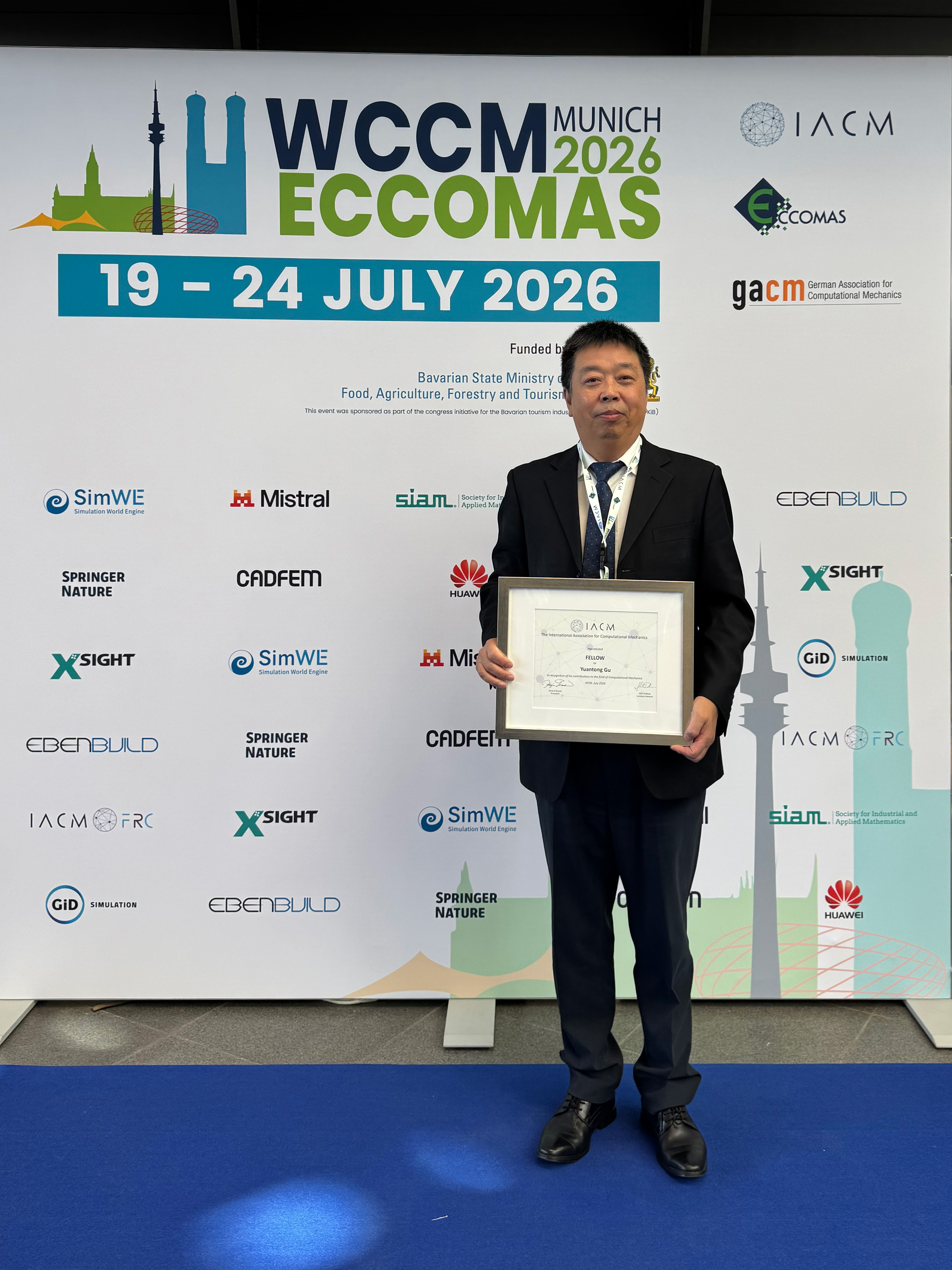
with his award in Munich.
Professor Gu is the QUT Pro Vice-Chancellor (Research Career Advancement) and Head of the QUT School of Mechanical, Medical and Process Engineering. He has spent more than two decades advancing the field through pioneering research in meshless numerical methods, multiscale modelling, computational biomechanics and, more recently, the integration of artificial intelligence with mechanics-based modelling for healthcare and other applications.
Professor Gu is recognised as one of the world’s leading figures in computational mechanic. His work has fundamentally advanced computational methods used in engineering, materials science, biomedical and healthcare.
The award was presented during the World Congress on Computational Mechanics in Munich, Germany, where over 4,500 researchers from across the globe gathered to celebrate the discipline’s most significant scientific achievements.
“I am deeply honoured to receive an IACM Fellows Award,” Professor Gu said.
“This recognition reflects not only my research, but also the outstanding contributions of my colleagues, students and collaborators at QUT and around the world.
“Computational mechanics is transforming the way we design technologies, develop advanced materials and improve healthcare.
“By combining physics-based modelling with artificial intelligence, we can create more accurate, reliable and practical solutions to some of society’s most complex engineering and biomedical challenges.”