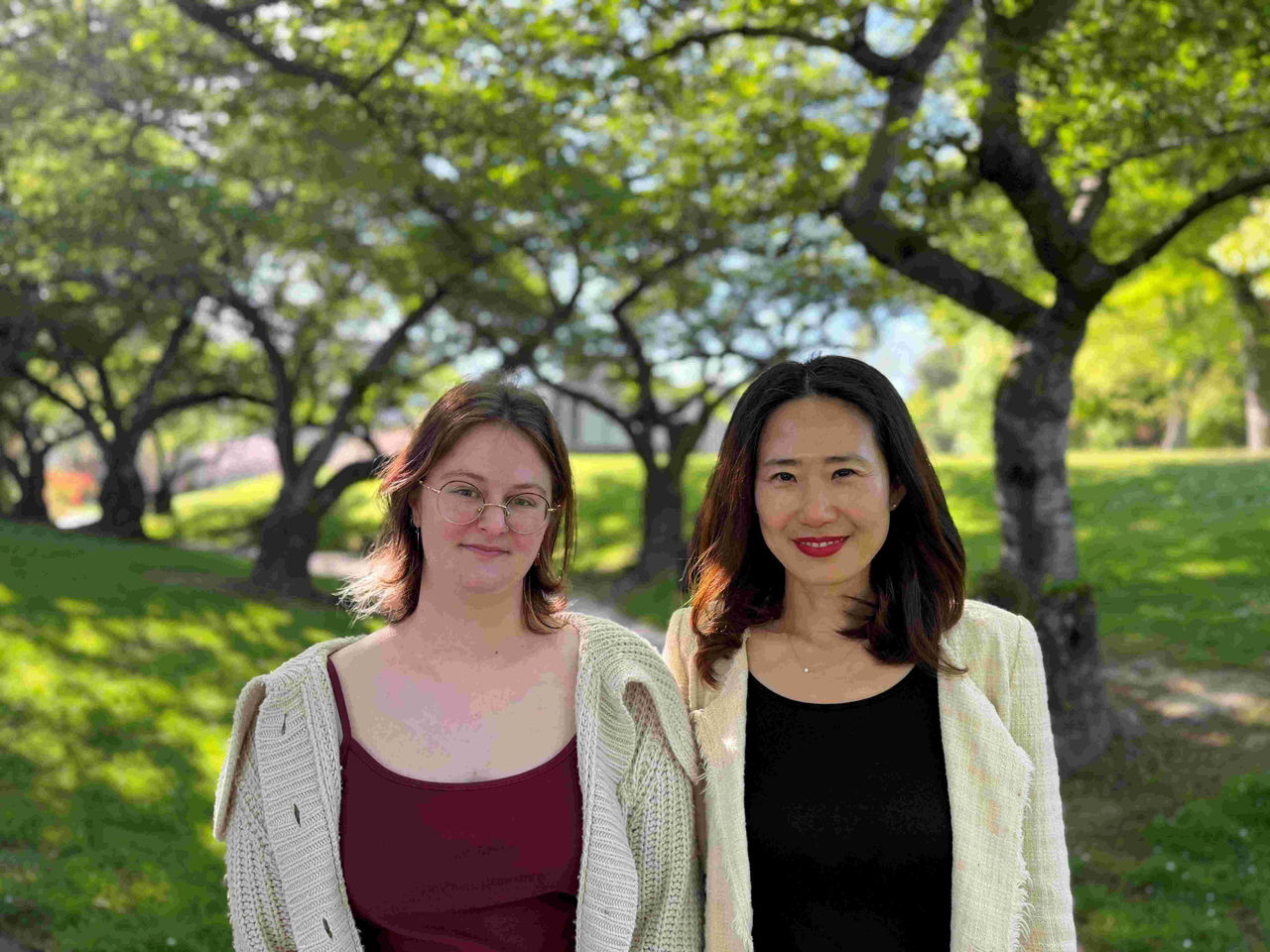
Photo caption: UC Master of Linguistics student Ash Palin and Linguistics Lecturer Dr Heeju Hwang
The research, led by Te Whare Wānanga o Waitaha | University of Canterbury (UC) Linguistics Lecturer Dr Heeju Hwang, suggests autistic children’s language learning mechanisms may be intact, but the conditions they learn best in can differ from those of neurotypical children.
Dr Hwang’s research tested three possible explanations for language delays in autistic children: that difficulties arise from lower social motivation with language learning unaffected by the learning environment; that autistic children have impairments in the mechanisms needed to learn language; or that those mechanisms are intact, but autistic children learn differently depending on whether the environment is social or non-social.
“My hypothesis was that maybe they do have intact mechanisms, but they can learn language well from non-social input.”
In the experiment, autistic and neurotypical children took part in a picture-description task in which they were exposed to different sentence structures either by a person or through a computer. Researchers measured whether children reused sentence structures they had heard, both immediately and over time.
“Autistic children showed both short-term and long-term learning when they got input from the computer. But then they didn’t show any long-term learning when they got the language input from the human,” Dr Hwang says.
“But typical children showed the opposite pattern, so they showed the long-term learning when they got the input from the human, but not from the computer.
“I was really surprised by the longer-term result. I was suspecting maybe their learning would be overall less than neurotypical children across all conditions, but that wasn’t the case.”
Dr Hwang says the common assumption so far has been that social interaction is necessary to learn a language, however, her findings challenge that long-held assumption for autistic people.
Much previous research into autistic language has focused on correlations, rather than the underlying mechanisms of how language is learned, Dr Hwang says.
“Research that looks into the mechanisms or what kind of linguistic knowledge autistic people have is really rare.
“There are many case reports of children learning a foreign language from media, but as far as I know this is the first experimental study showing that.”
Unlike those reports, Dr Hwang’s research focused on children learning their first language.
Exactly why autistic children benefited more from the computer-based condition is not yet clear.
“There are many possibilities why autistic children learn better from the computer input. Maybe it’s because of anxiety. It could be they’re more motivated toward non-social things, or maybe social input including eye gaze and gestures is more distracting” Dr Hwang says.
Those questions are now being explored further by UC Master of Linguistics student Ash Palin, who is using constructed languages that imitate real language to compare how autistic and non-autistic adults learn from an autistic teacher, a neurotypical teacher or a computer.
Palin says difficulty with a social learning environment does not necessarily mean autistic people lack the desire to interact.
“We’re looking at whether the social factors are inbuilt in a social motivation model, where autistic people are just not as motivated to learn something or interact socially, or whether it’s to do more with something like social anxiety, where you still want to engage socially, but there are other limitations on it.”
Preliminary results from Palin’s research add another layer to the picture, with autistic participants showing a preference for interacting with the autistic teacher over the neurotypical teacher or computer.
The findings suggest the question may not simply be whether autistic people are socially motivated, but who they are interacting with.
“If autistic people are socially motivated, maybe they are more motivated to learn from other autistic individuals. And maybe they can learn better.”
The researchers say the findings should not be interpreted as an argument for replacing teachers with computers or separating autistic and neurotypical learners.
Instead, they point to the potential value of offering a wider range of learning environments and support options.
Dr Hwang says greater diversity among teachers could also be beneficial, while computer-based approaches could have potential in areas such as language assessment, where some autistic learners may be better able to demonstrate their abilities in a less socially demanding setting.
Palin says educators and families could also be more open to alternative ways of learning, including opportunities for autistic people to connect and learn alongside other autistic people.