A Cornell researcher’s bold new redesign of firefighter gear – which hasn’t significantly changed in decades – is more versatile and better adapted to their actual work, only a small fraction of which involves actually fighting structure fires.
Heeju Terry Park, the Vincent V.C. Woo Professor in the Department of Human Centered Design in the College of Human Ecology, and his lab developed the new two-piece, Velcro- and zipper-equipped suits after interviewing more than 50 firefighters.
“I was asked to design new turnout gear for better thermal management and work efficiency,” Park said. “Current turnout gear has been used for decades with modest changes of design and materials despite increasing fire service roles for handling more wildland fires and emergency rescue operations.”
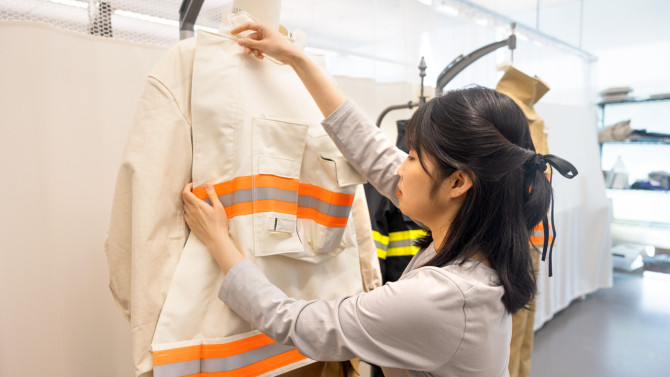
Huieun Do, M.A. ’25, a member of the Performance Apparel Design Lab, works with a prototype of the redesigned fire gear the lab is developing in coordination with professional firefighters.
Park’s yearlong redesign project – which included Huieun Do, M.A. ’25; Albert Lin, M.A. ’23; and Kim Phung Nguyen, all doctoral students in apparel design – was supported by a grant from the Federal Emergency Management Agency.
The project was in collaboration with International Personnel Protection Inc., a private consulting company, as a subcontractor to the International Association of Fire Fighters (IAFF), the union representing more than 360,000 professional firefighters and paramedics in North America. This work was undertaken as part of a Department of Homeland Security grant to the IAFF.
The term “firefighter,” while technically accurate, doesn’t paint the full picture of what these men and women do on a daily basis. In fact, according to the U.S. Fire Administration, more than 60% of fire department responses are for medical aid calls. Firefighters respond more to false alarms (8%) than to actual fires (3.9%).
Firefighters don’t always need their bulky turnout gear, which creates additional physiological stress due to heat and restricted movement. Additionally, some of the materials these protective suits contain or are treated with PFAS (per- and polyfluoroalkyl substances), known carcinogens dubbed “forever chemicals.”
Park’s Performance Apparel Design Lab‘s modernized gear, inspired by the suits worn by Formula 1 racecar drivers, can be adapted to the task at hand, and uses noncarcinogenic materials.
In interviews, the researchers identified three primary problems with firefighter suits:
- These suits are designed mainly for thermal protection – understandable, but since less than 4% of firefighter calls are for fires, firefighters are often overdressed. According to the U.S. Fire Administration, the main cause of on-duty firefighter death is cardiovascular in nature, triggered by heat stress;
- A growing number of firefighters are women (approximately 9% of all firefighters, paid and volunteer), and clothing generally designed for men don’t always work if they’re just made smaller; and
- The PFAS chemicals used to treat suits pose a significant health risk. According to the Firefighter Cancer Support Network, firefighters are 9% more likely than the general public to be diagnosed with cancer, and 14% more likely to die from it.
Traditional fire suits are multilayer, heavy-duty coats and pants featuring three layers of material – a flame- and puncture-resistant outer shell, made from a blend of Kevlar (Para-aramid) and polybenzimidazole (PBI) or Nomex fibers; a moisture barrier, typically made from heat-resistant breathable film material laminated to an aramid substrate; and a thermal barrier to provide additional thermal insulation.
The main difference between current firefighter clothing and the Park lab’s redesign is versatility. The new clothing strikes a balance between a one-piece coverall concept and the more traditional two-piece design. Lin said that in interviews with firefighters, a one-piece coverall wasn’t well received.
“The firefighters were very hesitant to accept a coverall design,” Lin said, “so we had to navigate creating something that has the level of protection that a coverall provides, but in a design where firefighters will be more accepting of it.”
The new design is two pieces, which can be connected with zippers and Velcro to function as a coverall. The protective outer layer of the top can be unzipped and secured around the waist or completely removed when not needed, a feature similar to the suits worn by F1 racers.
“This unique design feature will enable firefighters to quickly cool down their body in non-firefighting situations,” Park said. In particular, the upper portion of the redesigned gear promotes effective heat release; more than 60% of perspiration occurs in the head and torso.
Additionally, the top features dual vertical zippers, for ease of donning and removal; a detachable front panel, convenient for bathroom breaks; two-way zippers to allow for ventilation; and a lower collar to reduce skin irritation and improve breathability.
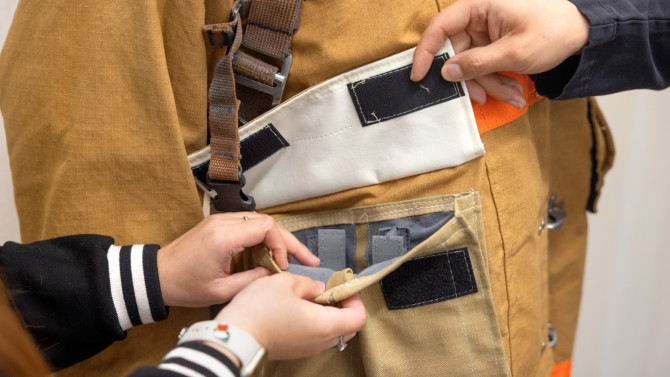
The detachable front pocket of the redesigned fire suit features compartments so tools can be custom-organized by the firefighter.
Another improvement is the front pocket, which typically stores the tools a firefighter needs. To facilitate quick access, the new design’s pocket features compartments so the tools can be custom-organized by the firefighter for ease of access in stressful situations.
The pocket is also detachable, and can be secured in front to accommodate either right- or left-handed people, and so access is not restricted, for example, by the straps of an oxygen tank.
Considering the significant concern over PFAS chemicals, the new gear Park’s team designed were prototyped using PFAS-free fabrics for the outer shell and moisture barrier. Recently, some U.S. states have moved toward banning turnout gear with PFAS; Canada and the European Union have moved toward banning PFAS in all goods, including turnout gear.
In the U.S., PFAS bans are mostly enacted at the local and state level; what few federal proposals there are only fund research into PFAS replacements, but not regulation. State-level bans have been enacted, but are not yet in effect, in Connecticut, Massachusetts, New York, Florida, Illinois, and California; disclosure laws also have been enacted in Rhode Island.
Most state-level PFAS bans restrict buying of turnout gear with PFAS; however, they do not fund the replacement or purchase of new turnout gear.
Park is hoping to secure additional funding to enable further testing of the updated fire suits, with firefighters in Ithaca as well as at the New York City Fire Department training facility on Randall’s Island.
“I want to test whether this is really better designed to handle all the stressful tasks,” he said. “We want to see how quickly they can put it on and take it off, and how quickly they can reach the tools without dexterity issues, and how they feel about the new design aesthetically, culturally, psychologically, and whether it works for men, women, tall people, small people. That’s the next step.”





/in-page-highlights/insecticide-resistance-500pix.tmb-768v.jpg?sfvrsn=30ce5f58_9)