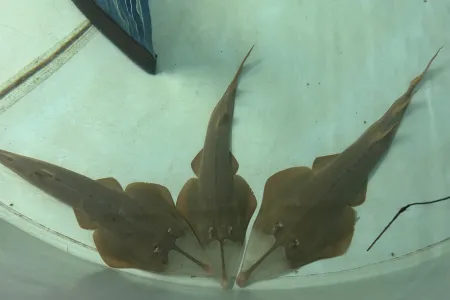
A study on how select species of rays and sharks respond to sensory deterrents has reinforced why there isn’t a one-size-fits-all solution to prevent fisheries bycatch.
The study by Charles Darwin University (CDU) investigated the effect of visual and electrosensory deterrents on a variety of elasmobranch species – a subclass of fish species that includes sharks, rays and sawfish.
A third of all elasmobranch species are threatened with extinction, by the International Union for the Conservation of Nature Red List criteria, with overfishing a major threat and bycatch being a particular concern.
Bycatch is an enduring challenge in fisheries, particularly for net gears, in which elasmobranchs can become entangled. Sensory deterrents have emerged as a bycatch mitigation technique for net gears, such as gillnets.
The study explored the response of captive Giant Shovelnose Rays (Glaucostegus typus) and Brownbanded Bamboo Sharks (Chiloscyllium punctatum) to a static green LED light and a pulsed electrosensory deterrent attached to an experimental gillnet.
Results show the Giant Shovelnose Rays were initially deterred by the green LED light, but effectiveness reduced over time. Brownbanded Bamboo Sharks weren’t deterred by either device.
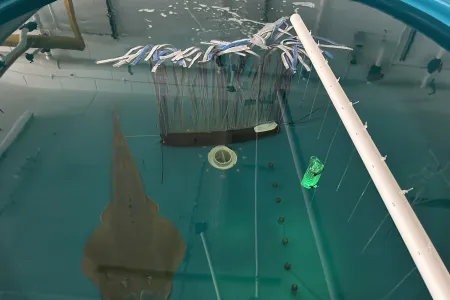
Lead author and CDU Research Institute for the Environment and Livelihoods (RIEL) PhD student Emily Taljaard said the results underscored how bycatch solutions need to be tested species by species.
“Both species are bottom dwellers whose sensory systems are adapted to life on the seafloor, so a device placed in the middle of a net may not be detected the same way as it would by species swimming higher in the water column,” Ms Taljaard said.
“That’s why deterrents aren’t a one-size-fits-all solution: they need to be tested on the species a fishery actually interacts with.
“The next step is testing across a broader range of commercially relevant species. We’d also like to explore different device settings, such as pulse strength and frequency, and the placement of devices on nets.”
The study was conducted alongside RIEL Adjunct Professor Rik Buckworth and RIEL Research Fellow Dr Joni Pini-Fitzsimmons, who is also the leader of CDU’s Northern Shark and Ray Research Group.
“Bycatch is an ongoing management challenge for fisheries worldwide, and northern Australia is no exception,” Dr Pini-Fitzsimmons said.
“Our fisheries are already well managed, with controls in place to limit interactions with threatened and protected species like sawfish, and this work builds on that. These small, controlled trials are a first step in understanding what might help, and any real-world application would need much more testing.”
Effect of visual and electrosensory deterrents on captive elasmobranchs was published in Journal of Fish Biology.