Blocking the activity of ZFP384 can prolong the brain’s endogenous repair functions after stroke, report researchers in a collaborative study. They developed an antisense oligonucleotide-based therapy that sustained the reparative activity of microglia by promoting remyelination and neural plasticity, thereby improving functional recovery in mice. Surprisingly, these results were observed even when the treatment began weeks after injury. The findings reveal a promising strategy to extend the brain’s recovery window after stroke, improving long-term outcomes.
Extending the Brain’s Recovery Window After Stroke by Targeting ZFP384
Stroke is one of the leading causes of long-term disability worldwide, which often results in impairments in movement, speech, and cognition in patients. While rehabilitation helps patients regain some lost functions, the brain’s natural ability to repair itself often fades within a few months after an injury. This limited period of spontaneous recovery poses a major challenge for patients, often resulting in permanent neurological deficits after the brain’s intrinsic repair capacity declines. Although this loss of reparative ability has been studied extensively, the mechanism behind this loss remains unclear.
To uncover the reason why this happens, a team led by Assistant Professor Jun Tsuyama and Professor Takashi Shichita from the Department of Neuroinflammation and Repair, Institute of Science Tokyo (Science Tokyo), Japan, conducted research in collaboration with researchers from the Tokyo Metropolitan Institute of Medical Science, Kyushu University, Japan, and the University of Freiburg, Germany. Their findings were published in the journal Nature on May 13, 2026.
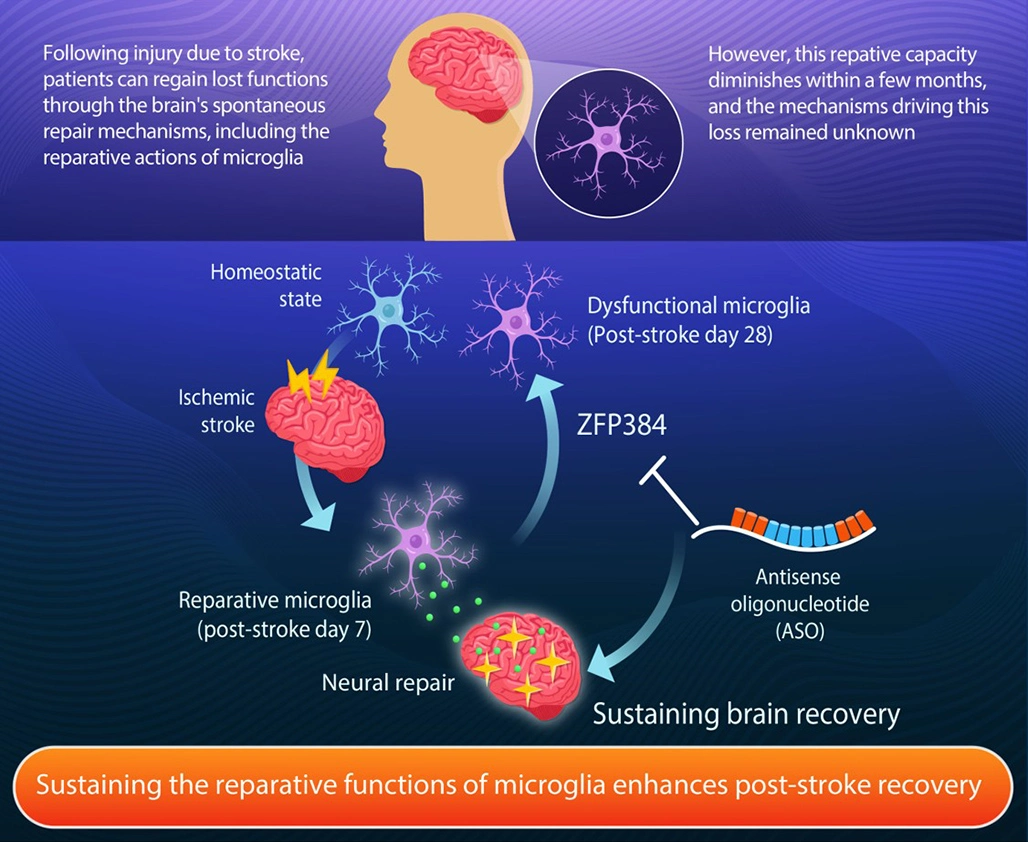
After a stroke, the brain launches a coordinated repair program that involves several types of cells. Among these, microglia, the brain’s resident immune cells, play a pivotal role. Immediately after an injury, microglia are activated to trigger inflammation, but thereafter, they rapidly transition into a reparative state and produce growth factors, such as insulin-like growth factor 1 (IGF1), which support remyelination, strengthen neural connections, and promote functional recovery. But this only lasts for two months, limiting the brain’s capacity to repair further.
“We aimed to identify the molecular mechanism responsible for diminishing microglial reparative functions,” explains Tsuyama.
To uncover this, the researchers identified a specific transcription factor called ZFP384, which increases as the brain’s spontaneous repair functions diminish. They discovered that ZFP384 diminished the expression of genes associated with microglial reparative functions. Mechanistically, ZFP384 disrupts the chromatin interactions mediated by the protein YY1 that are necessary for the gene expression associated with neural repair. As a result, the microglia lose their reparative properties despite the brain’s ongoing recovery needs.
“By identifying the mechanism that diminishes the brain’s intrinsic recovery functions, we looked for a potential way to preserve its spontaneous recovery,” notes Tsuyama.
To investigate whether preventing this loss of reparative properties in microglia could help improve recovery, the team first genetically deleted the Zfp384 gene specifically from microglia in mouse models of stroke. Interestingly, these animals maintained their recovery-associated gene expression for a much longer period than normal mice. Sustaining the reparative state of microglia enhanced remyelination of damaged nerve fibers and promoted synaptic plasticity, resulting in significantly better long-term neurological function.
Based on these findings, the researchers developed a therapeutic antisense oligonucleotide (ASO), a short, synthetic strand of nucleic acids that specifically decreases expression of a targeted gene. ASO-Zfp384 was designed to suppress Zfp384 expression. Remarkably, the treatment sustained microglial reparative functions and remained therapeutic even when administered 1 week or 1 month after stroke onset. Rather than simply reducing inflammation, the ASO-Zfp384 helped retain the brain’s own reparative program, enhancing post-stroke recovery from neurological deficits.
The team also examined the brain tissues from the patients who had experienced a stroke and found evidence that the mechanism also operates in humans. Similar to observations in mice, the expression of ZNF384 in humans (an orthologue of murine ZFP384) also increased as the reparative factor IGF1 declined, revealing an inverse relationship, suggesting that the molecular pathway identified in mice was also relevant to human stroke recovery and could represent a potential therapeutic target.
“Based on our findings, sustaining the brain’s endogenous repair program creates new opportunities to decrease/diminish the permanent neurological symptoms during the rehabilitation phase,” adds Tsuyama.
Beyond stroke, the study introduces a broader concept for promoting endogenous recovery mechanisms after organ injury: Instead of attempting to replace damaged tissue, focusing on preserving and prolonging the body’s own repair mechanisms will hold the key to more successful treatments. In the future, the researchers will focus on evaluating the safety and efficacy of ZFP384-targeting therapies in larger preclinical models and ultimately in clinical trials. If successful, this approach will enhance functional recovery from post-stroke neurological deficits by extending the brain’s spontaneous recovery window, reducing the burden of stroke-related disability.
Reference
- Authors:
- Jun Tsuyama1,2,3,*, Seiichiro Sakai1,2,3, Kumiko Kurabayashi1,2,3, Ayaka Nakamura1,2, Eri Tanaka1,2, Yuichiro Hara4, Ito Kawakami5, Makoto Tsuda6, Takahiro Masuda7, Marco Prinz8,9,10, Hideya Kawaji4, and Takashi Shichita1,2,3,11,*
- Title:
- Sustaining microglial reparative function enhances stroke recovery
- Journal:
- Nature
- Affiliations:
- 1Department of Neuroinflammation and Repair, Medical Research Laboratory, Institute of Science Tokyo, Tokyo, Japan
2Core Research for Evolutionary Medical Science and Technology (CREST),
Japan Agency for Medical Research and Development (AMED), Tokyo, Japan
3Stroke Renaissance Project, Tokyo Metropolitan Institute of Medical Science, Tokyo, Japan
4Research Center for Genome and Medical Sciences, Tokyo Metropolitan Institute of Medical Science, Tokyo, Japan
5Laboratory for Neuropathology, Tokyo Metropolitan Institute of Medical Science, Tokyo, Japan
6Department of Molecular and System Pharmacology, Graduate School of Pharmaceutical Sciences, Kyushu University, Fukuoka, Japan
7Division of Molecular Neuroimmunology, Medical Institute of Bioregulation, Kyushu University, Fukuoka, Japan
8Institute of Neuropathology, Faculty of Medicine, University of Freiburg, Freiburg, Germany
9Signalling Research Centres BIOSS and CIBSS, University of Freiburg, Freiburg, Germany
10Center for Brain Research and Advancements In Neuroimmunology (BRAIN), Faculty of Medicine, University of Freiburg, Freiburg, Germany
11Department of Medicine and Clinical Science, Graduate School of Medical Sciences, Kyushu University, Fukuoka, Japan