
An autonomous swarm of robots is set to explore a vast valley and caves on Mars. Computer Scientists at the University of Würzburg are helping to develop the key technologies required for this.
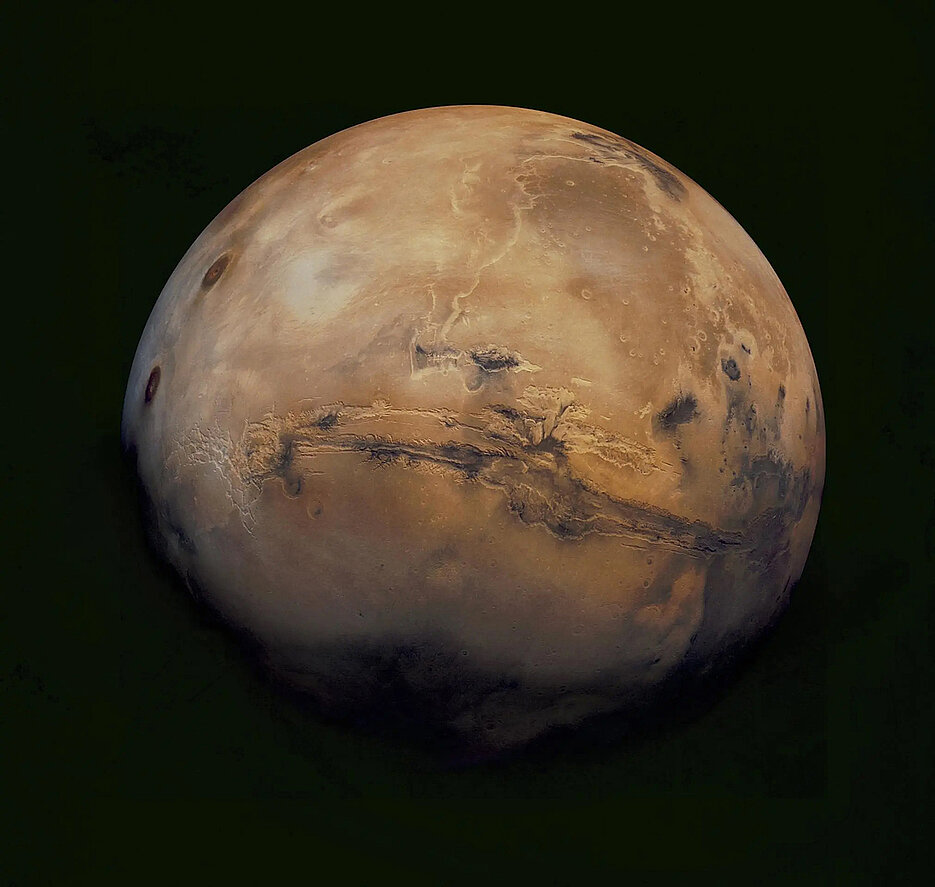
Two professors from the Institute of Computer Science at the University of Würzburg and their teams are involved in an ambitious collaborative project to explore Mars.
The idea is that a swarm of autonomously operating, interconnected robots will explore the vast Valles Marineris valley on the Red Planet – both on the ground and from the air. The robots are also set to venture into the caves that are thought to exist in the valley and collect images and other data there.
This is the aim of the VaMEx initiative run by the German Space Agency at the German Aerospace Centre (DLR). The project has been running since 2012 and has now reached its fourth development phase. Those involved are continuing to work on the key technologies required by robot swarms to explore the challenging terrain on Mars.
Hakan Kayal, Professor for Space Technology, and Guido Dietl, Professor of Satellite Communication and Radar Systems, are involved in VaMEx. The two scientists from the University of Würzburg are receiving around 1.4 million euros from the DLR for their current sub-project. The project began in early October 2026 and will run for three years. It forms part of the Würzburg Interdisciplinary Research Centre for Extraterrestrial Studies (IFEX).
Robust solutions for robot swarms
The JMU professors are building on preliminary work carried out by themselves and others in recent years as part of the VAMEX initiative. They are also setting out several new areas of focus.
Broadly speaking, the aim of the project is to develop robust navigation and coordination solutions for swarms of flying, walking and driving robots. At the start of the new project, the JMU teams are initially involved in defining the overall system architecture, the requirements specification and the relevant hardware and software interfaces.
Würzburg’s SkyCAM is being further developed
One focus is on the further development of the SkyCAM system. This camera system was developed by Hakan Kayal’s research team. It is designed for observing the sky and is intended to specifically and automatically detect short-lived celestial phenomena such as lightning, cloud formation, meteors or unidentified anomalous phenomena (UAP) in the sky.
“We are now adapting SkyCAM for integration onto the Janus Mars rover and will then prepare the system for deployment on the AMADEE-27 analogue mission,” says Hakan Kayal. This mission by the Austrian Space Forum takes place on Earth under conditions that are as close as possible to those on Mars. It is scheduled to take place from 5 to 18 April 2027 in Monsaraz, Portugal.
Kayal’s team would like to have two or three SkyCAM stations there, which would simultaneously record phenomena in the sky and synchronise their data with one another. As well as taking photos and videos, the main aim is to measure the distance, speed and flight profile of moving objects and to assist with the navigation of the VaMEx swarm’s robots.
Specialised navigation system in development
Guido Dietl’s team is working on technologies that will enable the robots to orientate themselves reliably on Mars. As there are no navigation satellites there, such as GPS on Earth, the aim is to develop a navigation system that combines data from star and sun sensors with position data via a network of radio beacons.
Ultra-wideband (UWB) technology is to be used both for precise distance measurement and for determining the angles to the respective beacons. By combining all this measurement data, the robots should be able to determine their position and direction of travel autonomously and reliably, even in challenging terrain.
The sensor and navigation systems developed at the University of Würzburg will be gradually integrated into the robot swarm and validated during future analogue missions and final field tests under realistic conditions.
About the project
The Würzburg-based VaMEx-ARES sub-project “Navigation-Supporting Robotics Hardware, Radio Software Further Development, UWB sensor fusion, SkyCAM navigation algorithms’ is funded by the German Aerospace Centre (DLR) under grant reference 50NA2606D, following a resolution by the German Bundestag, with funding from the Federal Ministry of Research, Technology and Space.
The VaMEx-ARES consortium also includes research groups from the University of Bremen, the German Research Centre for Artificial Intelligence (DFKI), the Technical University of Braunschweig, the University of Erlangen-Nuremberg and RWTH Aachen University.