Key points
- Advanced X-Ray imaging reveals that water in tiny rock pores acts as a gatekeeper, separating gas pockets before sudden ‘cascade’ events cause rapid mixing.
- The new findings could lead to more accurate predictions on the purity and energy recovery of hydrogen stored in depleted gas fields.
- The multi-year international partnership with Ghent University and the University of Rennes is helping unlock fundamental science critical to scaling clean energy storage.
Storing renewable energy at large scale is one of the biggest challenges facing the energy transition.
Without it, excess renewable power is lost on sunny, windy days and unavailable when the sun sets and the wind drops. CSIRO estimates that Australia’s National Electricity Market could need 10 to 14 times more storage between 2025 and 2050, drawing on a diverse mix of technologies.
Increasingly, attention is turning underground, with the International Energy Agency reporting that projects worldwide could store 11 terawatt-hours of hydrogen by 2035, about 30 times the energy Snowy 2.0 is designed to hold. Depleted gas fields, like those being assessed in Victoria’s H2RESTORE project, could store renewable hydrogen made from surplus wind and solar and convert it back to electricity months later, complementing short duration battery storage.
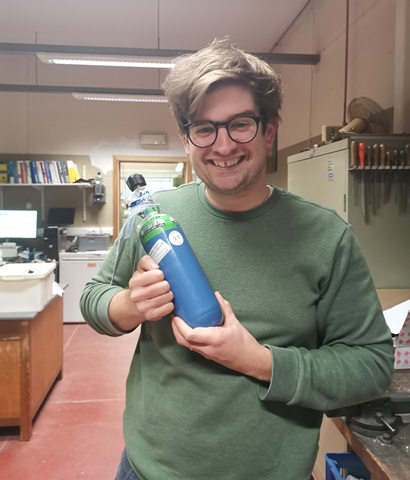
Now, CSIRO-led research reveals how tiny movements of gas and water in rock can dramatically change how gases mix underground, affecting how much clean hydrogen can be recovered.
Recently published in the Proceedings of the National Academy of Sciences (PNAS) , the research challenges conventional models that assume gases mix smoothly and continuously as they move through porous rock.
Instead, researchers found that water can act as a kind of gatekeeper, separating pockets of gas before sudden rearrangements connect them and trigger rapid bursts of mixing.
Lead author Dr Samuel Jackson said understanding this process was particularly important for underground hydrogen storage in depleted natural gas fields.
“How the gases mix controls the purity of the gas as you’re pulling it out of the subsurface, and that determines how efficiently you can recover the stored energy,” Dr Jackson said.
“Models that we use at large scale essentially assume that the gases mix smoothly, and that there’s no impact from the very small-scale movement of the gas through the water.
“It wasn’t clear to us what was actually happening at that very small scale, and if that impacts large-scale predictions.”
Watching gases mix, pore by pore
To understand what the large-scale modelling was missing, Dr Jackson turned his attention to what was happening at the scale of individual pores within the rock.
A CSIRO Julius Career Award, received in 2021, enabled him to pursue those questions through extended research visits to Ghent University in Belgium and the University of Rennes in France.
Dr Jackson and his collaborators used pioneering 4D X-ray imaging at Ghent to observe gases moving and mixing inside a tiny sandstone rock sample just six millimetres in diameter.
Study co-author Associate Professor Tom Bultreys from Ghent University said the international partnership was key to making the breakthrough.
“It’s been fantastic to host Sam in our team and work on breakthrough science together,” Associate Professor Bultreys said. “By collaborating across continents, we were able to combine the latest X-ray imaging methods, theoretical developments and technological insights into underground storage needed to discover and understand this new mechanism.”
The sample was initially filled with water and krypton gas , with nitrogen then injected to represent a second gas entering the system. Krypton and nitrogen were chosen because their different X-ray properties allowed researchers to distinguish between them and track changes in gas composition through the rock. The imaging technique allowed the team to observe the process dynamically, following gas and water as they moved through pores around 100 microns in size – the width of a human hair.
What they saw was strikingly different from the smooth mixing predicted by conventional models, many of which were developed 30 to 50 years ago.’
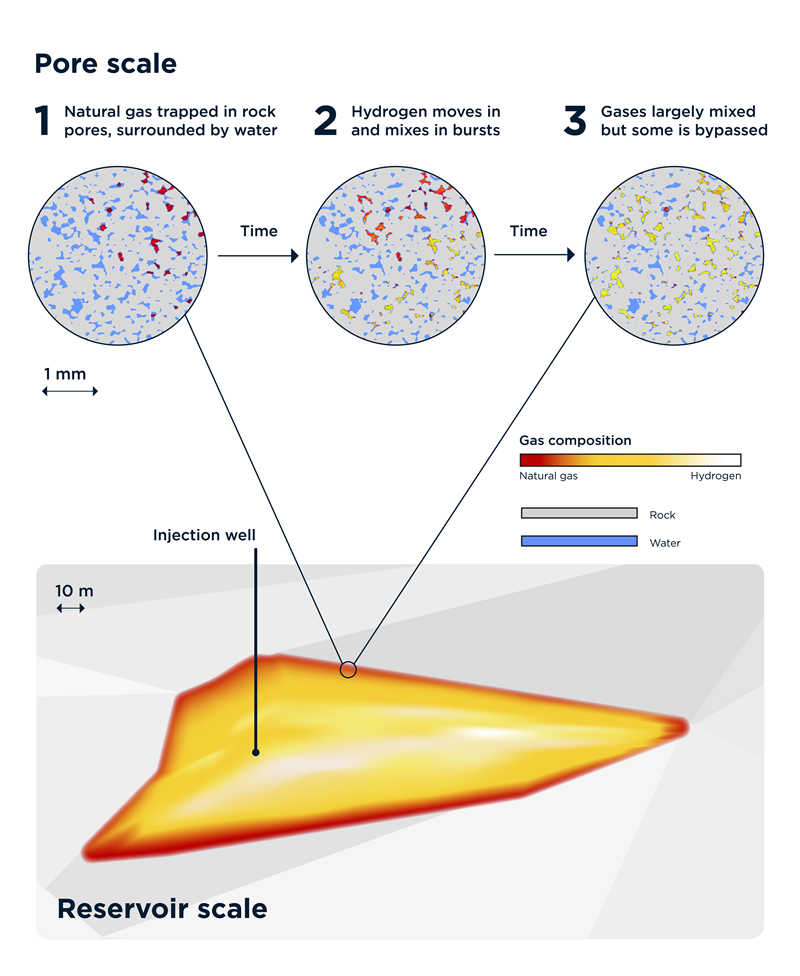
“Our recent experiments demonstrate that the connectivity of the gases control how they mix together,” Dr Jackson said.
“You observe microscopic cascade events whereby the gases rapidly displace water and mix together.”
Rather than gases simply diffusing into each other, water initially separated gases of different compositions in neighbouring pores. As gas connectivity increased, sudden rearrangements of gas and water brought these regions together, causing rapid mixing.
Dr Jackson said this represents “a very different type of mixing to what we’ve assumed in the past”.
A second process hiding in the pores
The team also directly observed another process that had previously been largely theoretical.
Small, isolated pockets of gas left behind in the rock slowly exchanged gases through the surrounding water, in a process known as Ostwald ripening .
“This is the first direct visualisation of it between different gases in a rock sample, and it has real implications for hydrogen storage,” Dr Jackson said.
“Any hydrogen left behind can slowly exchange with natural gas through the surrounding water, which can reduce its purity when it’s eventually recovered”.
“Current models don’t capture this exchange, and it could be an important factor.”
From the European lab back to the Australian field
The research is rooted in CSIRO’s work with Lochard Energy on H2RESTORE, a project assessing the feasibility of underground hydrogen storage in Victoria’s Otway region.
Rod Harris, H2RESTORE Project Lead at Lochard Energy, said the new research builds on and extends the subsurface modelling completed for the project’s feasibility study .
“This important research deepens our understanding of the subsurface and the technical knowledge supporting underground hydrogen storage in Australia,” Mr Harris said.
The next challenge is translating this new understanding of pore-scale behaviour into improved models of how gases mix across much larger underground reservoirs – potentially providing a more accurate picture of what happens when hydrogen is stored beneath our feet.