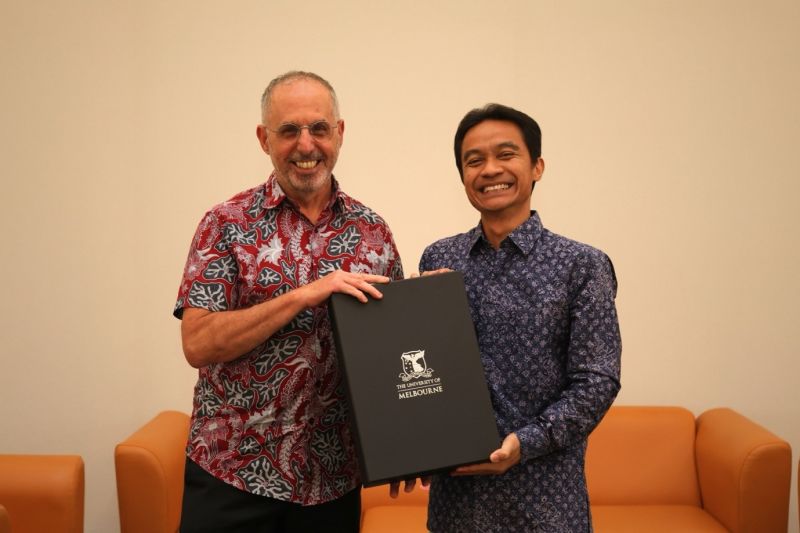
Students will have new opportunities to study across Melbourne and Indonesia with three dual degree programs launched by the University of Melbourne and Universitas Gadjah Mada (UGM), marking 30 years of collaboration between the universities.
The programs build on the University of Melbourne’s long-standing engagement with Indonesia, which encompasses over 55 formal agreements with more than 15 institutions across Indonesia, including universities, government agencies and other partners .
Offered through the Faculties of Science, Arts, and Medicine, Dentistry and Health Sciences, the dual degrees create new pathways for students to gain international experience while developing expertise in agriculture, communications or public health.
The programs bring together the expertise of both universities to prepare graduates for complex challenges facing communities in Australia, Indonesia and beyond.
The programs also reflect a growing focus on transnational education, creating flexible pathways for students to access learning experiences across borders while drawing on the strengths of partner institutions.
University of Melbourne Pro Vice-Chancellor (Global) Professor Frank Vetere said the new programs marked an important next step in a long-standing partnership between the two universities.
“Universitas Gadjah Mada has been an important partner of the University of Melbourne for more than three decades ,” Professor Vetere said.
“Students increasingly want learning experiences that allow them to engage with different cultures, perspectives and professional contexts.
“Through partnerships such as this, universities can create opportunities for students to study across borders, learn from different academic traditions and build international networks that will benefit them throughout their careers.”
“These programs show what can be achieved when universities work together to create opportunities for students and strengthen connections between communities, countries and institutions.”
The programs are:
- Media and communications students will complete one year of the Master of Communication Science at UGM followed by one year of the Master of Global Media Communication at the University of Melbourne. They will graduate with a Master of Global Media Communication from the University of Melbourne and the skills to build a career across the international media landscape.
- Agriculture students will complete one year of the Master in Agro-industrial Technology at UGM before undertaking their second year at the University of Melbourne. They will graduate with a master’s degree from each institution and the skills to lead the future of sustainable agriculture.
- Health students will complete six months of the Master of Public Health Policy and Management at UGM, followed by one year of the Master of Public Health at the University of Melbourne, and then a further six months of the Master of Public Health Policy and Management at UGM.
Indonesian prospective postgraduate student Alifia Nur Aziza said she was excited by the opportunity to study in both Indonesia and Australia.
“I would love to join this program because it would give me the opportunity to study in two difference countries and experience diverse cultures and perspectives,” Ms Aziza said.
“I’m excited to meet people from different backgrounds and build connections with friends from around the world. The University of Melbourne is one of Australia’s leading universities and I’m looking forward to learning from its academic environment and the opportunities it offers.”
Vice Rector for Research, Business Development, and Partnerships at UGM, Dr Danang Sri Hadmoko, said the programs marked an important step forward in the partnership.
“This partnership reflects our shared ambition to move towards a more comprehensive and multi-layered relationship encompassing education, research, innovation and institutional engagement,” Dr Hadmoko said.
“We hope that these initiatives will not only provide our students with greater international exposure but also create new opportunities for our academics and faculties to develop deeper and more sustainable collaboration.”