Scientists have created a light-sensitive material that can produce tiny, coloured light-emitting pixels, an advance that could enable sharper miniature screens and light-powered medical technologies.
While screens are becoming increasingly sharper, shrinking them for use in augmented reality glasses, camera viewfinders or other applications is limited because conventional light-emitting diode crystals become dimmer the smaller they are cut.
RMIT University computational chemist Dr Andrew Christofferson said organic light-emitting diodes, or OLEDs, could provide the way forward because they continue to shine bright even as tiny pixels. But they do have another limitation.
“The problem is that OLEDs have not been suitable for high-precision manufacturing because the solvents and other chemicals used in the semiconductor industry attack and degrade the organic molecules,” he said.
But now an international team led by ETH Zurich have succeeded in making OLED molecules suitable for manufacture at tiny scales using light, the way silicon computer chips are made, and able to survive the process.
They have published their findings in the journal Nature.
 RMIT’s Dr Andrew Christofferson ran computer simulations on how the molecules could effectively shield themselves from harsh chemicals while still being able to emit light, as part of the international collaboration led by ETH Zurich.
 Photoresists for lithography
The lead scientists in Zurich made luminescent polymers in various colours that serve as photoresists – a light-sensitive material used to engrave patterns on a surface – whilst withstanding harsh chemical conditions.
Associate Professor Yinyin Bao, who conducted research at ETH Zurich and is now at the University of Helsinki, said these polymers can enable the creation of fine-scale geometric structures on a semiconductor chip when exposed to UV light.
“We’ve developed a new class of long-chain molecules that can be manufactured into OLED pixels using direct light exposure,” he said.
Bao led the research together with ETH’s Professor Chih-Jen Shih.
RMIT’s Christofferson provided computer simulations on how the molecules could effectively shield themselves while still being able to emit light.
Protective shell, luminescent core
To protect the sensitive luminescent molecules from aggressive chemicals, the researchers developed a molecular complex based on the core-shell principle: at its centre lies the colour-emitting molecule.
Surrounding it are arms arranged in a star-like pattern, the outer ends of which react to UV light.
When exposed to light, they cross-link with the arms of other stars, thereby shielding the OLED molecules during the manufacturing process used to make computer chips, called photolithography.
“We separate the two functions spatially,” explained Shih.
“The light-emitting molecule is protected inside, whilst the reactive cross-linking groups are on the outside. This allows the photoresist to react during lithography without causing significant damage to the light-emitting core.”
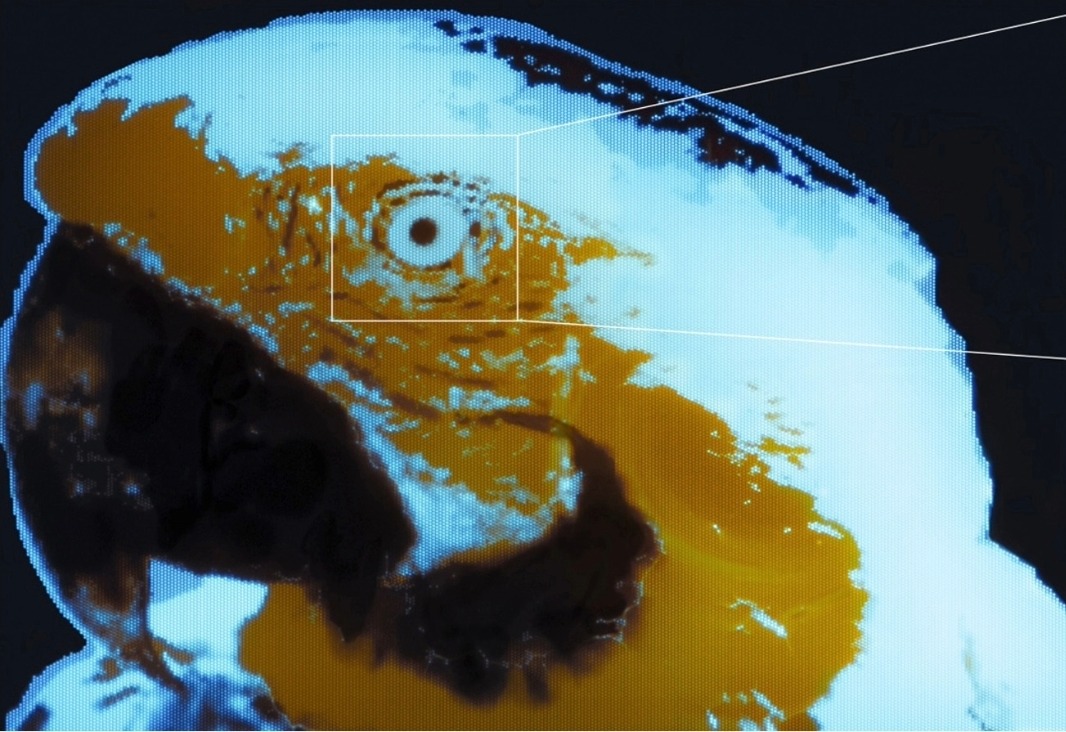 A record: the highest-resolution multicolour image using fluorescent dyes. Microscopic image. The image is 0.3 by 0.43 millimetres in size. Credit: Lo SW et al., Nature 2026.
 A macaw parrot made of micropixels
The researchers demonstrated just how precisely different coloured luminescent materials can be patterned using this method with a high-resolution test image.
Researchers produced an image of a macaw parrot measuring 0.3 by 0.43 millimetres and consisting of 250 by 350 pixels.
The static image made up of fluorescent colours is not yet a display as the pixels are not made to glow electrically. Instead, they are excited by external light, causing them to glow.
The image is the highest-resolution multicolour image made up of fluorescent colours to date that has been produced using photolithography.
Next steps
The researchers now aim to further reduce the pixel size of the light-emitting diodes.
To ultimately produce a functioning screen, electronics are still required that allow the individual pixels to be controlled independently of one another.
Shih sees potential applications not only in small screens, but also in tiny light sources for medical technology and in devices for biological and neuroscientific research.
“We can use this to generate light on a small scale and with high precision exactly where it is needed,” Shih said.
Tiny OLEDs could, for example, be used in research equipment to examine individual biological cells in a targeted manner or to stimulate nerve cells in a petri dish with light.
Very small and precisely controllable light sources could thus be produced directly on microchips and could also be useful in microscopy and sensors.
The study ‘Electroluminescent photoresists extending lithographic scaling to OLEDs‘ is published in Nature (DOI: 10.1038/s41586-026-11042-0).