Latest
  • Albanese rejects Coalition Tax Back Guarantee, protects $255 billion in higher taxes
  • From fitness to bowls and beyond: meet Yarra Leisure legend John Inglese
  • Independent Financial Review examining the QPS financial practices
  • Proposed rule amendments to ensure aviation safety for new Sydney Basin Class D CTA airspace
  • Why Everyone Is Suddenly Eating Sardines
  • AEC CEO Opening Remarks – Energy2050: Mapping Way Forward
  • QPS internal financial mismanagement exposed in independent audit
  • Fortnightly Update: Roads
  • NSW Releases Its First Cultural Fire Strategy |
  • UN report warns AI could soon use 3% of world’s electricity and more water than we need to drink
  • Home
  • National
  • Local
    • ACT
    • QLD
    • NSW
    • NT
    • SA
    • TAS
    • VIC
    • WA
  • Politics
  • Business
  • Science
  • Technology
  • Health
  • Life
    • Sport
    • Travel
    • Education
    • Environment
  • World
SEARCH

What Exactly Is UV Radiation?

The National Tribune
  • Health
  • 19 Mar 2024 1:12 pm AEST Date Time
  • Share
Courtesy of Cancer Council WA

For Australians, protecting themselves from UV radiation and remaining SunSmart, is a year-long exercise. While many know to “slip, slop, slap, sleek, and slide”, they may not know what UV radiation is, what types of UV there are, and how it affects us.

We’ve put together a handy guide to walk you through UV radiation, and what you need to know.
UV radiation explained

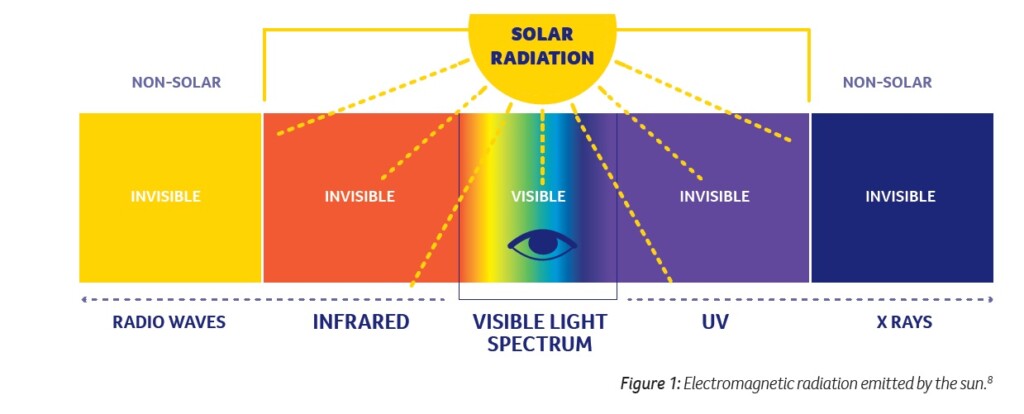
The sun emits different types of radiation, including visible light or sunlight that we see, infrared radiation (heat) that we feel, and ultraviolet (UV) radiation that can’t be seen or felt.

UV radiation is classified as a human carcinogen, meaning it causes cancer. Every time we overexpose our skin to UV radiation, we damage some of our skin cells and increase our risk of developing skin cancer.

It is important to remember that temperature is not related to UV radiation. As we cannot feel UV, our skin can be damaged without us knowing.

The ABC of UV

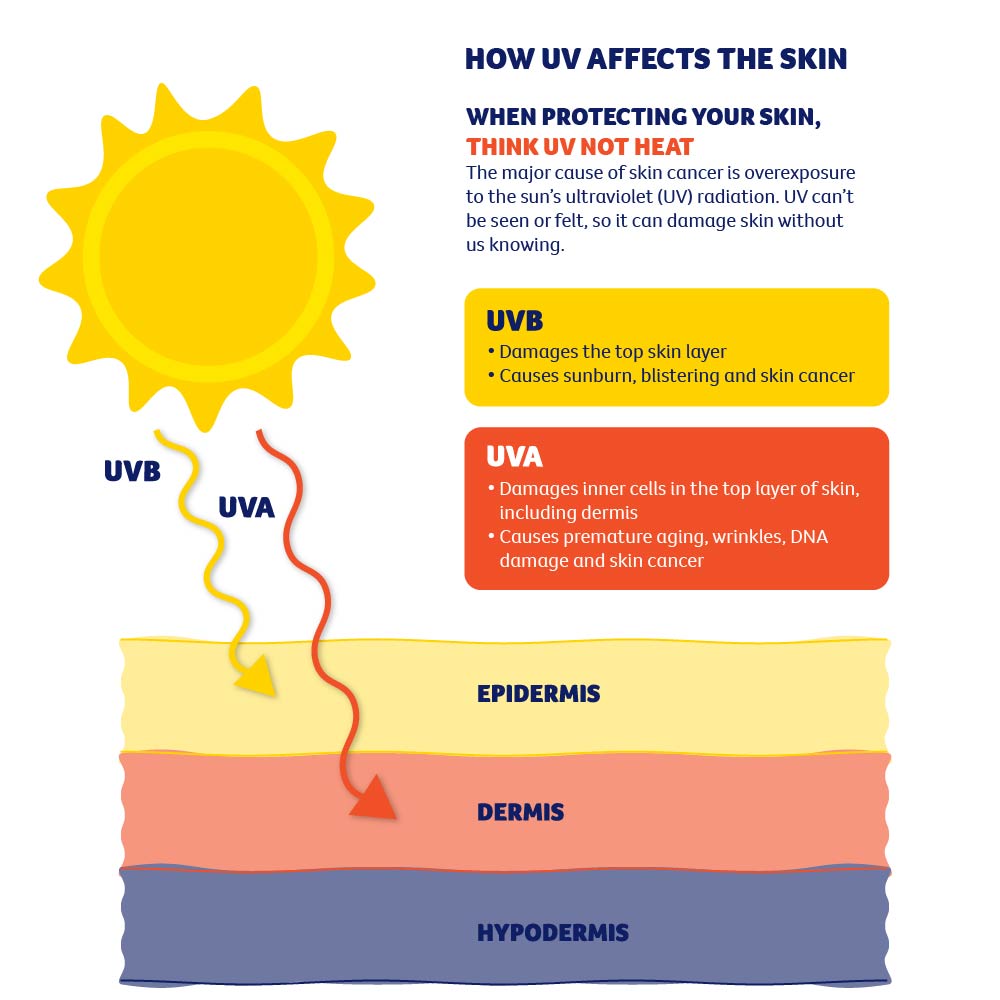
There are three types of UV radiation, based on wavelength:

  • UVA penetrates deeply into the skin (the dermis) causing genetic damage to cells, photo-ageing (wrinkling, saggy skin etc) and skin cancers. UVA makes up most of the UV radiation that reaches the Earth’s surface.
  • UVB damages the top layer of the skin (the epidermis) causing damage to the cells. UVB is responsible for sunburn and skin cancers. .
  • UVC is absorbed in the atmosphere and does not reach the Earth’s surface.
Direct vs diffuse UV

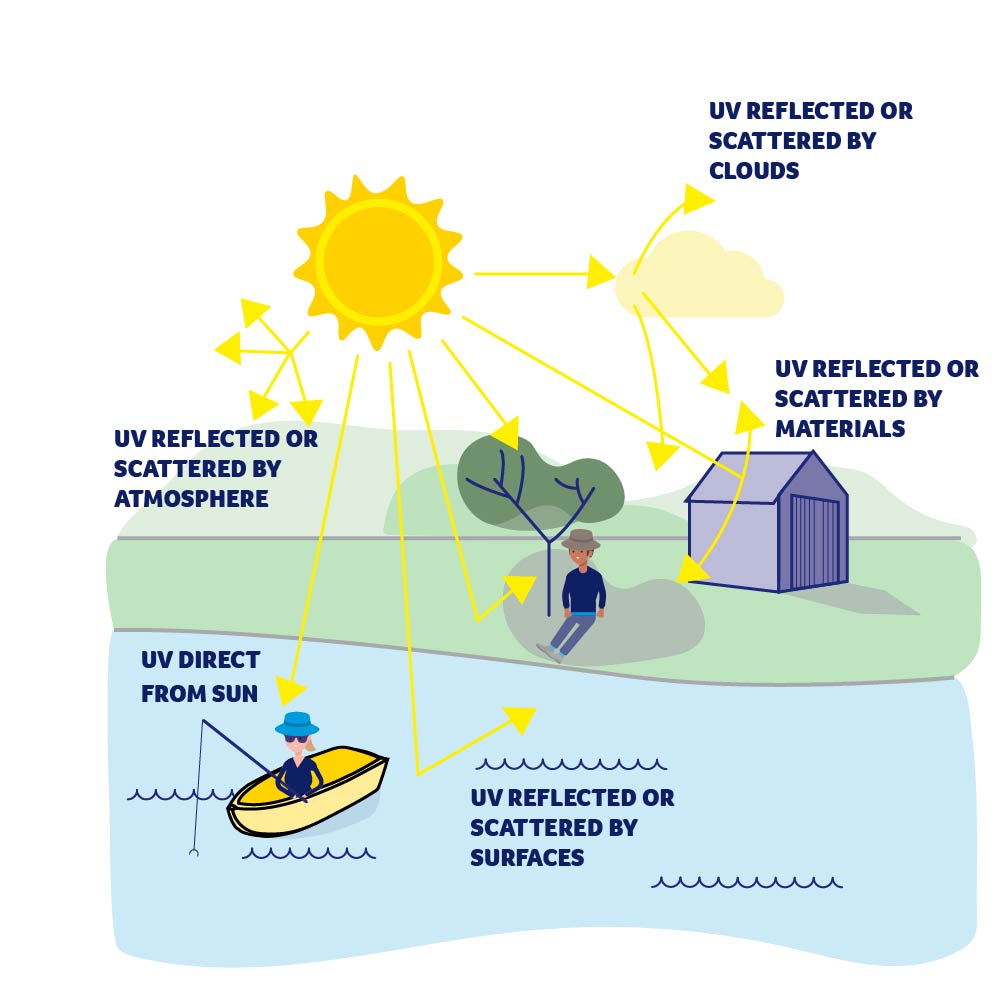
UV radiation can reach you on the ground directly from the sun. It can also be scattered by particles in the air. If you are standing in the shade and can still see large areas of sky, the scattered or diffuse UV from those areas of the sky can reach you.
UV and skin cancer

Overexposure to UV radiation is estimated to cause up to 95 per cent of melanomas and 99 per cent of non-melanoma skin cancers, notably basal cell carcinomas (BCCs) and squamous cell carcinomas (SCCs). BCCs and SCCs are found almost exclusively on sun exposed body sites, and almost never occur on skin that is routinely shielded from the sun.

Every time we go into sunlight, our skin cells and genetic material (DNA) are damaged by UV radiation. This UV damage accumulates, meaning it builds up over time. This damage can evolve into skin cancer and have deadly consequences. UV radiation has also been linked with cancer of the eye, cataracts (clouding on the lens of the eye) and pterygium (a growth on the white of the eye).

What affects solar UV?

UV levels are affected by several different factors, including:

  • Solar elevation, or how high the sun is in the sky. UV levels increase throughout the morning, and peak around the middle of the day.
  • Location, with UV higher the closer you are to the equator.
  • Time of year. UV is highest in the summer months.
  • Cloud cover reduces but does not eliminate UV.
  • Higher altitudes have higher UV.
  • Reflective ground surfaces, such as snow, water and sand increase the amount of UV that reaches you.

Understanding the UV Index

The UV index was developed by the World Health Organization (WHO) to measure UV levels on Earth’s surface.

The index starts at zero and has no upper limit.

UV levels are categorised as:

  • low (1-2)
  • moderate (3-5)
  • high (6-7)
  • very high (8-10)
  • extreme (11 and above).

In summer in WA, UV levels average in the extreme range nearly every day.

When to use sun protection

Sun protection is necessary when UV is three or above.

You can check the daily UV forecast at:

  • The MyUV website
  • The free SunSmart Global UV app
  • Bureau of Meteorology weather forecast page and app
  • Other news and weather sources

Remember to protect your skin in 5 ways:

  • Slip on protective clothing that covers as much skin as possible.
  • Slop on SPF50+ sunscreen that is labelled as ‘broad-spectrum’ – this will filter both UVA and UVB radiation.
  • Slap on a hat that provides as much shade as possible to the face, head, neck, ears and eyes.
  • Seek shade that casts a dark shadow.
  • Slide on sunglasses.

/Public Release. View in full here.
Tags:ABC, atmosphere, basal cell carcinoma, Bureau of Meteorology, cancer council, Cancer Council WA, cataracts, Earth, Health, non-melanoma skin cancer, protection, skin cancer, squamous cell carcinoma, sunscreen, ultraviolet, WA, weather forecast, World Health Organization

You might also like

Marine Incident Report: January

Man arrested for possess child exploitation material

Hawkesbury City Council reaches agreement with Sydney Water for wastewater divestment

Why Australia needs stronger laws to stop dangerous products being sold online

From the Commissioner: Play it safe with basketball hoops and backboards

Joint statement – Albany Airport upgrade to support growing Great Southern region

Open Day showcases opportunities for WA medical research

Mining leaders unite to drive action on respect and safety

Just In

4 Jun 2026 4:18 pm AEST

WA Police Confidential: Ep 17 – Storm Stories and Kings Park Arson Investigation

4 Jun 2026 4:09 pm AEST

Unearthing More Prosperous Future

4 Jun 2026 4:06 pm AEST

Police Update: Disturbance in Toowoomba City, QLD

4 Jun 2026 4:03 pm AEST

Speech, House Of Representatives, Labor’s Toxic Taxes

4 Jun 2026 4:00 pm AEST

First Peoples filmmakers explore Treaty in Sovereign Shorts

4 Jun 2026 3:57 pm AEST

High-rise Towers Coming To Suburb Near You

4 Jun 2026 3:57 pm AEST

Council endorses evidence-based improvements to flood mapping

4 Jun 2026 3:54 pm AEST

Fashion and beauty retailers trading under the Zara, H&M and Sephora brands pay $596,000 in infringement notices for failing to lodge financial…

4 Jun 2026 3:54 pm AEST

Wagga Comedy Fest underway: headline acts sold out as festival kicks off

4 Jun 2026 3:51 pm AEST

ACT Greens to Introduce Law Reform for Medicinal Cannabis Patients

4 Jun 2026 3:48 pm AEST

Statement On Reporting Regarding Church St Barbeque

4 Jun 2026 3:45 pm AEST

Greens Pressure Pays Off: Climate Funding Boost Locked In

4 Jun 2026 3:45 pm AEST

Barunga Festival returns celebrating First Nations culture, connection and community

4 Jun 2026 3:43 pm AEST

Taking Airborne Connections To New Heights

4 Jun 2026 3:42 pm AEST

Police Appeal To Locate Man Missing From Near Goulburn

4 Jun 2026 3:42 pm AEST

Man charged with multiple alleged malicious damage and graffiti offences – Port Macquarie

4 Jun 2026 3:39 pm AEST

Designs unveiled for $630 million Fairfield Hospital Redevelopment

4 Jun 2026 3:39 pm AEST

One in four confirmed DRC Ebola deaths are children underscoring the urgent need to protect them

4 Jun 2026 3:36 pm AEST

Help Shape Future Of Eurobodalla’s Economy

4 Jun 2026 3:30 pm AEST

Community invited to help shape Latrobe City’s visitor economy

4 Jun 2026 3:28 pm AEST

Moving Forward On Truth-telling And Treaty

4 Jun 2026 3:27 pm AEST

BHP to help deliver quality services, infrastructure in Port Hedland

4 Jun 2026 3:24 pm AEST

New Forest Hill Oval Playground Under Construction

4 Jun 2026 3:15 pm AEST

Draft Victoria Street Revitalisation Plan

4 Jun 2026 3:12 pm AEST

National weather forecast: Showers and winds easing in SE Aus

4 Jun 2026 3:09 pm AEST

Lighting Upgrades Powering Safer, More Inclusive Play

4 Jun 2026 3:09 pm AEST

Historic steam locomotive returns to Bathurst for railway anniversary celebrations

4 Jun 2026 3:03 pm AEST

RUN, DON’T WALK: SAN CHURRO IS GIVING AWAY 10,000 FREE CHURROS, BUY ONE GET ONE OFFERS AND LIMITED-EDITION BUDGY SMUGGLERS NATIONWIDE. THAT’S…
More News
ABOUT US

Based in Toowoomba QLD, The National Tribune provides 24/7 free live coverage of important events and developments in Australia and the Pacific region leveraging real-time open-source intelligence. We endeavor to give the Australian community greater transparency and access to government information and other developments free from encroaching corporate, ideological or any other interests/influences. More

We acknowledge the Traditional Custodians of Country throughout Australia and their continuing connection to land, culture and community.

POPULAR TOPICS

AustraliaGovernmentAustraliancommunityPoliceNSWVictorialocal councilQueenslandUniversitycouncilAusPolministerNew South WalesEnvironmentHealthinfrastructurebusinessNew Zealandinvestigationinvestmentcrime
QUICK LINKS
  • Latest Australia News
  • Latest Toowoomba News
  • Latest Queensland News
  • Latest New Zealand News
  • Latest Police News
  • Latest University News
  • Latest AusPol News
FOLLOW
  • Facebook

© 2026 - The National Tribune Australia

  • About Us
  • Contact Us
  • Terms of Use
  • Privacy Policy
  • Disclaimer