Every day, people check the weather and make decisions, big and small, for the day or week ahead. Should I hang out the washing? Take a coat and umbrella or a hat and sunscreen? What about the barbecue on Saturday?
When the weather matches our plans, things go smoothly. But when it goes the other way, the weather can have a big impact.
Knowing what the weather might do helps us make decisions. But how can we predict what the weather will do today, tomorrow, or next week?
Behind every forecast is science. Meteorology is the science of understanding and predicting the weather.
Where the weather comes from
It all starts with the sun. It heats the Earth unevenly, so some places are warmer than others. This drives the movement of air and water.
The sun causes water to evaporate from lakes, oceans, and even plants. As water vapour rises and cools, it turns into tiny droplets that gather as clouds. When those droplets become heavy enough, they fall as rain.
When the sun warms the air, it rises and cooler air moves in to replace it. That movement of air creates wind.
This includes local winds like sea breezes, and larger wind flows around the high and low pressure systems that move across Australia.
High pressure systems are areas where air is sinking. Low pressure systems on the other hand, are where air rises. What difference does this make?
The rising air in lows often brings wind, rain and storms. Lows in the tropics to the north of Australia can develop into cyclones.
For high pressure systems, sinking air can mean clear skies and more settled weather.
The wind direction also affects the temperature. Lows can bring cold winds from the south. In summer, slow-moving highs can bring hot winds from the north and heatwaves.
We start by watching what’s happening now
To predict what the weather will do next, we need to know what’s happening right now. For nearly 120 years, our highly trained scientists have been observing, monitoring and learning about Australia’s weather. We have meteorologists, hydrologists, climatologists, space weather experts, data scientists, and technicians all over Australia, our oceans and islands, and even Antarctica.
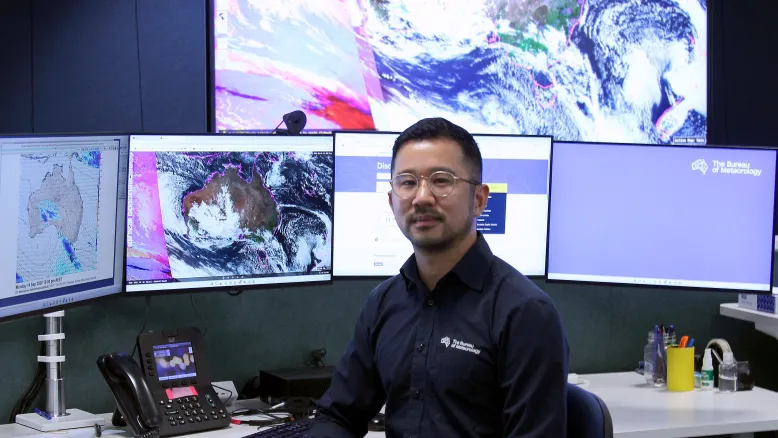
Meteorologists use science, knowledge and experience to make weather forecasts
We measure and record all the key weather elements: temperature, air pressure, wind, humidity, rainfall, and much more to build a picture of what’s happening now.
Our observation network stretches across Australia. We watch the land, sea, sky, and space with weather stations, buoys, weather balloons, and satellites. Our radars track rain and storms, and our gauges measure rainfall and river height. We also have volunteers who collect and record weather data on the ground and there are even ships that record data at sea.
Together, they give us billions of measurements about what the weather is doing.
From data to forecast
All of this collected weather data is fed into a powerful supercomputer, which calculates how the weather could develop. The atmosphere is always changing so the supercomputer produces a range of possible outcomes. These evaluate the chance of different types of weather happening.
That’s where our meteorologists step in. They use their knowledge and experience to study the data and work out what the weather is most likely to do. As well as making the forecast, they decide when conditions are serious enough to issue a warning for severe weather like thunderstorms, flooding, dangerous wind and waves, and cyclones.
Our meteorologists monitor the latest observation and computer data and update forecasts regularly.
Information you can use
The result is the weather information, forecasts and warnings that people use every day. You can find them on our website, our app and beyond.
So next time you check the weather, you can be sure there’s science, knowledge and experience behind every forecast.