What the research is about
As plastic waste continues to cause environmental problems, biodegradable plastics made by microorganisms and broken down in nature are attracting growing attention. If carbon dioxide (CO₂) could also be used as a raw material to make these plastics, it could help reduce our reliance on petroleum resources while making better use of emitted CO₂.
One bacterium known for producing such biodegradable plastics is Ralstonia eutropha, a type of hydrogen-oxidizing bacterium. It obtains energy from hydrogen, takes in CO₂, and stores poly(3-hydroxybutyrate), or P(3HB), inside its cells. For the bacterium, P(3HB) serves as a way to store carbon and energy, while it can also be used as a biodegradable plastic.
Using this bacterium could provide a way to produce plastics without relying on petroleum. However, conventional cultivation methods use high concentrations of hydrogen, which creates a risk of explosion. A research team led by Specially Appointed Assistant Professor Yuki Miyahara and Professor Takeharu Tsuge at Institute of Science Tokyo (Science Tokyo) has previously developed a safer cultivation method that keeps the hydrogen concentration below the flammable range.
What remained unclear was how much CO₂ should be supplied to efficiently produce P(3HB) under these safer, low-hydrogen conditions. The researchers therefore examined how different CO₂ concentrations affected bacterial growth and P(3HB) production.
They also focused on an enzyme called carbonic anhydrase. When the bacterium uses CO₂, this enzyme helps convert CO₂ into a form that can be more readily used inside the cell. Previous studies had reported conflicting results about whether increasing the amount of this enzyme could improve P(3HB) production, so the team investigated this question as well.
Why this matters
The researchers grew the bacterium under three different CO₂ concentrations – high, medium, and low – and compared both bacterial growth and P(3HB) production.
The result was unexpected. The bacteria grew better and produced more P(3HB) under the low-CO₂ condition than under the high-CO₂ condition. The amount of P(3HB) produced relative to the CO₂ supplied was about 11.8 times higher under the low-CO₂ condition than under the high-CO₂ condition.
The team then increased the amount of carbonic anhydrase produced by the bacterium. Although this did not greatly change the dry weight of the bacterial cells after cultivation, P(3HB) increased from 77% to 81% of the cell dry weight. In other words, the cells did not grow substantially more; instead, P(3HB) made up a greater proportion of their dry weight.
Importantly, this effect was seen only when CO₂ levels were low. When plenty of CO₂ was available, increasing the amount of the enzyme made little difference.
Even more interestingly, the bacteria themselves produced more carbonic anhydrase under low-CO₂ conditions. This suggests that when CO₂ is limited, the bacterium boosts its own ability to make better use of the available CO₂. Increasing the amount of the enzyme further may then help promote P(3HB) production.
What’s next
These findings suggest that bacteria may be able to use CO₂ efficiently and produce biodegradable plastic even when the CO₂ concentration is low. In the future, exhaust gas containing low-concentrations of CO₂ could potentially be used directly as a raw material, without first concentrating the CO₂. This provide a way to make used of CO₂ that would otherwise be emitted.
However, the present study was conducted using a small-scale cultivation system. Before the method can be applied to large-scale production, researchers will need to determine how well it performs when large amounts of exhaust gas are supplied continuously and reliably.
It is also not yet clear why higher CO₂ concentrations reduce the efficiency of P(3HB) production. The team plans to investigate bacterial metabolism in greater detail and to explore production using actual industrial exhaust gases.
Comment from the researcher
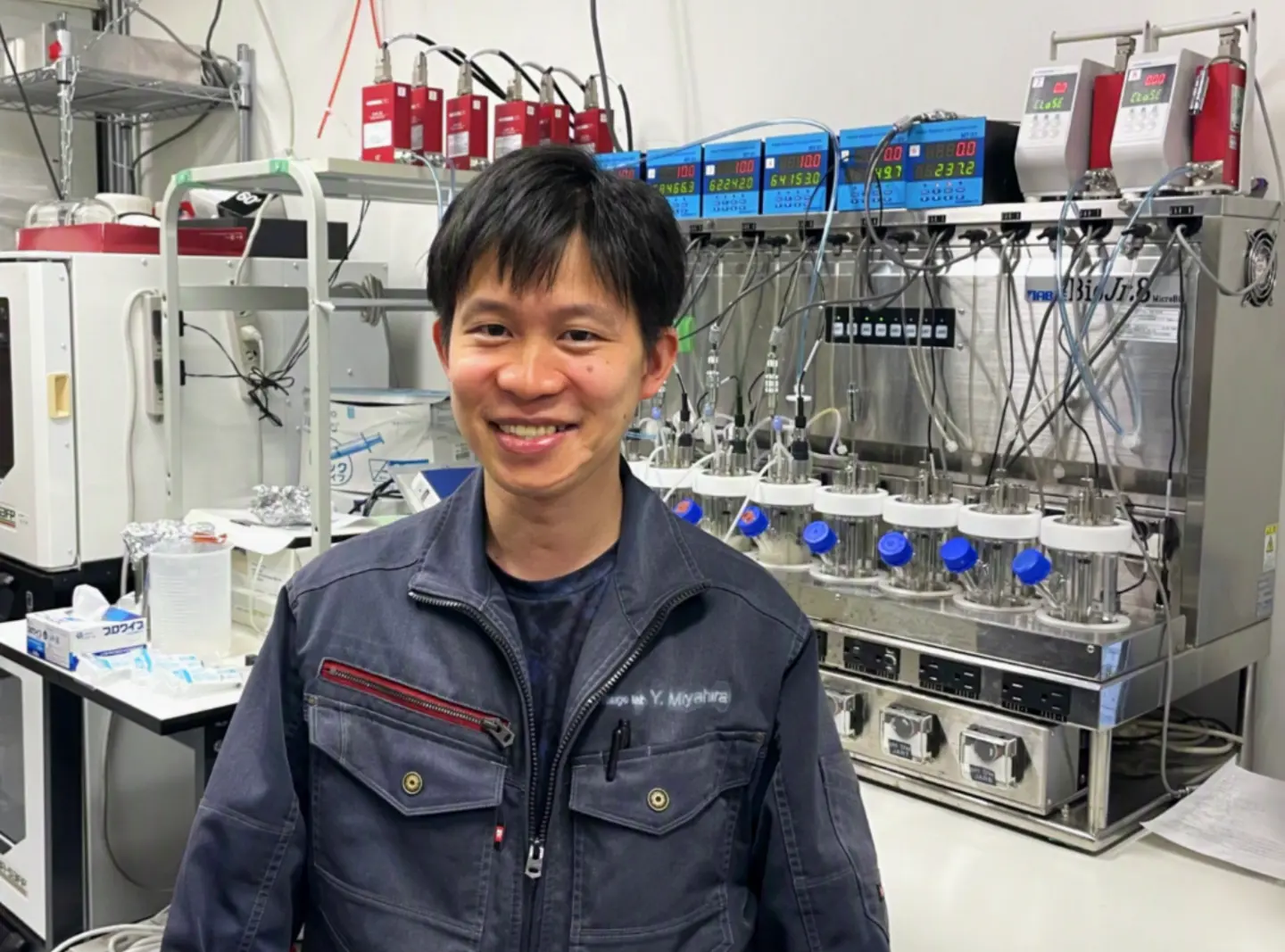
Because CO₂ is the raw material, we expected that supplying more of it would be better. Instead, we found the opposite: lower CO₂ concentrations led to more efficient production of biodegradable plastic. It was also fascinating to see that the microorganisms themselves strengthened their ability to make efficient use of limited CO₂.
Going forward, I would like to find ways to draw out even more of the microorganisms’ natural capabilities and use CO₂ as a raw material to produce environmentally friendly plastics and other useful substances.
(Yuki Miyahara, Specially Appointed Assistant Professor, School of Materials and Chemical Technology, Institute of Science Tokyo, Japan)
Dive deeper
Explore more research in Science for All
Science for All showcases cutting-edge research at Science Tokyo and highlights the ideas, people, and possibilities shaping the future.

Follow Science Tokyo research on X
Our Research Frontiers account features selected stories from Science for All and regularly shares research from across Science Tokyo.