What the plight of the Hylaeus navai reveals about the world’s unknown species
A rare, tiny, canopy dwelling bee, identified by scientists only two years ago, is already on the cusp of extinction, raising fearsthat species around the world are disappearing before we even know they exist.
New research led by the University of Wollongong (UOW) revealed the Fijian Hylaeus navai, a species of masked bee that appears to rely heavily on red-flower canopy plants, has suffered an estimated 99 per cent collapse in its population over the past 150 years.
Published in Ecology and Evolution, the research estimates the timing of the decline, which coincided with European colonisation and appears to be driven by deforestation and habitat reduction caused by climate change-exacerbated extreme weather, and the introduction of invasive species.

Hylaeus navai are the most common species of the endemic Fijian Hylaeus bees, which are smaller than a grain of rice and carry pollen internally. They live in forest canopies, so had evaded scientists for years. Fijian Hylaeus bees are a cryptic group, meaning they can be difficult to tell apart but comprise a variety of genetically distinct species.
Lead author Tegan Edwards, from UOW’s School of Science, began the research as part of her Honours thesis. She said bees are critical to planetary health and there is growing urgency to bridge patchy taxonomic gaps.
“Pollinators are keystone species in our ecosystems, underpinning many human needs, as well as maintaining the health of our natural systems. These tiny bees have a vital role to play and need our conservation action,” Ms Edwards said.
“Having the tools to discover these declines, and to hypothesise their drivers, gives us a baseline to begin working towards conserving these species. This work helps showcase some of our littlest, most hidden species, and gives us a real chance to work towards conserving them into the future.”
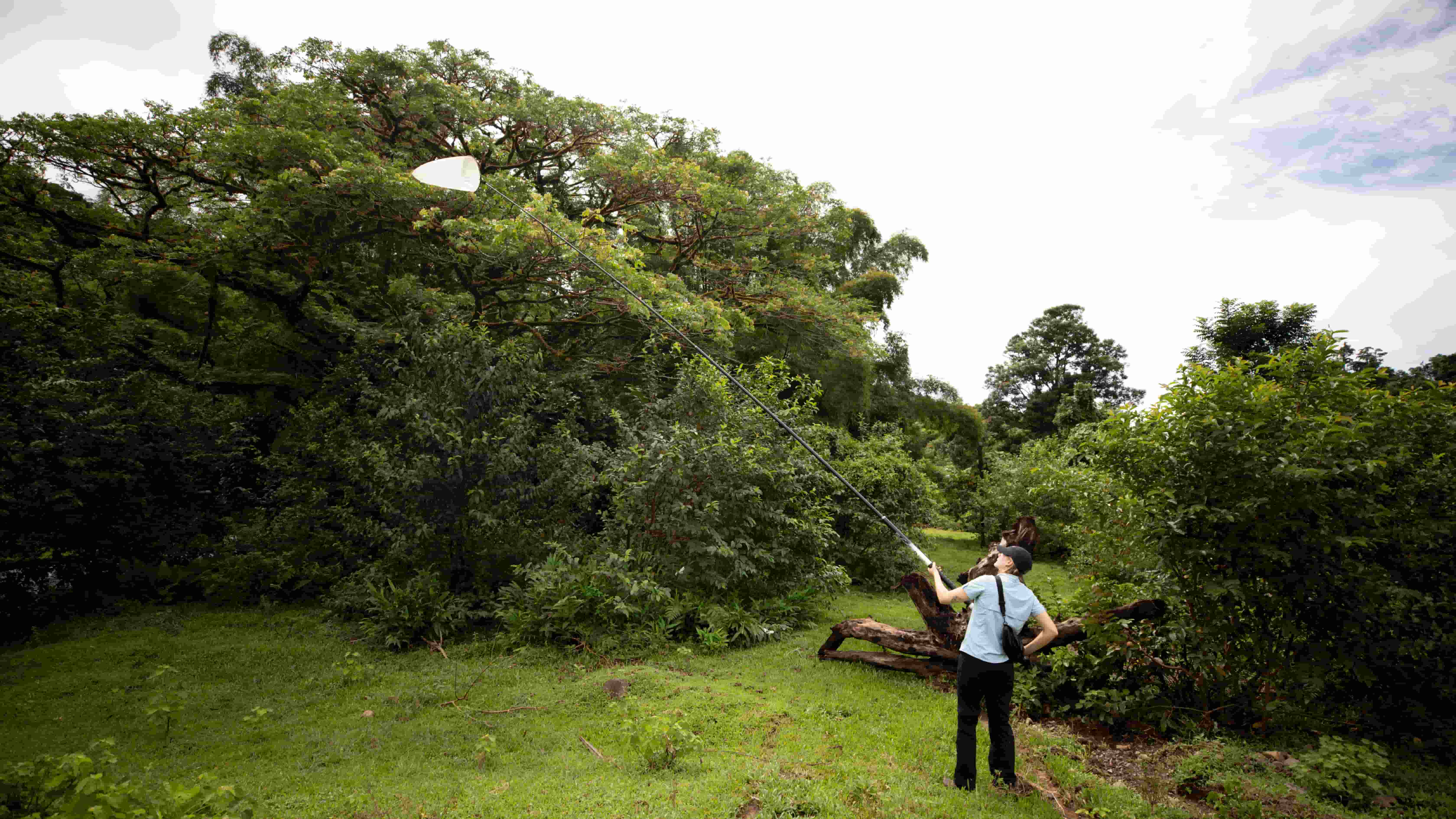
The researchers sampled 54 sites across Fiji’s main island, Viti Levu, using ground-level netting and specialised canopy nets reaching up to 14 metres. Genetic analysis of the bees they collected allowed them to reconstruct the species’ population history.
They found three 10-year windows with severe population declines; 61 per cent between 1933 and 1942, 76 per cent between 2002 and 2011, and 82 per cent between 2016 and 2025. Together with the multiple threats facing the species, the researchers said the findings justify an international threatened species listing.
Modelling indicates suitable habitat for the species now only covers just 1.4 to 2.4 per cent of Fiji’s land area, confined largely to high-elevation forests. Historically, the bees were also recorded in the lowlands, where they now appear to be absent.

Dr James Dorey from UOW’s Environmental Futures research program, said the findings offered concerning implications for the world’s forest pollination ecosystems.
“Island ecosystems are biodiversity hotspots that host a disproportionately high share of unique, endemic species of bees, but they are desperately under-researched and under-resourced,” Dr Dorey said.
“By the time we discovered the Fijian Hylaeus, they were already in serious trouble. How many other bee or insect species are out there, and have not yet been discovered but are seriously threatened or even extinct?”
About the research
‘Genomics reveal population crash and range contraction in elusive Fijian Hylaeus bees’, was published in Ecology and Evolution. The authors are Tegan Edwards, Damien Esquerré, Nikolas Johnston, Stephen Galvin, Nikkita Maxwell, Francisco Encinas-Viso, and James Dorey: https://onlinelibrary.wiley.com/doi/10.1002/ece3.74366
This project was funded by the Department of Foreign Affairs and Trade through a New Colombo Plan Grant and the University of Wollongong’s Faculty of Science, Medicine, and Health.