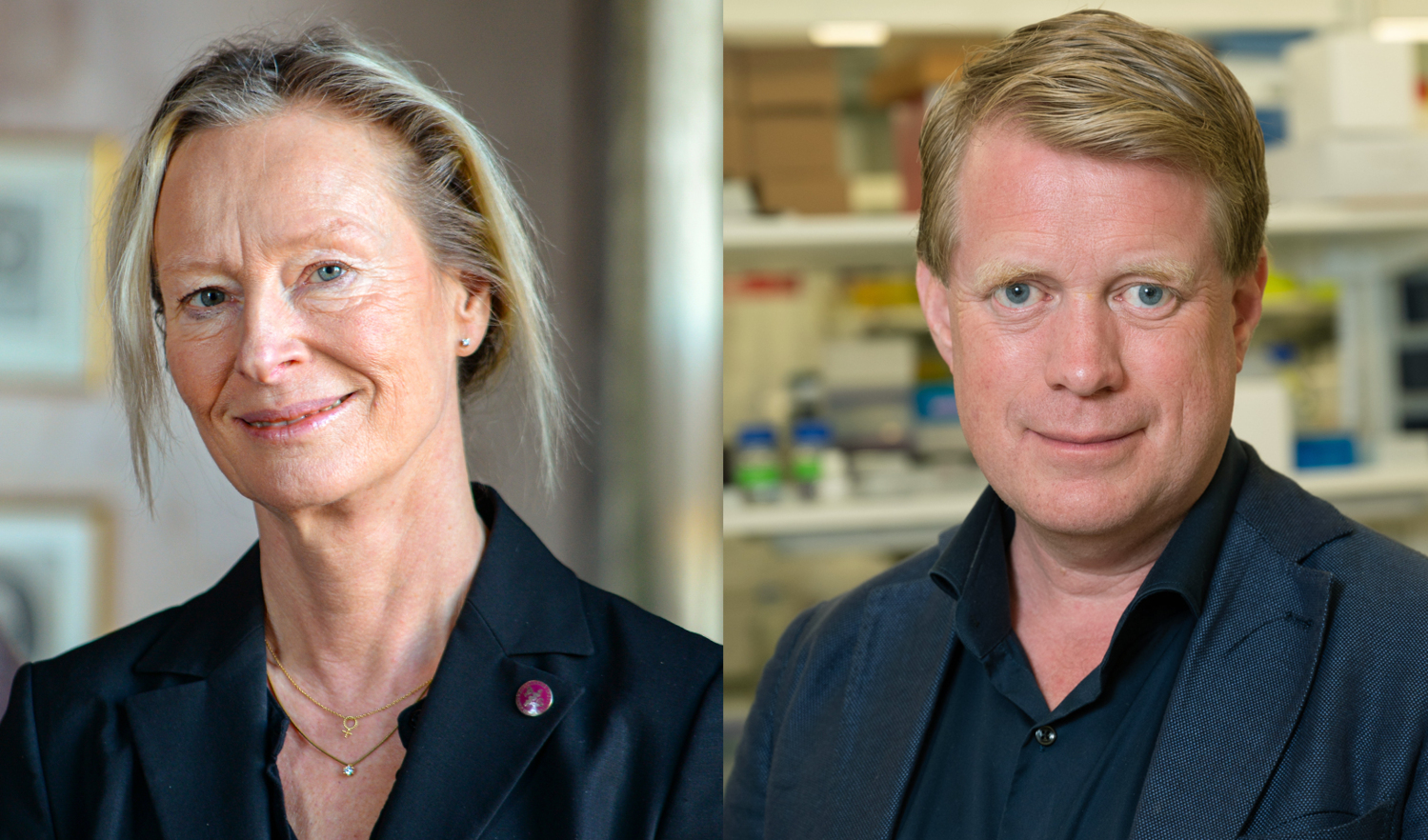
Kristina Gemzell Danielsson will develop contraceptives that protect against breast cancer, while Thomas Helleday aims for new points of attack to counteract chronic inflammation and, by extension, cancer, autoimmunity and ageing. They receive the ERC Advanced Grant for their projects.
The prestigious grants from the European Research Council amount to EUR 2.5 million, which corresponds to just over SEK 27 million over five years. It is given to established, world-leading researchers to enable them to conduct bold and innovative research.
One example is to develop a completely new class of contraceptives, which Kristina Gemzell Danielsson , professor of obstetrics and gynecology at the Department of Women’s and Children’s Health , KI, plans to do.
“The endometrium is poorly studied. Despite its incredibly important role in fertility and reproductive health, it is not known in detail what regulates its monthly structure,” she says.
The lining of the uterus determines whether a fertilized egg can be implanted or not. Part of her project is to develop a new class of contraceptives for women.
The alternatives available on the market today increase the risk of breast cancer during use, which according to her means that more and more women, both in Sweden and abroad, do not want to take them.
“The drug we want to develop instead has a protective effect against breast cancer,” says Kristina Gemzell Danielsson.
Better diagnosis and treatment in ectopic pregnancy
The drug mifepristone prevents a fertilised egg from implanting in the uterine lining and is currently used in an early abortion treatment that her group has developed. It inhibits the hormone progesterone, which is produced in the ovaries and prepares the uterus for pregnancy. Now the plan is to further develop its use into a contraceptive.
Kristina Gemzell Danielsson will also study ectopic pregnancies, when the fertilised egg attaches outside the uterus. It occurs in two percent of all pregnancies and is the most common cause of death in connection with early pregnancy globally.
“Here we want to find new biomarkers in blood to be able to make a diagnosis quickly, accurately and non-invasively, and also use anti-progesterone as a treatment,” she says.
In this part of the project, tissue from healthy and ectopic pregnancies is compared.
She got her grant on the first try …
The third part of the project is about studying in detail the structure and regeneration of the endometrium and developing new in vitro models for this.
“Here we have already found completely new cell types,” says Kristina Gemzell Danielsson.
She emphasises the importance of having received the ERC Advanced Grant.
“This means that I can afford to do these studies, which are potentially groundbreaking and clinically important,” she says and continues:
“For me as a researcher, it’s great to get recognition for my ideas and it can also lead to new collaborations in the future. I had heard that clinics never get ERC grants, plus you never get it on the first try, so that’s extra fun.”
… while he is now receiving his seventh ERC grant
Thomas Helleday , professor of chemical biology and translational medicine at the Department of Oncology-Pathology , KI, has now received his seventh ERC grant. He describes the feeling in one word – relief.
“If I hadn’t received the grant, I wouldn’t have been able to continue with my research here. Working to develop new treatments is very resource-intensive,” he says.
From working with cancer for 25 years, he is now turning his focus to inflammation.
“Previously, treatments have been developed that dampen the inflammatory response. What we aim to do now is to strike inflammation at its root” says Thomas Helleday.
The hypothesis: Link between DNA damage and disease
Our lives are based on a fine-tuned balance, turning oxygen and nutrients into energy. In diseases, when things go off balance, oxidative stress is formed that damage DNA and initiates a DNA damage response.
The hypothesis is that there is a central link between DNA damage response and various autoimmune diseases, that the research group wants to exploit to tailor new treatments.
“There could be a stable change in these cells that we may exploit. It could be a completely new type of treatment,” he says.
Wants to identify target proteins
To investigate this, samples will be collected from patients with autoimmune diseases and different types of cancer to map genes and signaling pathways that are active when disease develops or when treatment stops working.
“Then we want to identify what type of target proteins we should use to change the inflammatory response,” he says.
The final step is to develop and test substances in cells, organoids and finally animal models to see if the immune system can be reprogrammed into a healthier state.
Catalytic medicine – a new way of thinking
One part is to use so-called catalytic medicine, which according to Thomas Helleday is a completely new way of thinking about medicines.
“Instead of inhibiting various processes in the body, we instead increase repair and create new biochemical functions in the repair proteins,” he says.
His research group has developed a molecule that creates a new biochemical function to the DNA repair protein OGG1.
“This means that we can repair oxidative DNA damage 1,000 percent faster. My hope is that this will be able to help – not only against inflammation and cancer, but also against ageing,” he says.
Important help from the Grants Office
As an example of a fruitful research environment, Thomas Helleday highlights SciLifeLab , where researchers from KI, KTH and Stockholm University collaborate.
“It creates an environment that is unbeatable, I think.”
Kristina Gemzell Danielsson also describes the research environment at KI as “fantastic” and highlights BioMedicum and its location between the hospital and academia. The support through the Grants Office was important before the application.
“That structure helps a lot and I would also like to thank the department’s EU grant support,” she says.
Thomas Helleday agrees.
“These EU grants are administratively difficult to apply for, they have made it very, very complicated. It’s really important to get that help, otherwise it’s a full-time job.”
New treatments for the sake of patients
The ERC’s selection criterion is that the research is “excellent”, which means a quality stamp.
“But for me as a clinician, it is important to also be able to translate the knowledge into new treatments or ways to prevent disease,” says Kristina Gemzell Danielsson.
Thomas Helleday also emphasises the importance of investing in new treatments.
“We are missing the train because there are no grants in Sweden or the EU to apply for to develop new valuable treatments.”
He describes that China accounts for almost half of all new drug projects that are tested, while Europe’s share has shrunk to around one in ten.
“Investing in new treatments can be valuable – look at the Danish Novo Nordisk and their weight loss drugs. And AstraZeneca is still the highest valued company on the Swedish stock exchange,” he says.
But the most important thing is the patient benefit.
“At the end of the day, for me personally, what drives me is that I meet people who are alive because of the thoughts I’ve had. Being able to make a difference is what drives me, to help loved ones and many other people around the planet,” says Thomas Helleday.
Text: Lotta Fredholm
More about this year’s ERC Advanced Grants
The European Research Council (ERC) has announced the winners of its latest Advanced Grant competition. The funding, worth €838 million, will go to 319 leading researchers across Europe.
The Advanced Grants give senior researchers the opportunity to pursue ambitious, curiosity-driven projects that could lead to major scientific breakthroughs. The grants are part of the EU’s Horizon Europe programme.
The grantees will be based at universities and research centres in 24 EU Member States and associated countries.
A record of 3,329 proposals was submitted to this competition, up 31 per cent from 2,534 last year. 9.6 per cent of proposals were selected for funding. Estimates show that the grants will create more than 3,000 jobs in the teams of new grantees.
Source: ERC