For Andrea Parent-Tibbetts, owner of Clover Brooke Farm in Hyde Park, New York, the llamas and alpacas are the lure: the doe-eyes and fluff and the fact that they approach you face to face.
“I can grab peoples’ attention that way,” Parent-Tibbetts said. “And then I can tell them a little bit about the animal, why they’re really purposeful, useful, so that people can understand what we do.”
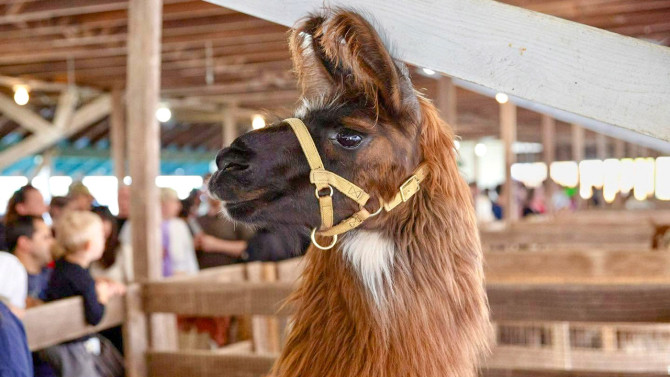
Parent-Tibbetts said the llamas and alpacas grab peoples’ attention, and then she can educate guests about why the animals are useful and important.
Over the past 10 years, the Parent-Tibbetts’ fiber farm has grown from a few sheep and llamas on a “feral” plot of land to a full-fledged agritourism business, hosting 5,000 visitors a year and known for its alpaca and llama hikes and natural fibers. Crucial help has come from Cornell Cooperative Extension (CCE), which began boosting its support for New York state agritourism in 2020 to keep pace with growth in the industry. Agritourism activity in the state has more than tripled since 2007, with nearly 1,000 farms generating $55.5 million in revenue as of 2022, according to the U.S. Department of Agriculture’s (USDA) Census of Agriculture.
CCE support has helped Parent-Tibbetts prioritize and stay aligned with her mission as her business has grown.
“There are so many aspects of your business, and you can go down a rabbit hole really easily. You need to stay at a macro level and at the same time juggle all the micro aspects,” she said. “I’ll be honest, it’s really the support that’s come from Cornell Cooperative Extension, through many different programs, that has gotten me to where I am.”
In a flurry of activity to support agritourism in the last three years, CCE has hosted and recorded more than 40 webinars, with accompanying fact sheets, on topics ranging from taxes and liability to writing grants and designing experiences. A working group of more than 80 CCE educators across county offices has organized farm tours and events to connect farmers with each other and with local resources, including an inaugural agritourism conference in 2025 in Saratoga Springs, New York.
Lindsey Pashow, CCE agricultural business development marketing specialist and agritourism statewide specialist, said last year’s conference hadn’t even ended yet when people started asking about this year’s event, which will be held Nov. 4-5 at Cornell AgriTech in Geneva, New York.
“For farmers, agritourism is a way to diversify their operation, to bring in additional revenue,” Pashow said. “It also connects them with the community.”
Agritourism educates, too, even when that’s not an explicit goal, Pashow said: “The farmers are developing an experience, they’re bringing people to the farm, and those visitors are seeing something that’s not produced in a factory, something living and growing.”
That education is crucial for sustaining farms, Parent-Tibbetts said. She’s especially concerned about agriculture in Dutchess County where farmland has become prime real estate for development. Statewide, the upward agritourism trend contrasts the trajectory for farms generally; New York state lost 14% of its farms and 9% of farmland between 2017 and 2022, according to the USDA.
“The best thing we can do is welcome people onto our farms, educate them, let them see our passion and why we do it,” Parent-Tibbetts said. “Otherwise, they’ll say, ‘Why is this important in my life?'”
Building, empowering new lives
Parent-Tibbett’s relationship with CCE – and llamas and alpacas – started long before her business venture. When her family moved to the Hudson Valley in the 1990s, her kids got involved with 4-H through CCE Dutchess County, and Parent-Tibbetts, who was then the director of finance for a private school, found a new passion.
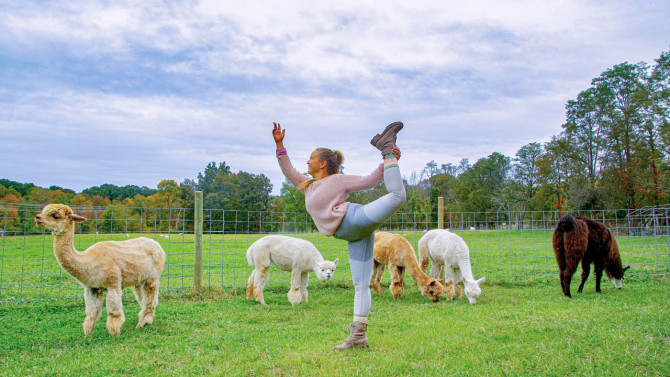
In addition to hikes, Clover Brooke Farm offers llama and alpaca yoga, soap and loofah making, crafts, farm tours and more.
“I really loved the basis of 4-H, with kids learning and doing and the families being involved as a community,” she said.
Parent-Tibbetts went on to serve in multiple volunteer leadership positions for CCE (including leader of the Llama and Alpaca Club and president of the 4-H advisory committee). In 2018, she participated in a CCE training for women farmers – based on a national curriculum and nonprofit called Annie’s Project – which gave her confidence as she expanded her farm.
“It really empowered me and made me feel like I could do anything I set my mind to. I know that sounds cliché, but I was a woman coming from a completely different career, in my 50s. It was intimidating,” she said.
Similarly, Steven Marion, a first-time farmer who bought a defunct farm in Broome County a year ago, said CCE helped him establish Farm in Broome. His agritourism business offers unique farm stays that allow visitors to disconnect from technology.
“CCE has been integral in getting things started, because I didn’t live in the area, and I had never farmed in my life,” said Marion, who started the farm to honor a dream he and his late husband shared. “They really helped me navigate where agritourism stands in the local environment and where I can fit in. Now so many people in the community are encouraged that something is being built here again, to see the life coming back into it.”
“Connector of people”
Agritourism is meeting a demand from the public as well, said Melaine Rottkamp, executive director of Destination Dutchess, a nonprofit that promotes tourism in the county. Rottkamp recounted a farm tour where a 70-year-old man, a visitor from New York City, lay on the ground and rolled down a grassy hill for the joy of it.
“People want to connect with the land, they want to connect with their food, they want a way to relax and have fun, and since COVID-19, they’re more focused on wellness,” she said. “We have properties that are finding ways to provide those kinds of experiences, which then help the farmers do the work they want to do.”
Rottkamp said in addition to traditional hayrides and pick-your-own fruits, farmers have been adding u-pick sunflower and lavender fields and even “luxury” farm stays. Marion said his farm offers people a way to reconnect with themselves and to heal.
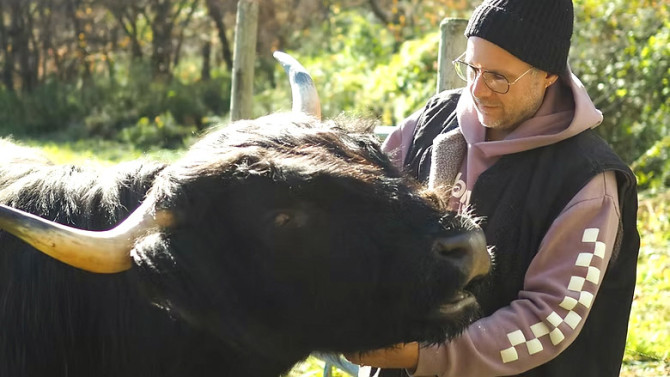
Steven Marion bought farmland in Broome County last year and is inviting guests for stays that help them disconnect from technology.
“A lot of us have lost our connection to experience, to where our food comes from or the sounds the trees make or how to skip a rock,” he said. “I want to use farming and this space as a place where people can reconnect and learn something new, where they can just exhale. It’s been healing for me as far as the process of trauma and loss, and I hear from a lot of people who are inspired by it and want to be a part of it.”
Inviting people onto the farm is not always easy, though.
“There are a lot of trials and tribulations,” Pashow said, “from working with your municipality to the liability of having people on your farm, and the fact that people are going to be on your property and in your space, maybe doing things you don’t want them to do.”
The network of business owners created by CCE helps. “We need that network to survive,” Marion said. “You need to be able to call on someone to help you do something or answer a question, and that community of understanding – it’s so important.”
CCE has become an essential part of the ecosystem surrounding agritourism, Rottkamp said, describing extension as “an incredible connector of people.”
“And we really need them to do that because we can’t do it all on our own,” she said. “CCE is looking out for the whole industry and guiding these new people coming in, to show them the opportunities and great careers to be had, to continue to build programming that stays up with the trends and shows people: You’re not going it alone.”