A new observatory is set to detect sources of cosmic rays, dark matter and other relics of the Big Bang in a few years’ time. Astrophysicists from the University of Würzburg are involved in the project.
The green light has been given for an ambitious astrophysics project: a new gamma-ray observatory is currently being built and is due to be completed by 2031 – with one site in the Earth’s northern hemisphere and one in the southern hemisphere. A German consortium comprising two Max Planck Institutes, a Helmholtz Centre and seven German universities, including the Julius-Maximilians-Universität Würzburg (JMU), is playing a key role in this project.
The gamma rays will be used to trace sources of cosmic radiation, dark matter and other relics of the Big Bang. The Federal Ministry of Research, Technology and Space (BMFTR) is providing the universities in the consortium with a total of 4.1 million euros in funding over the next three years.
Gamma rays are a veritable treasure trove for research into the universe. They are produced during high-energy cosmic processes, such as when massive stars explode, neutron stars collide with one another, or jets eject matter from around black holes.
66 telescopes with 125,000 light sensors
“Unlike electrons or protons, gamma rays are not deflected by magnetic fields. This means they tell us quite precisely in which direction the sources of cosmic energy can be found,” says Professor Stefan Funk from the Erlangen Centre for Astroparticle Physics (ECAP). When gamma rays strike the Earth’s atmosphere, they produce flashes of blue light lasting only a few billionths of a second; whilst these are invisible to the human eye, they can be detected by specialised sensors.
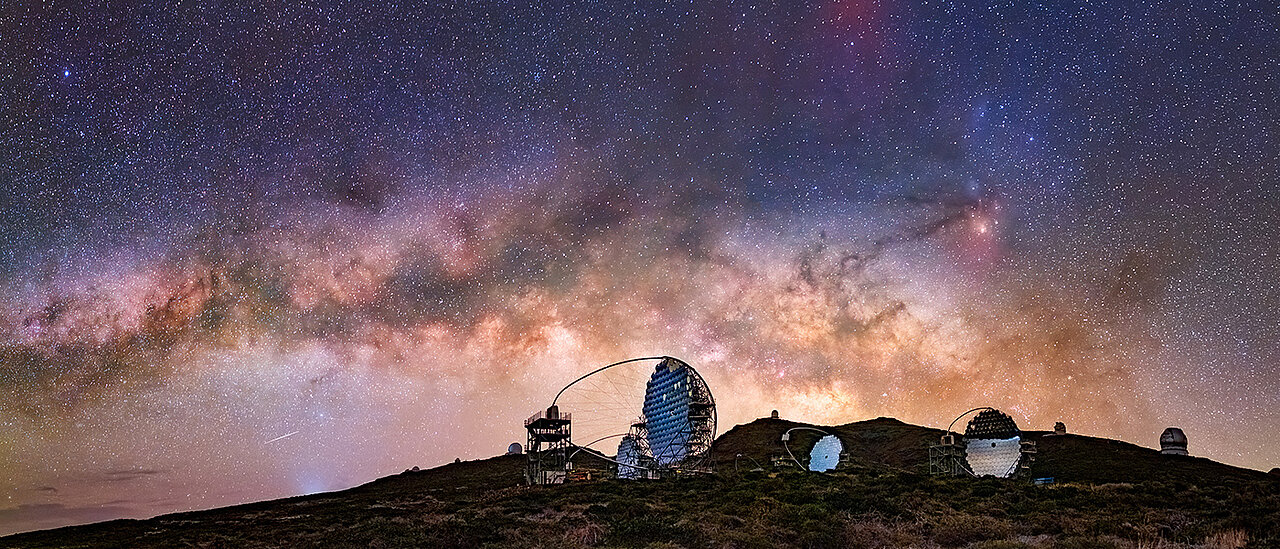
It is precisely for this purpose that a total of 66 telescopes will be erected over the next five years in the Atacama Desert in Chile and on the Canary Island of La Palma. Together, they will form the Cherenkov Telescope Array Observatory, or CTAO for short. It will be the world’s largest and most precise observatory for ground-based gamma-ray astronomy – ten times more sensitive than previous detectors. The telescopes, which vary in size, are equipped with a total of around 125,000 ultra-fast camera light sensors and monitor an area of approximately one million square metres.
German consortium plays a key role in the CTAO
A German consortium will play a key role in driving forward the construction and commissioning of the CTAO telescopes. To this end, the BMFTR is providing over four million euros over the next three years as part of the ‘Exploration of the Universe and Matter’ programme.
In addition to the University of Erlangen-Nuremberg, the consortium includes Humboldt University of Berlin, Dortmund Technical University, and the universities of Bochum, Potsdam, Tübingen and Würzburg. Also involved are the Max Planck Institutes for Nuclear Physics in Heidelberg and for Physics in Munich, and the German Electron Synchrotron (DESY) in Zeuthen, which is part of the Helmholtz Association.
“The project partners play a crucial role in many aspects of CTAO: they are testing components, developing software for detection and data analysis, and supporting the commissioning of the first telescopes,” explains consortium spokesperson Stefan Funk. “This ensures that the German university groups secure a strong position within the European CTAO consortium.”
Commissioning of the large-size telescopes
The largest types of telescope in the CTAO each have a mirror diameter of 23 metres. Four of them have already been erected on La Palma at an altitude of 2,400 metres above sea level. “This will enable us to detect gamma radiation from the vicinity of black holes in cosmologically distant galaxies and quasars,” explains Professor Karl Mannheim, holder of the Chair of Astronomy at the University of Würzburg.
As part of the new collaborative project, in addition to commissioning the telescopes, a system for monitoring their vibration behaviour is to be developed and installed, in order to detect any potential damage to the mounting or the supporting structure at an early stage. The Würzburg sub-project has a budget of 500,000 euros for three years for this purpose.
“When the telescope moves, vibrations are generated which, over time, cause operational damage to the telescope’s body and impair the accuracy of astronomical observations,” explains Mannheim. Sensors collect data on the vibration behaviour, which is analysed by the JMU team. “Our contribution to the work on the telescopes enables students to gain their first practical experience with the new observatory during the commissioning phase,” says Daniela Dorner, senior research associate at the JMU Chair of Astronomy.