Strict regulations have prevented continental U.S. beekeepers from participating in the lucrative organic honey market, but new research finds that bees’ actual habits make certain rules too extreme. The findings potentially provide evidence for federal agencies to ease restrictions and open organic markets to U.S. producers.
“Consumers are willing to pay 20 to 30% more for organic certified honey than nonorganic certified honey,” said Scott McArt, associate professor of entomology in the College of Agriculture and Life Sciences and a senior author of the new study, published July 29 in the journal Science of the Total Environment. “If organic honey was possible to produce in the continental U.S., it would open up a huge market for our country’s beekeepers, who are really struggling right now.”
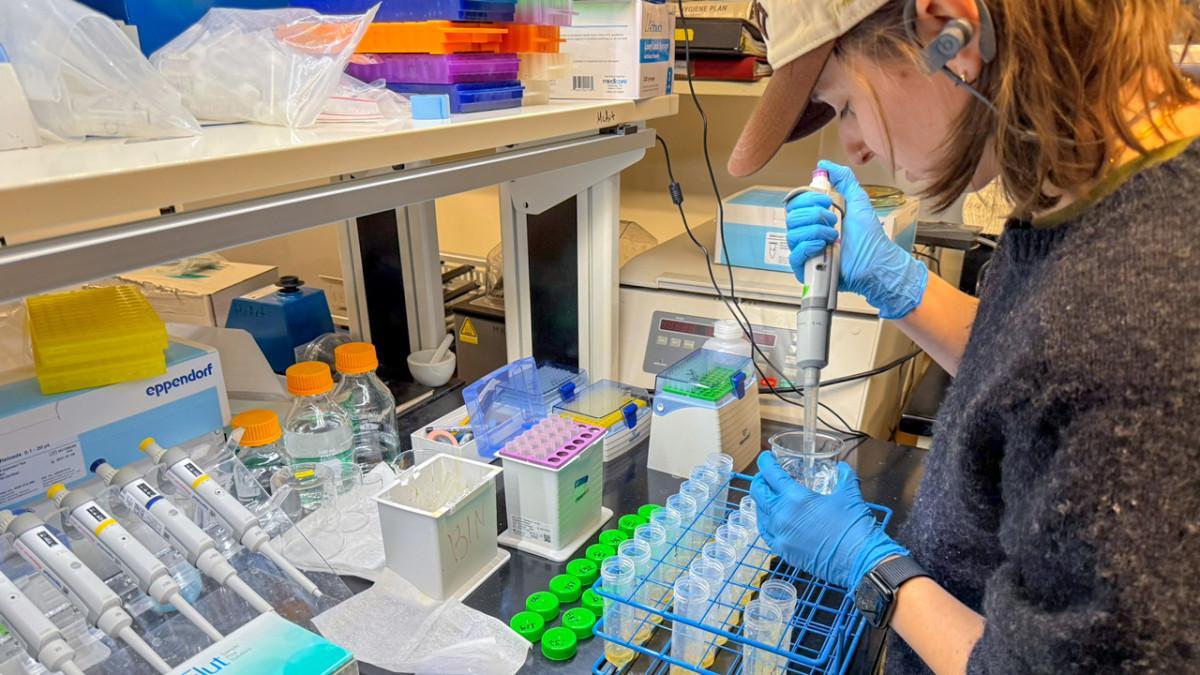
Study co-author Emily O’Neil, a technician in Scott McArt’s lab, extracts pesticides from honey samples for analysis in the Cornell Chemical Ecology Core Facility.
Current organic certification guidelines set by the U.S. Department of Agriculture require apiaries to have a 6.4 kilometer (close to 4 miles) buffer zone of organic-certified or natural land for bees to forage. Additionally, the Food and Drug Administration has set standards for pesticide contamination, called maximum residue limits, that U.S. organic honey products must meet.
It is very hard to find a 6.4 kilometer radius of fully organic-certified or natural land in the continental U.S., McArt said. The policy has effectively closed markets to the country’s beekeepers, except for three producers in Hawaii. As a result, the U.S. imports most organic honey from foreign countries, such as Brazil.
In the new study, the authors produced honey with pesticide contamination comparable to certified organic honey by applying organic colony management practices on farms where natural and semi-natural habitats dominated the surrounding landscape.
Furthermore, related work by the project team tracked bees from their hives to see how far they typically travel when they forage. They determined that the bees’ median foraging distance was closer to 750 meters, far less than the organic guidelines require.
“Our research shows that beekeepers in the Northeast U.S. may only need a small fraction of that land to produce honey with pesticide contamination as low as imported USDA organic honeys,” said Ben DeMoras ’22, M.S. ’25, the paper’s first author.
“One in five beekeepers already manage their hives with organic methods, so with revised organic standards, many could still benefit economically,” said DeMoras, who worked in McArt’s lab while conducting this research and who is currently a doctoral student at the Auburn University Bee Center in Auburn, Alabama.
Those existing organic methods require beekeepers to prevent devastating Varroa mites by treating their colonies with naturally occurring organic compounds – such as organic acids or concentrated hops from India Pale Ale beer – that don’t leave beeswax combs or honey with long-term chemical residues. Conventional colonies are commonly treated with the chemical insecticide amitraz to prevent Varroa mites, the most damaging honeybee pest and the main cause of colony collapse. U.S. beekeepers lost 56% of their colonies in 2024 and 39% last year due to colony deaths.
Chemical residues, often from amitraz, can get stored long term in honeycomb wax, which is the most energetically costly part of a hive for bees to produce, so beekeepers reuse them year after year. In order to follow organic processes, a hive’s wax combs must be built by bees in organic certified conditions, so they don’t contain chemical residues. In the study, DeMoras and colleagues began with empty boxes in 2023 and then added bees. By the following year, the bees had built new wax honeycombs and colonies began producing honey.
The team established 72 colonies using organic management practices on six large organic farms in the Northeast, to test whether organic farms in this region provided sufficient forage for organic honey production. Over a 3 kilometer radius, each colony was surrounded by land that was between 56% and 93% natural (such as forests or wetlands) or semi-natural (often fallow farm fields). In 2024, the team screened the honey the bees produced for 96 pesticide residues at the Cornell Chemical Ecology Core Facility and compared it with 20 store-bought brands of organic and conventional honey.
“When we looked at the pesticide residues in the honey produced from those colonies compared to the certified organic imports and certified organic Hawaiian honeys, they were low and comparable,” McArt said, with only one Northeastern sample exceeding maximum residue limits. Residue levels from conventional honeys were much higher.
“This study demonstrates that it is possible to produce clean honey that could meet the standards for USDA organic certification in the continental U.S., even though the apiaries were placed in relatively small organic farms,” said Margarita López-Uribe, Ph.D. ’14, associate professor of entomology at the Pennsylvania State University and a senior author of the study.
In next steps, the researchers hope to expand these tests to other parts of the country.
López-Uribe is principal investigator of a three-year, $1.5 million USDA Organic Agriculture Research and Extension Initiative grant that funded the project.