
In materials chemistry, identifying common parameters that can organize magnetic ground states across complex intermetallic compounds remains a central challenge. Several chemically tunable parameters have historically been employed in a wide range of compounds to control magnetic properties. One such parameter is the valence-electron concentration, commonly discussed as electron-per-atom (e/a) ratio. The e/a ratio has been widely used to classify magnetic ground states in metallic systems such as Heusler alloys and approximant crystals.
In gold (Au)-based Tsai-type approximant crystals, the e/a ratio has been found to control magnetic ground states, including long-range antiferromagnetic (AFM) and ferromagnetic (FM) orders, as well as the spin-glass state. Tsai-type compounds are generally described as multi-shell cluster-based structures, in which the moment-bearing rare-earth element occupies an icosahedral site (as illustrated in Fig. 1). The predictive power of e/a, however, is limited across different alloy families and constituent elements. Given the potential of quasicrystal-based intermetallics as platforms for exploring emergent magnetic phenomena, it is highly desirable to establish reliable and experimentally accessible parameters for identifying and guiding the development of their magnetic properties.
To address this gap, a research team led by Assistant Professor Farid Labib from the Research Institute for Science and Technology at Tokyo University of Science (TUS), Japan, and Associate Professor Kazuhiro Nawa from the Institute of Multidisciplinary Research for Advanced Materials, Tohoku University, Japan, along with Professor Ryuji Tamura from TUS, investigated the lattice parameter as a unified structural parameter associated with magnetic ground state selection in Tsai-type icosahedral compounds.
“Quasicrystals are among the most uniquely structured materials discovered to date and are expected to exhibit novel magnetic states and quantum phenomena not found in ordinary crystals,” explains Dr. Labib. “Until now, there has been no unified guideline for systematically exploring these novel phenomena in quasicrystals and their approximant crystals.” Their study will be published in the Journal of the American Chemical Society on September 30, 2026.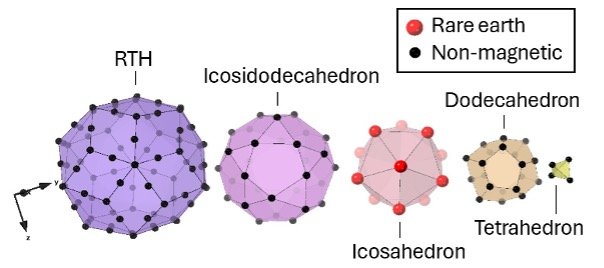
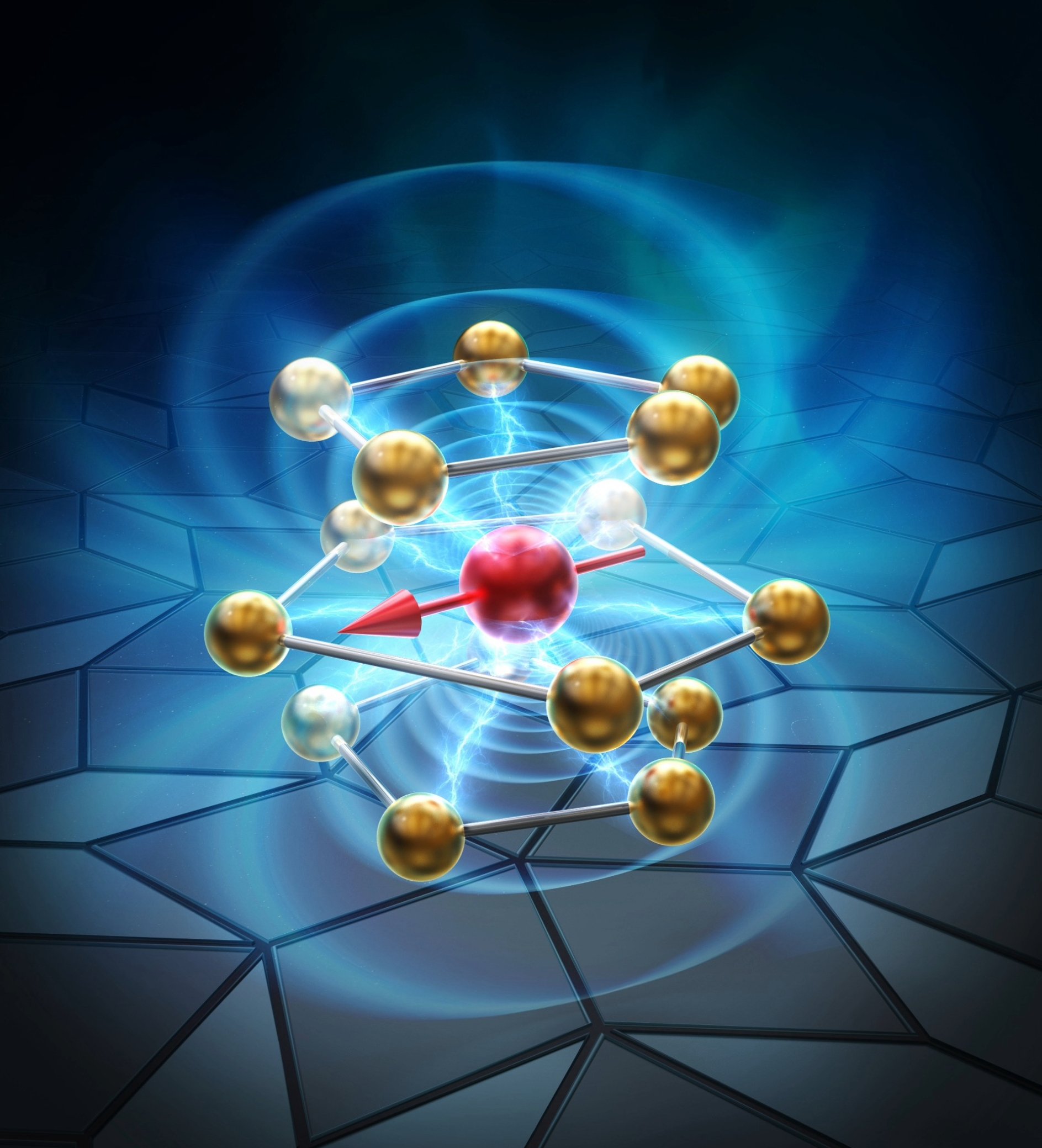
After synthesizing a family of Au-(Al/Ga)-based 1/1 approximant crystals containing the rare-earth elements terbium (Tb), dysprosium (Dy), and holmium (Ho), the researchers systematically investigated their structural and magnetic properties. They found a nearly monotonic inverse correlation between e/a and the lattice parameter (as demonstrated in Fig. 2). They also performed further experiments in non-Heisenberg Tsai-type compounds containing Tb, Dy, and Ho, and revealed characteristic whirling AFM and FM orders associated with strong uniaxial magnetic anisotropy. The crystal electric field generates strong magnetic anisotropy that favors specific orientations of the magnetic moments (Fig. 3).
Based on these experimental results, they revealed that the magnetic ground states could be organized with high accuracy according to the lattice parameter, whereas the conventional e/a classification exhibited systematic shifts depending on the rare-earth element and alloy composition. As shown in Fig. 2, the compounds exhibited a whirling AFM state at lattice parameters above approximately 14.72 Å, a whirling FM state between 14.62 and 14.72 Å, and a spin-glass state below approximately 14.62 Å. The well-defined threshold values separating the magnetic states establish the lattice parameter as a unified and experimentally accessible structural descriptor for predicting magnetic ground states and guiding the development of new materials.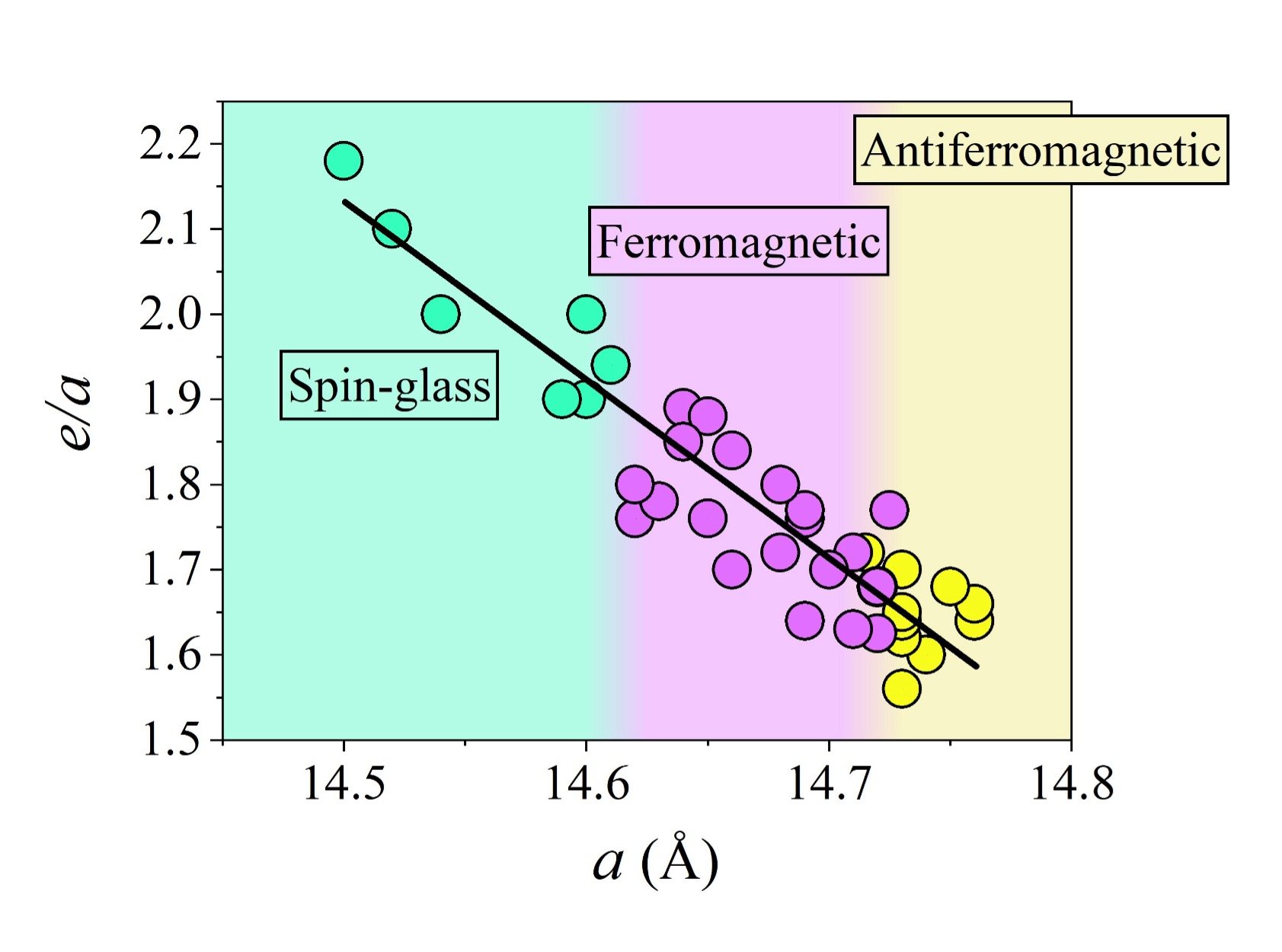
“The unified magnetic phase diagram constructed in this study can serve as a practical roadmap for systematic exploration of new magnetic quasicrystals and approximant crystals exhibiting novel magnetic orders and quantum phenomena,” remarks Dr. Nawa. “It can also provide a guideline for designing new magnetic materials with targeted magnetic ground states, opening new opportunities for discovering unconventional magnetism in quasiperiodic and complex intermetallic systems.”
Overall, this study establishes the lattice parameter as a unified structural descriptor for magnetic ground state selection in Tsai-type compounds, providing a practical framework for exploring and designing materials with novel magnetic properties. The findings indicate that structural length scales, alongside electron concentration, should be explicitly considered when understanding conduction-electron-mediated magnetic interactions in complex alloys.
- Publication Details:
Title: Lattice Parameter Governs Magnetic Ground State Selection in Tsai-Type Intermetallic Compounds
Authors: Farid Labib, Kazuhiro Nawa, Yusuke Nambu, Hiroyuki Takakura, Yoichi Ikeda, Kazuhiko Deguchi, Masato Matsuura, Asuka Ishikawa, Ryoichi Kajimoto, Kazuhiko Ikeuchi, Taku J. Sato, Ryuji Tamura
Journal: Journal of the American Chemical Society
DOI: 10.1021/jacs.6c05709


