Up to 75% of the world’s soils are degraded, threatening food production, biodiversity, climate regulation and human health and wellbeing.
Flinders University soil ecology and restoration experts warn that restoring degraded soils back to full ecological health can be a lengthy and difficult process.
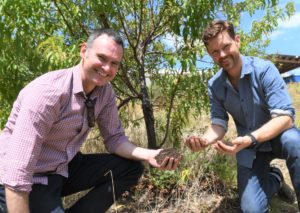
What appears above ground in native revegetation efforts does not automatically improve the complex web of fungi, other microbes and ecosystem components to restore soil health for long-term sustainable growth.
New research published in Molecular Ecology examines changes in soil fungal communities over a six-year interval – finding that different aspects of soil fungal communities may recover at different rates following restoration plantings.
Restoration of degraded landscapes usually focuses on vegetation which yields positive and measurable outcomes, but this may not translate to recovery across the whole ecosystem, says lead researcher Matthew Flinders Professor Martin Breed, from the Restoration Ecology research group.
“Ecologically degraded sites need ongoing monitoring and management to check for the long-term recovery of the whole community of fungi and other important soil properties,” says Professor Breed, from the College of Science and Engineering.
“Our longitudinal resampling study identified changes consistent with continued functional recovery over six years, despite little additional progress in whole fungal community recovery.
“This could be attributed to the land-use history and elevated soil nutrient levels in the post-agricultural sites, which can act as a barrier to full fungal and microbial recovery.”
Future studies could look at different restoration approaches and ecosystems to assess barriers and solutions.
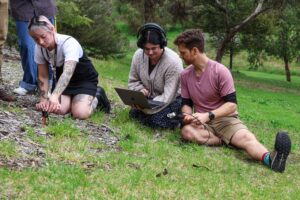
Monitoring soil and leaf-litter biodiversity remains a major barrier to tracking restoration success, particularly for invertebrates that underpin key processes such as nutrient cycling and soil aggregation.
In another recent article, published in Biology Letters, Flinders University researchers used a form of soil eco-acoustics to measure invertebrate activity in soil profiles, in order to assess soil and ecosystem health.
Soil invertebrates play an important role in overall soil health, contributing to nutrient cycling, soil aggregation and influencing plant health and food web dynamics.
Corresponding author Flinders University PhD candidate Amy Annells says the low-cost, sound-attenuated recording system was able to identify distinct acoustic signatures from the movements of six common surface-dwelling insects, including house cricket, red wiggler worm, mealworm and huntsman spider.
The latest article – ‘Restoration plantings promote functional recovery of soil fungi’ (2026) by Carl D Watson, Alfie J Lem, Andrew Bissett (CSIRO Hobart), Christian Cando-Dumancela, Michael G Gardner, Riley J Hodgson, Craig Liddicoat, Shawn D Peddle and Martin F Breed – has been published in Molecular Ecology DOI: 10.1111/mec.70552.
Soil restoration is a core part of the goals of the 2025-2034 Decade of Soil Sciences for Sustainable Development, a UN-endorsed strategic initiative highlighting soil’s critical role in achieving sustainable global development.
Acknowledgements: This work was supported by funding from the Australian Research Council (LP240100073), the New Zealand Ministry of Business Innovation and Employment (UOWX2101) and the Australian Government under the National Environmental Science Program’s Resilient Landscapes Hub. We acknowledge the contribution of Australian Microbiome, Parks Australia, the CSIRO and the Biomes of Australian Soil Environments (BASE) consortium.
‘Connected Restoration, Inspired Action’ is the theme of the Society for Ecological Restoration Australasia (SERA) conference in Adelaide this month (19-21 October 2026).
Flinders University presenters include Professor Martin Breed (‘Effective restoration via improved harnessing of soil biodiversity’), ‘Smart restoration under global change’ (Dr Irene Martin-Fores and Dr Sofie Costin) and Dr Kate Matthews, Dr Shawn Peddle, Dr Riley Hodgson, Alex Taylor, Amy Annells, Nicole Rickling and Dr Jake Robinson from the Grounded Minds Consortium.
Conference speakers also include experts from the Australasian Coastal Restoration Network (ACRN) and the Cooperative Research Centre for Transformations in Mining Economies (CRC TiME).