- More than 1,100 young people aged 14-25 from 14 Asia-Pacific countries participated in the Youth Leaders for World Tsunami Awareness Day 2026 Online Course, which ran from 1 to 30 September 2026.
- Through four self-paced modules and three live webinars, participants explored disaster risk reduction, community resilience and youth leadership.
- About 100 participants also completed three interactive evacuation-planning sessions connected to the High School Students Summit on “World Tsunami Awareness Day” 2026 in Iwate.
- The course is funded by the Government and People of Japan.
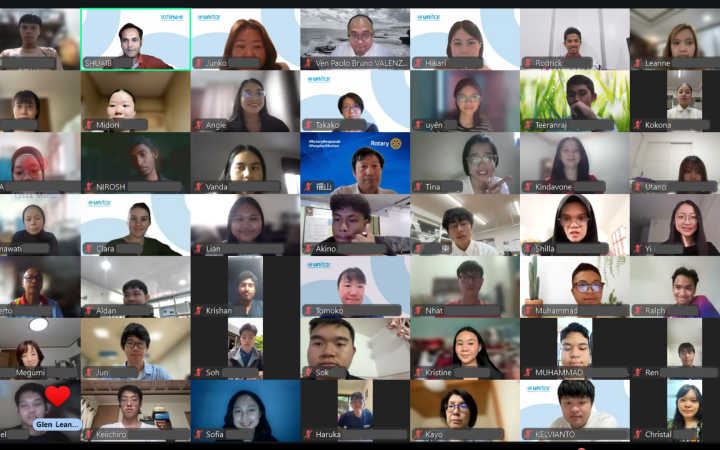
2 November, Hiroshima, Japan – As the world prepares to mark World Tsunami Awareness Day on 5 November, over 1,100 young people aged 14 to 25 participated in a month of learning on disaster risk reduction, community resilience and youth leadership. The online course, Youth Leaders for World Tsunami Awareness Day 2026 Online Course, ran from 1 to 30 September 2026 and was organized by the United Nations Institute for Training and Research (UNITAR) and funded by the Government and People of Japan.
Participants came from Brunei Darussalam, Cambodia, China, Fiji, the Federated States of Micronesia, Indonesia, Japan, Lao PDR, Malaysia, the Philippines, the Republic of Korea, Singapore, Thailand and Viet Nam.
About 100 of them also took part in a high school students summit in Iwate, Japan, in October.
Four modules, from Japan’s lessons to personal preparedness
In the online course, participants worked through four self-paced modules on the UNITAR Learning Platform, totalling around 8 to 10 hours of learning. The first module explained why hazards are natural but disasters are not and introduced the disaster risk formula and the Sendai Framework for Disaster Risk Reduction. The second drew on Japan’s experience, including the decisions made at schools on the day of the 2011 Great East Japan Earthquake and Tsunami and how the three principles of tsunami evacuation saved many lives in Iwate, which was devastated by the 2011 tsunami.
The Three Principles of Tsunami Evacuation
- Do not stick to assumptions. Hazard maps predicting the extent of tsunami flooding are only estimations.
- Do your best in the situation you are in. To protect your own life, do the best you can do at that time.
- Take initiative and evacuate: Evacuate first and foremost, no matter what those around you are doing.
Source: Kamaishi City, Iwate Prefecture
The third looked at disasters across the Asia-Pacific, how early warning systems work and how a changing climate affects risk. The final module focused on leaving no one behind, community-based disaster risk reduction and Building Back Better, and ended with practical steps such as preparing a personal Go Bag with essentials that one could simply grab and go in an emergency.
Three webinars with experts from Asia, the Pacific and the UN
The course also included three live webinars, with guest speakers and Q&A sessions
- Webinar 1, Welcome and Asia Case Study: After welcome remarks from Ms. Chisa Mikami (Head of the UNITAR Hiroshima Office), Dr. Ven Paolo Valenzuela (Research Fellow, Singapore Management University) explained why coastal hazards matter as Asian cities along the coast keep growing, and how young people can help prepare for and respond to emergencies, from volunteer networks to digital mapping.
- Webinar 2, Pacific Case Study: Dr. Richard Crichton (Lecturer and Theme Manager for Hazards, Risks and Resilience, University of the South Pacific) presented the hazards facing Pacific island communities, from tropical cyclones to earthquakes, tsunamis and volcanic eruptions along the Pacific Ring of Fire.
- Webinar 3, Global Priorities in Disaster Risk Reduction: Ms. Yuki Matsuoka (Head, United Nations Office for Disaster Risk Reduction [UNDRR] Kobe Office) presented the global disaster risk reduction agenda and the Sendai Framework for Disaster Risk Reduction 2015-2030, including its four priorities for action and seven global targets.
Participants said the course helped them gained confidence and strengthened their intention to share preparedness knowledge in their work and communities.
[The course] helped me learn new things, gain confidence, and better understand the importance of working with people from different backgrounds.” Zhai Ahn Mae M. Joaquin (Philippines).
[The course] has inspired me to [be] more proactive in sharing knowledge and promoting preparedness so that communities can better understand and reduce disaster risks.” Maryda Kheng (Cambodia)
From the online course to the Summit in Iwate
About 100 of the online course participants also prepared to take part in the 2026 High School Students Summit on “World Tsunami Awareness Day” in Iwate (20-22 October 2026). Applying what they learned in the online course, the participants worked in teams to compare evacuation and temporary shelter options for a coastal school facing tsunami, typhoon and storm-surge risks, weighing factors such as elevation, walking time and the expected duration of displacement. They also considered hazards and evacuation arrangements in their own schools and communities.
At the Summit, the participants joined further discussions and vowed to continue as disaster risk reduction leaders. Held annually since 2016, the Summit serves as a platform for high school students around the world to learn about the threat of tsunamis, disaster risk reduction and preparedness. The 2026 Summit was co-organized by Iwate Prefecture, the Iwate Prefecture Board of Education, UNITAR Hiroshima Office, UNDRR Kobe Office and the Ministry of Foreign Affairs of Japan.
About the Youth Leaders for World Tsunami Awareness Day 2026 Online Course
The Youth Leaders for World Tsunami Awareness Day 2026 Online Course was a four-week online programme offered by UNITAR for young people aged 14 to 25 across the Asia-Pacific region. It aimed to equip young leaders with foundational knowledge of disaster risk reduction and to introduce real-world examples of preparedness, resilience and recovery from Japan and the Asia-Pacific. The programme was offered free of charge thanks to the generous support of the Government and People of Japan.
Programme page link: https://unitar.org/hiroshima/our-portfolio/youth-leaders-world-tsunami-awareness-day-2026
Social Media Launch Post: https://www.facebook.com/photo/?fbid=1473514621467930&set=a.618826563603411
Programme Flyer: Youth Leaders for World Tsunami Awareness Day 2026 Online Course
Programme Flyer: Youth Leaders for World Tsunami Awareness Day 2026 Online Course