A former professional powerlifter who survived five strokes is urging Aussie blokes to learn the signs, before it’s too late.
Now, on the ten-year anniversary of his strokes, Nathan is aiming to improve men’s awareness of the key signs of stroke, lending his weight to the Stroke Foundation campaign, Bloke Beside You, running throughout Men’s Health Week (June 15 – 21).
Nathan Baxter was at the peak of his career in 2016, fresh off a Commonwealth record and chasing world championship glory, when everything changed overnight.
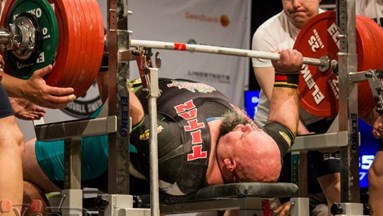
“What I didn’t realise is that I’d been in active heart failure through two world championships,” Nathan said.
“I would visit my GP, but doctors would often put my niggling chest pain down to the fact that I was a 175kg man benching 750 pounds.”
At 39 years old, Nathan had undiagnosed atrial fibrillation – an irregular heartbeat that increased his risk of stroke five-fold. Atrial fibrillation occurs when the heart cannot beat properly, allowing blood to pool within its upper chambers. If one of those clots breaks free, it can travel up to the brain, interrupt regular blood supply and cause a stroke. Atrial fibrillation is treatable, and is one of common risk factors for stroke, which also include high blood pressure, elevated cholesterol, diabetes, unhealthy diet, physical inactivity, excess alcohol intake and smoking.
“I woke up one morning around 4am and didn’t feel good. I woke my wife up and tried to communicate but my words were slurred,” Nathan said.
“She asked me to lift both arms, but I had weakness on one side, she said the side of my face was like a melted candle,” he said.
“My wife called an ambulance, which arrived quickly and I was at hospital in 8 minutes where I was officially diagnosed with having five simultaneous strokes.”
It was a long and lengthy road to recovery, and at times, Nathan feared he would never return to the sport he once loved. Instead, he rebuilt his life with a new purpose.
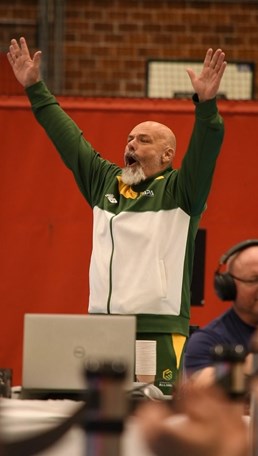
As part of his rehabilitation, Nathan studied neuroscience and now works as a neurological performance consultant. He has also served as an Australian national team coach.
Stroke is the fifth leading cause of death for Australian men, costing over 4,000 lives and over 27,000 years of potential life lost every year.
Data shows that across most age groups, men are nearly 1.5 times more likely to experience a stroke than women, yet around 2 in 5 Aussie men (37 percent) fail to recognise any of the F.A.S.T. common signs of stroke. Similarly concerning, 1 in 3 (30 percent) do not know that stroke is a medical emergency where an ambulance triple zero (000) call must be made immediately to seek medical help. These awareness gaps are costing lives.
F.A.S.T. highlights three of the common stroke signs: Facial droop, the inability to lift both Arms, and Slurred speech. The T is a reminder that medical treatment for stroke is time critical. Without it, thousands of Australians die each year or are left with permanent physical and cognitive disabilities.
Stroke Foundation Chief Executive Officer, Dr Lisa Murphy said Nathan’s story highlights the fact that stroke does not discriminate.
“The data is confronting. Someone in Australia experiences a stroke every 11 minutes, yet 2 in 5 Aussie men are unaware of what a stroke looks like, and 1 in 3 don’t know to call triple 000 in the event of a stroke. Stroke can strike at any age, and we know that the faster people access treatment, the more likely they are to prevent death and disability,” Dr Murphy said.
“We’re asking all Australians to look out for the Bloke Beside You. Your mate, your dad, your brother, your colleague and start a conversation about stroke.”
“Stroke doesn’t care how strong you are. Knowing the signs is your real power. Learn the F.A.S.T. message, it may just save a life.”