How does a cell know it’s infected? This essential question is at the heart of how we understand viral infections and inflammation.
New research led by Hudson Institute of Medical Research has discovered how a cell knows it is infected with a virus in order to protect itself and surrounding cells, or to induce inflammation.
The discovery, published in Nature Immunology and led by Dr Natália Sampaio, turns our understanding of how inflammation begins at a cellular level on its head.
Dr Sampaio and an international team of researchers focussed on a sensor called MDA5, which is produced by every cell and triggers an inflammatory response when it detects double-stranded RNA (dsRNA). She explains that dsRNA is an abnormal molecule typically absent in healthy cells but which appears during viral infection.
“For two decades, scientists have assumed that this dsRNA originated directly from the invading virus,” she said. “However, we discovered that the source is actually the host cell itself.”
Re-writing scientific dogma to understand infection and inflammation
“When a virus hijacks a cell and transforms it into a virus-making factory, the host’s internal balance is severely disrupted. This cellular stress causes the host cell’s own RNA to be improperly processed, generating the aberrant double-stranded form.
“This host-derived dsRNA then binds to MDA5, triggering an inflammatory response that alerts neighbouring cells to control the infection.”
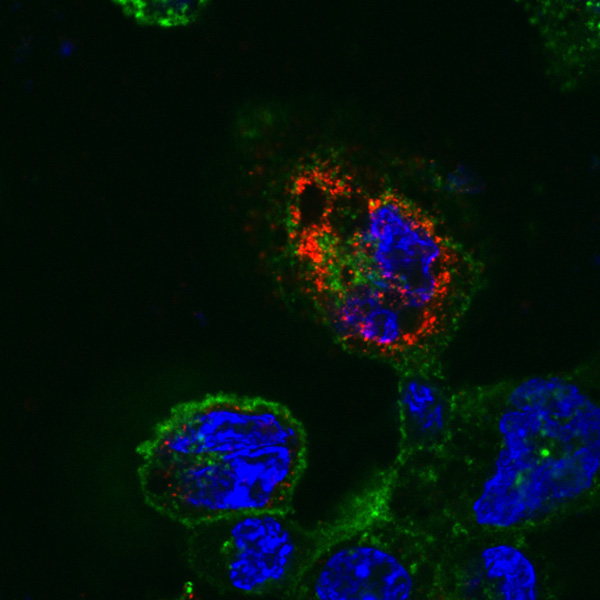
“Ultimately, we found that ‘the call is coming from inside the house’, ” Dr Sampaio said. “Rather than detecting a foreign viral component, MDA5 senses an internal cellular crisis triggered by the infection, questioning 20 years of dogma in the field.”
These findings give medical professionals a much deeper understanding of the systems our cells use to identify infection.
“This first line of defence against viruses is critically important, in particular when the body encounters entirely novel viruses, like what happened in the SARS-CoV-2 pandemic,” Dr Sampaio said.
“In fact, we and others previously showed that MDA5 is the critical sensor of SARS-CoV-2.”
How infection leads to inflammation
This research started while Dr Sampaio was at the University of Oxford working with renowned innate immunity expert Prof Jan Rehwinkel. It reveals that viruses, including SARS-CoV-2, cause massive imbalances to the host cell’s RNA, and this is what MDA5 detects.
“Importantly, we are now understanding that imbalances in RNA can happen in other scenarios, including in rare genetic diseases, neurological conditions, and during cancer treatments.”
“The highly specialised methods we developed in this work can now be applied to understand MDA5 activation and resulting inflammation in many other disease scenarios beyond viral infection,” she said.
Implications for inflammatory diseases

Head of Hudson Institute’s Regulation of Interferon and Innate Signalling research group, Professor Paul Hertzog, says MDA5 was thought to recognise viral RNA but this study found it recognised cellular RNA which, instead of being shielded, is exposed due to virus-induced damage, and can then bind MDA5.
Prof Hertzog believes this research has far-reaching implications: “It provides a mechanistic link with other inflammatory diseases where similar damage can be caused, like in cancer treatments. It also explains how rare mutations in MDA5 can drive autoimmune disease through inappropriate production of proinflammatory cytokines like interferons and interleukins.”
Dr Sampaio agrees, saying the team was surprised with the findings.
“We now better understand how MDA5 is essential for protection from viruses, but can also cause unwanted inflammation leading to serious conditions like hypercytokinemia (cytokine storm) and inflammatory diseases such as systemic lupus erythematosus, and Aicardi-Goutières syndrome,” she said.