What do universities and wine have in common? This question is being explored by geographers at the University of Würzburg. Nine university wines were presented at the Staatlicher Hofkeller, with the help of regional wine royalty.
There are 54 higher education institutions located across Germany’s 13 wine-growing regions. This is what Dr. Rebekka Kanesu has discovered. A researcher at the Chair of Economic Geography at Julius-Maximilians-Universität Würzburg (JMU), she studies, among other things, the role of product royalty – such as beer queens and wine princes – in marketing agricultural products.
Together with Professor Matthias Naumann from the Chair of Human Geography, she has launched the research project “University and Wine: Partnerships between Winegrowers and Higher Education Institutions in Germany”. JMU has had its own university wine bottled for several years, in cooperation with the Staatlicher Hofkeller since 2024.
Their research revealed that Würzburg’s university wine is far from unique. So far, the researchers have identified eight other university wines from six wine-growing regions across Germany.
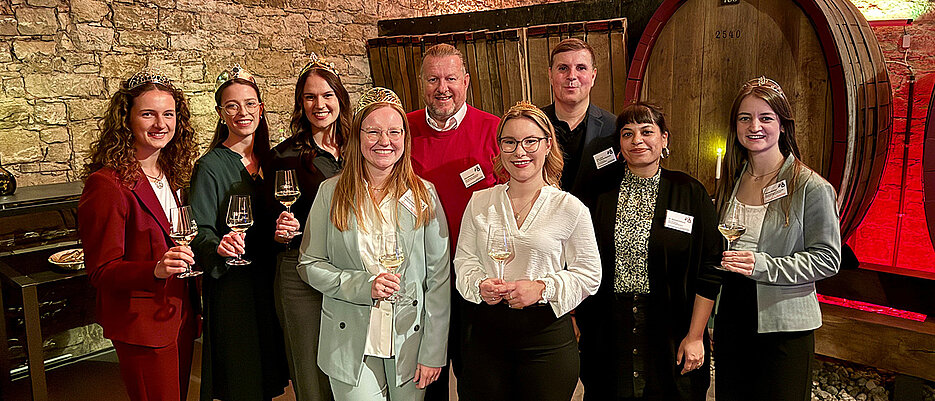
On 4 November, all nine wines were available for tasting in the historic cellars of the Staatlicher Hofkeller beneath the Würzburg Residence, presented by wine royalty from the respective regions.
A multifaceted relationship
Both winegrowing and universities have a long history – and their paths have crossed repeatedly over the centuries. Universities once owned agricultural land, sometimes including vineyards. Revenue from wine sales was used, for example, to fund staff positions, and professors’ salaries were sometimes linked to wine sales.
Today, universities regard their wines as prestigious products that make high-quality gifts. Working with local wineries demonstrates a connection to the region and strengthens the university’s identity. For wineries, meanwhile, producing a university wine offers potential access to new target groups.
At some institutions, wine is also a subject of teaching and research. In times of climate change, for example, there is a growing need to identify or breed grape varieties that are particularly resistant to pests or heat.
Through their research project, Rebekka Kanesu and Matthias Naumann aim to explore these connections, focusing in particular on regional differences between university wines.
Presentations throughout the evening
In the impressive cellars beneath the Würzburg Residence, Kanesu and Naumann presented their project to invited guests. Klaus Baumann, Vice-Chancellor of JMU, spoke about the more recent history of Würzburg’s university wine. Thilo Heuft, Director of the Staatlicher Hofkeller winery, offered insights from a producer’s perspective, while climatology expert Professor Heiko Paeth outlined the particular challenges that climate change poses for winegrowing.
Professor Jonas Müller, Programme Director of the Bachelor’s degree programme in Culinary Arts and Wine Tourism at the Technical University of Applied Sciences Würzburg-Schweinfurt, also introduced his former workplace, Weincampus Neustadt, a research and teaching institution jointly run by the universities of Ludwigshafen, Bingen, and Kaiserslautern.
From off-dry Trier wine to sparkling Heilbronn wine
The highlight of the evening was, of course, the tasting of the nine university wines. These came from Baden-Wuerttemberg Cooperative State University Heilbronn, JMU, the University of Hohenheim, Weincampus Neustadt, the University of Kaiserslautern-Landau (RPTU), Trier University, the University of Freiburg, Heilbronn University of Applied Sciences, and Geisenheim University.
All the wines were presented by wine royalty from Württemberg, Franconia, the Palatinate, the Moselle, Baden, and the Rheingau. The aim was explicitly not to crown the finest wine. Instead, the focus was on the regional characteristics of the wines and the exchange of ideas among guests.