For most of her life, Gemma thought the clatter in her head was normal.
“I have a lot of noise in my head. It’s pretty constant,” she says. Like many women, the Faculty of Arts Strategic Projects Manager received a late-in-life diagnosis of Attention Deficit Hyperactive Disorder (ADHD).
Looking back, the signs were there: report cards that praised her intelligence but urged her to “just focus”, a tendency to leave tasks until the last minute, and a lifelong habit of creating detailed systems and spreadsheets to keep.
In the 1990s, ADHD was less understood, and many girls like Gemma slipped through the cracks.
“Back then, if you couldn’t focus in school, you were labelled disruptive; especially if you were considered smart enough, no teacher asked if you needed help. And I needed help,” she says.
The road to a diagnosis
Throughout her life, Gemma built many coping mechanisms and systems to keep things functioning – but after the mental and physical toll of parenthood, all those systems came crashing down.
It wasn’t until she became a parent that everything began to fall into place. After her infant son’s own multiple diagnoses began rolling in, the subsequent exposure to allied health, medical specialists and other parent-carers compelled Gemma to pursue a diagnosis of her own.
“My ADHD diagnosis wasn’t a shock, but it gave me the words to describe what I had experienced for so long. I felt like I could forgive myself for things that never actually needed forgiving,” she says. “That clarity is important. if I don’t understand how I’m wired and create sustainable systems, I’ll drown.”
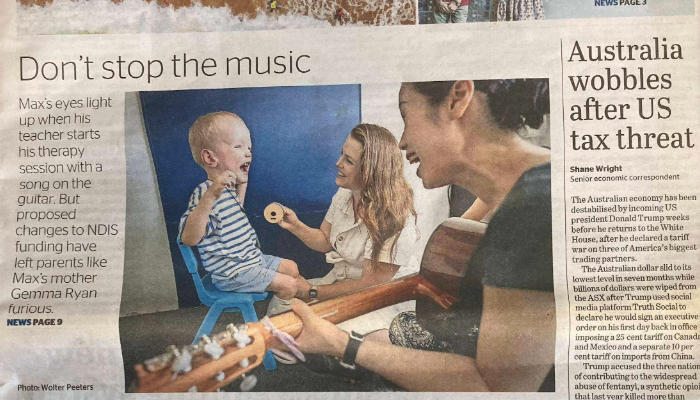 Gemma with her son Max on the cover of The Sydney Morning Herald following the announcement of NDIS cuts in late 2024.
Gemma and her husband Tim are now raising two young children – a juggle for any working parent – while their son Max has two rare genetic conditions, resulting in high support needs.
As a mother, a priority for Gemma is supporting Max’s life to be more than just his medical charts. “My kids both deserve to be known for who they are, to thrive, be curious, be happy – even if it takes more than I ever thought I’d have in me,” she says.
Despite the challenges, Gemma has found a lot of meaning in her journey. The experience has transformed the way she understands herself, her work, and the world around her.
Embedding inclusion from the start
Last year, when planning Faculty of Arts engagement events such as the flagship Arts After Dark series, Gemma decided to leverage everything she has learned to take bold new steps to advance inclusion at Macquarie events.
Drawing on her lived experience with her son, the expertise of the Macquarie Neurodiversity Community of Practice (MQND CoP), allied health professionals and industry best practice, she began introducing initiatives like low-sensory networking sessions, dedicated quiet spaces, tailored accessibility guides, sensory resources, and direct communication channels for attendees with specific needs.
The response from the MQ community was overwhelmingly positive.
Attendees shared their appreciation not just for being considered from the outset, but for showing what was not only possible, but incredibly achievable. According to one attendee, Gemma’s inclusion efforts have been invaluable in growing her capability to advocate for herself in the future.
“I’ve never advocated for low sensory options for myself or asked for any adjustments… When asked what more could be done, I genuinely didn’t know how to answer because I’ve personally never seen it modelled well before,” the attendee said.
“I almost didn’t make it to the event tonight. But I am so glad I did because for the first time, I felt like I actually belonged in a professional’ setting… it was a window into a different way of doing things that I didn’t know was ever an option for me.”
This feedback gave Gemma hope that the efforts she has made for her own family have been just as valuable and inspired her to keep learning and improving.
We need to start asking the right questions
Gemma is now refining and sharing resources within the MQND CoP and with fellow engagement colleagues across the university, so others can continue to implement and refine her approaches.
“So many times I have heard, ‘We’ll check if there’s a need for that’ or ‘Do we think it’s worth doing that?’ To that I say, look around – if you’re only asking the people already in the room, but the room wasn’t designed and built to accommodate the people with the need, then they can’t even get in let alone share what they need. We have got to stop asking the wrong questions.”
Her approach reflects a broader belief that meaningful inclusion is often less complicated than people imagine.
“Listen to those with lived experience and inclusion professionals. Once there’s a framework in place, it doesn’t take much to refine and reuse it,” she says. “So many things that make a positive difference cost us nothing, and the things that do need investment are worth the cost”
“People deserve to know they are safe here, and that they can thrive. Because when people are understood, supported and included on our campus and in our environment, everyone benefits.”
“I was always on the right path”
Through her ADHD experience, Gemma now sees her need to become a data master and project manager in a whole new light – where once her extensive planning and documenting capabilities were built to support her own career and personal life, she now finds them essential to her parent-carer journey. “You wouldn’t believe the hacks I’ve built for myself,” she laughs.
“Everything has led me to this point. If my path hadn’t brought me exactly here, I would not be able to do what I do for my child”, she says. “It feels like, actually I wasn’t wasting time all those years, when I felt like I wasn’t living up to my potential. I was always on the right path.”
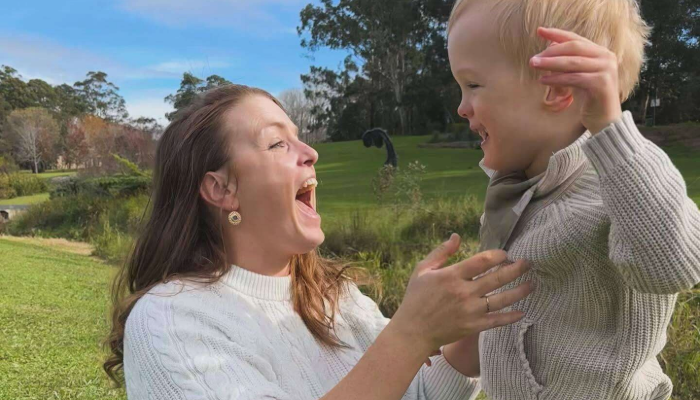
Gemma and her son Max play by the lake at Macquarie’s Wallumattagal campus
Today, Gemma speaks openly about both her ADHD and her experiences as a parent-carer, having seen firsthand the power of transparency and connection in advancing a more inclusive campus and environment at Macquarie.
“People deserve to know they are safe and they can thrive here. Because when people are understood, supported and included on our campus and in our environment, everyone benefits.”
More than 80 per cent of all disabilities are not visible. Invisible Disabilities Week runs from 18-24 October and focuses on chronic, sensory, neurological, and mental health conditions that are not immediately obvious.