A strategy encompassing simultaneous coprecipitation and oxidation has allowed the synthesis of highly oxidized amorphous precursors for BiNi1-xFexO3. This approach overcomes conventional challenges by reducing environmental impact, improving safety, and reducing synthesis time by generating a highly oxidized amorphous precursor, allowing
Cleaner Synthesis of High-Valent Perovskite Oxides
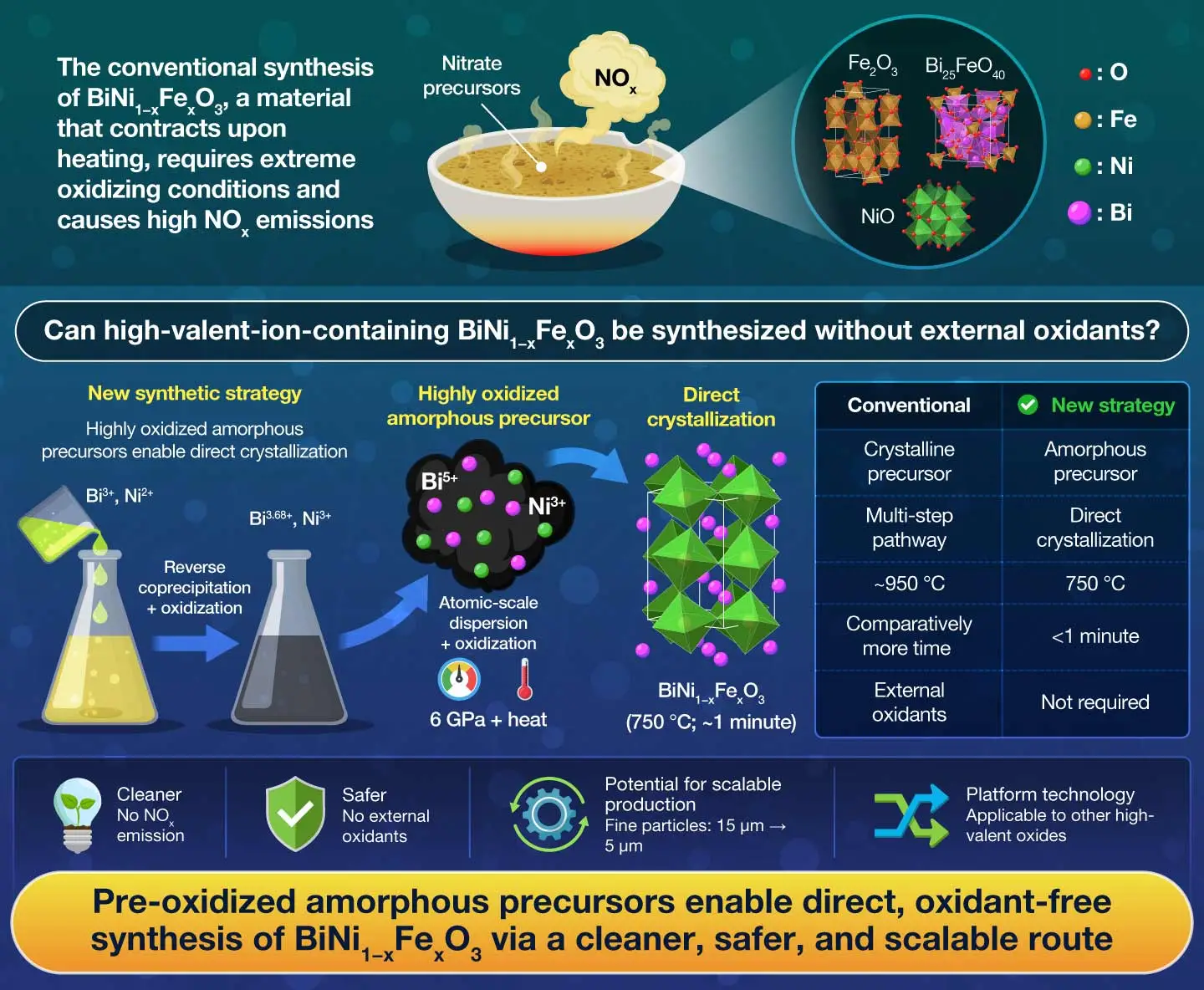
Among many of the modern technologies that shape modern life, functional oxide materials are found in almost everything, from advanced electronics to energy-efficient systems. The functional oxides with high-valent metal ions are a significant topic of interest due to their unusual properties, such as superconductivity, magnetics, ferroelectricity, and negative thermal expansion (NTE). However, manufacturing these materials often requires harsh chemical conditions that raise safety concerns and produce environmentally harmful byproducts.
Researchers have been searching for cleaner and more efficient ways to produce these products for many years. Traditional methods involve strong oxidizing agents and complex processing steps to stabilize high-valent metal ions, along with the safety hazards that pose risks during large-scale production. These challenges have limited the practical manufacturing of many promising functional oxides.
In an effort to counter these challenges, a research team led by Specially Appointed Assistant Professor Takumi Nishikubo from Institute of Science Tokyo (Science Tokyo) and the Kanagawa Institute of Industrial Science and Technology, together with Professor Kenneth R. Poeppelmeier of Northwestern University and Professor Masaki Azuma of Science Tokyo and the Kanagawa Institute of Industrial Science and Technology, has developed a new strategy. Their study, published in the Journal of the American Chemical Society on June 18, 2026, presents a safe and environmentally friendly route for producing BiNi1-xFexO3, a material exhibiting NTE, a rare property in which a material contracts when heated instead of expanding. Their findings could also be adapted to a much broader range of advanced oxide materials.
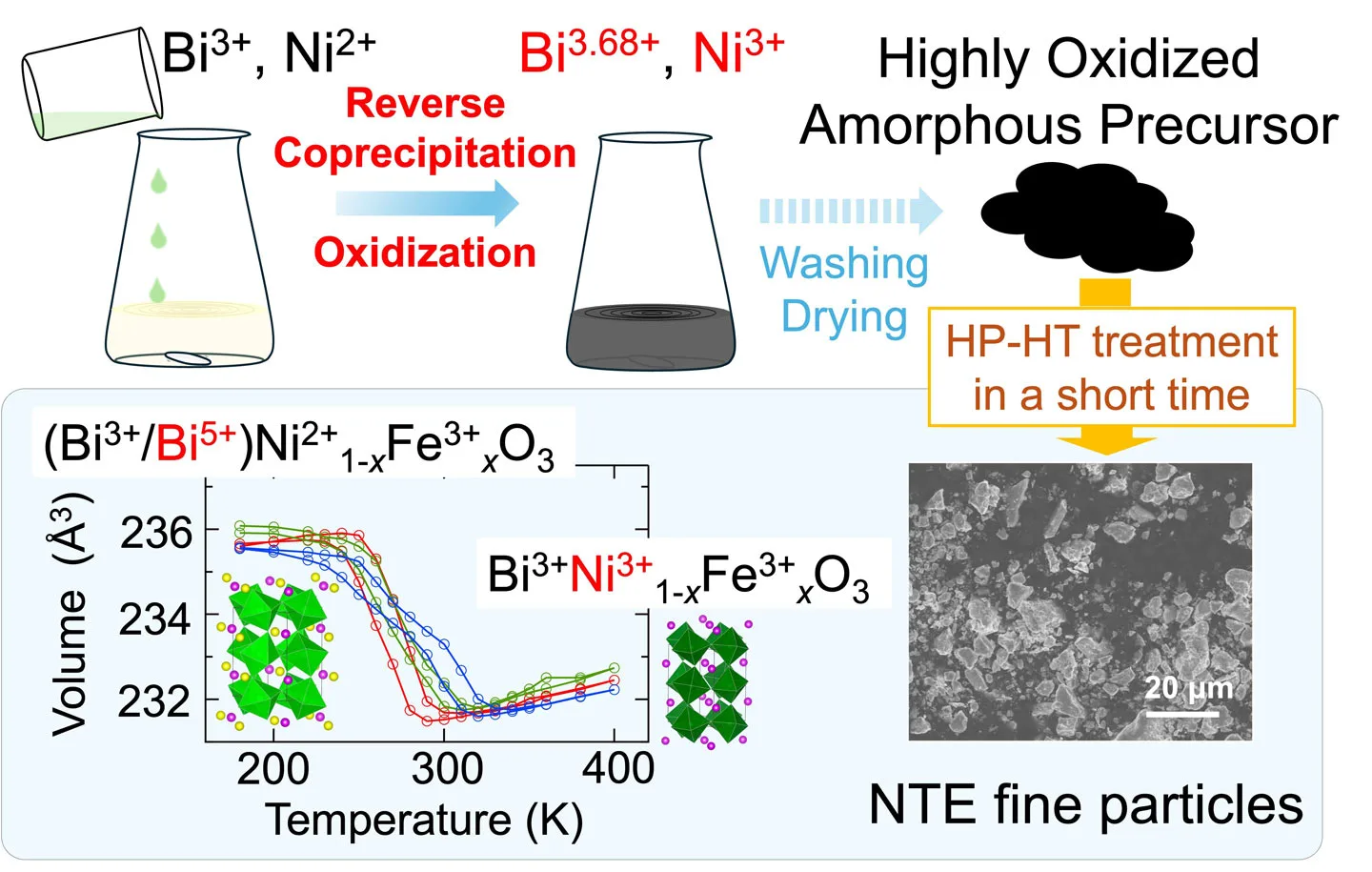
The researchers developed a process that combines reverse coprecipitation with oxidation in a single step. By introducing a metal nitrate solution into an alkaline sodium hypochlorite solution, a highly oxidized amorphous precursor containing high-valent ions, such as Bi5+ and Ni3+, was achieved. The resulting precursor exhibited excellent elemental dispersion, making it an effective starting material for synthesizing the target oxide. Nishikubo says, “This process eliminates the need for oxidizing agents and avoids the emission of NOx gases, making the synthesis significantly safer and cleaner.”
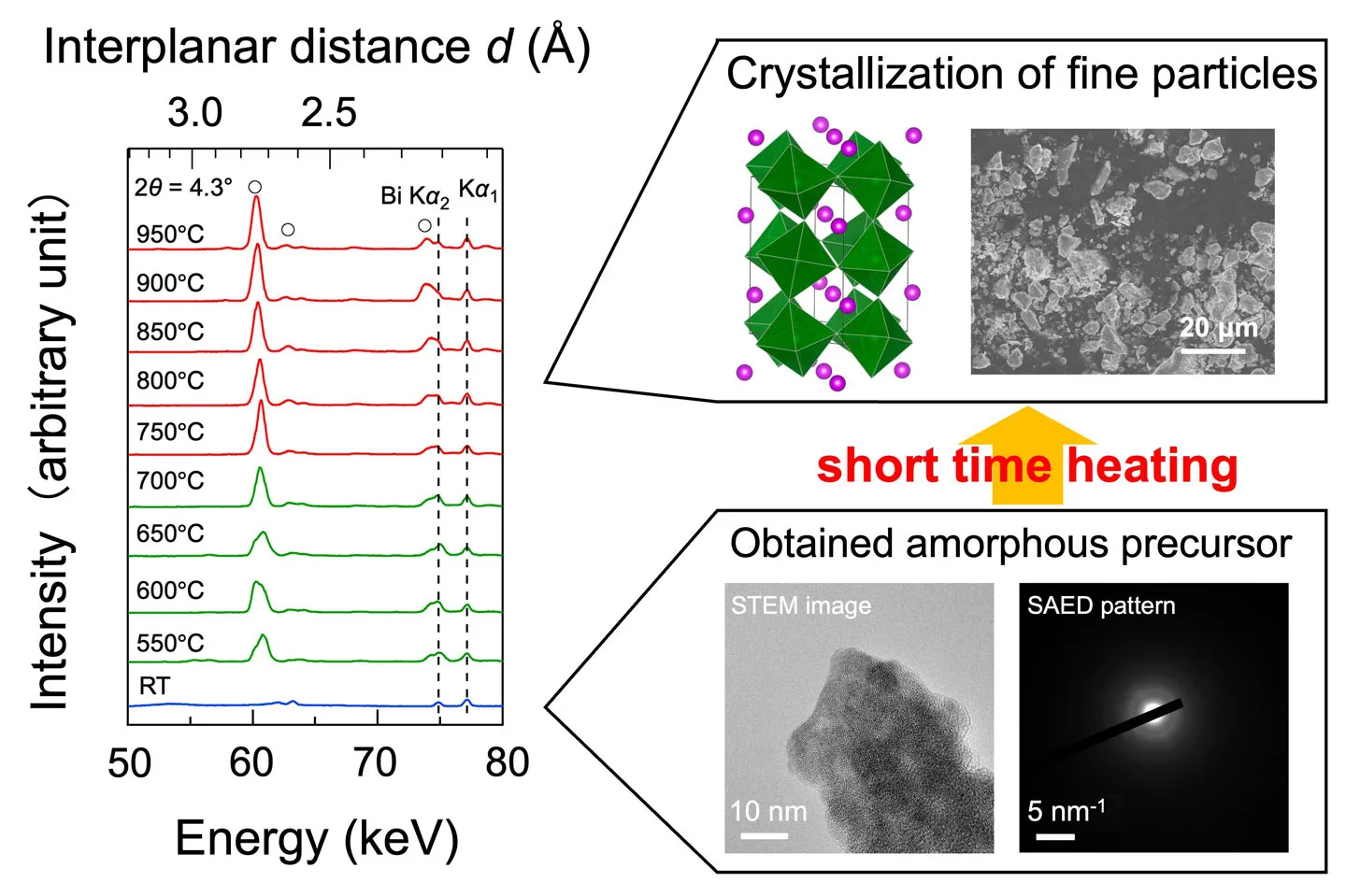
Additionally, since the precursor is already highly oxidized, the final material can be synthesized without the addition of external oxidants. Under high-pressure conditions, the desired perovskite phase crystallizes directly from the amorphous precursor at approximately 750 °C in less than one minute. In situ synchrotron diffraction experiments revealed that, unlike conventional precursors that form the final material through multiple intermediate phases and require temperatures approaching 950 °C, the new amorphous precursor crystallized directly into the target phase at substantially lower temperatures. Traditional synthesis methods typically require higher temperatures and undergo multiple steps before reaching the final product. On the other hand, the new strategy optimizes the process, improving both efficiency and controllability.
The research team also revealed that direct crystallization from the amorphous precursor offers an efficient way to tailor particle sizes. By reducing the exposure to heat, they decreased particle sizes from 15 μm to 5 μm while at the same time preserving the material’s NTE capacity. The subsequently formed fine particles demonstrated stable behavior over a wider temperature range, showing that improved processability can be achieved without sacrificing functionality.
These findings highlight this new strategy as a practical pathway towards safer and more sustainable production of advanced oxide materials. Importantly, the researchers revealed that the same precursor strategy can be extended beyond BiNi1-xFexO3 to other functional oxides, including Cu3+-based materials related to superconductivity.
This versatile approach could support the development of next-generation materials for thermal management, electronics, and energy technologies, while reducing environmental impact and improving production capacity in industries.
Reference
- Authors:
- Takumi Nishikubo1,*, Ryan J Paull2, Takatoshi Hirooka3, Kana Matsuno3, Koki Maebayashi3, Jiong Ding4, Hidetaka Kasai4, Shigeo Mori4, and Takafumi Yamamoto3, Kenneth R. Poeppelmeier2,*, and Masaki Azuma5,*
- Title:
- Synthesis of Unusually High Valent Perovskite Oxide from the Highly Oxidized Coprecipitation Precursor
- Journal:
- Journal of the American Chemical Society
- Affiliations:
- 1Kanagawa Institute of Industrial Science and Technology, Japan
2Department of Chemistry, Northwestern University, United States
3Materials and Structures Laboratory, Institute of Integrated Research, Institute of Science Tokyo, Japan
4Department of Materials Science, Graduate School of Engineering, Osaka Metropolitan University, Japan
5Research Center for Autonomous Systems Materialogy (ASMat), Institute of Integrated Research, Institute of Science Tokyo, Japan