Scientists at the Institute of Science Tokyo have developed a cholesterol-conjugated PMO/RNA heteroduplex oligonucleotide (Chol-HDO[PMO]) designed for treating disorders of the central nervous system. This advanced nucleic acid technology enables precise targeting of diverse genes while maintaining a strong balance between therapeutic efficacy and safety, offering a versatile platform for developing improved therapies for a wide range of neurological diseases.
Advanced Nucleic Acid Therapeutic With Safe, Robust Antisense Activity
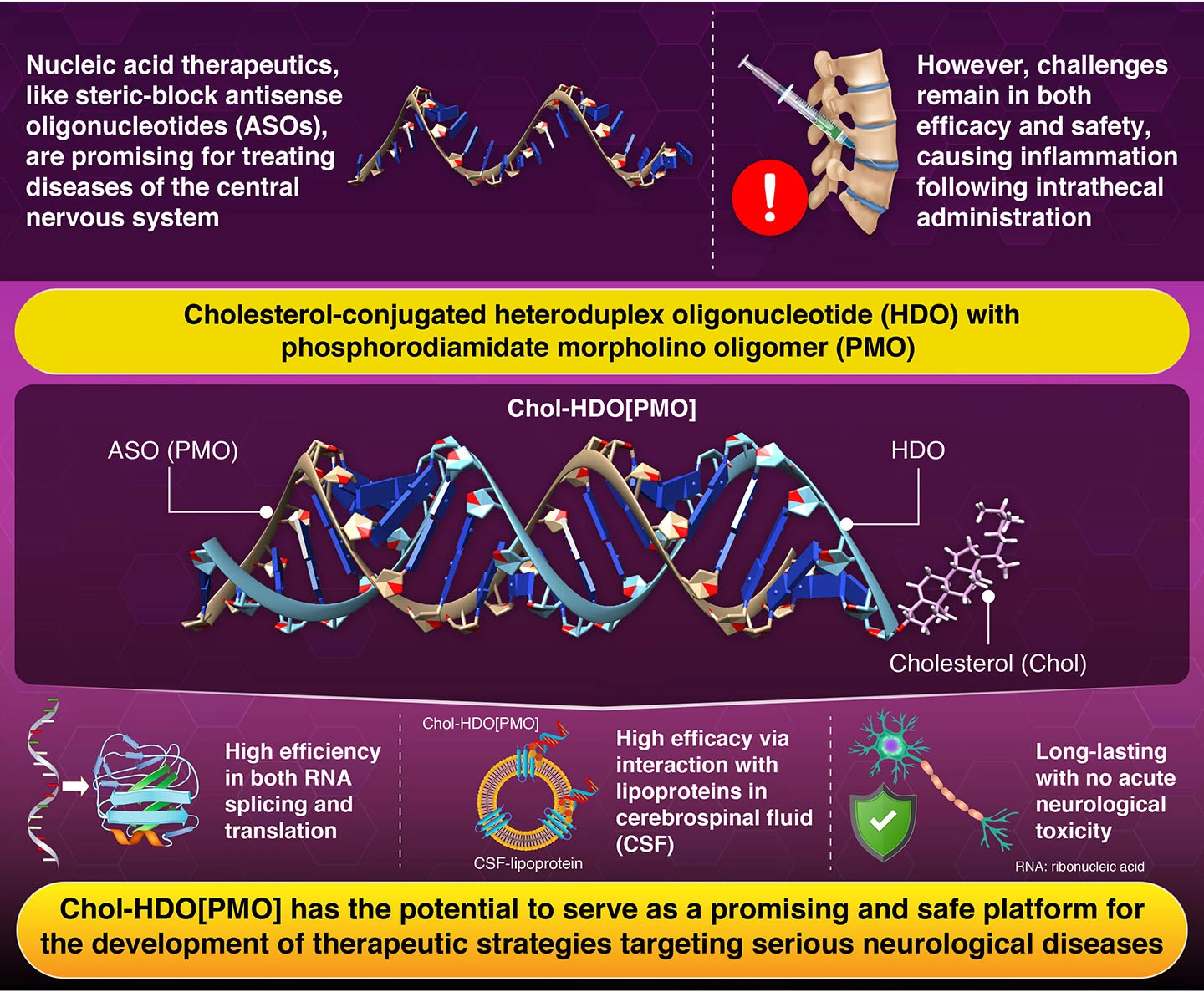
Nucleic acid therapeutics, such as antisense oligonucleotides (ASOs), have emerged as promising platforms for treating a variety of previously hard-to-treat diseases, including neurological diseases. Over the past decade, ASO drugs have been approved worldwide for hereditary amyotrophic lateral sclerosis and spinal muscular atrophy. These drugs are administered directly into the cerebrospinal fluid (CSF) via lumbar puncture, a method known as intrathecal administration, enabling them to reach the brain and spinal cord.
ASOs are short, synthetic, single-stranded strings of nucleic acids (deoxyribonucleic acid or ribonucleic acid (RNA)) designed to bind to a specific RNA in the body. By binding to RNA, ASOs can stop, reduce, or modify the production of disease-causing proteins. Despite their precision, current ASO therapies face challenges related to both effectiveness and safety. To function as drugs, ASOs require chemical modifications that improve their stability and cellular uptake. One widely used design features a phosphorothioate (PS) backbone combined with a 2′-O-methoxyethyl (MOE) modification, which enhances potency. However, PS-MOE ASOs can cause neurotoxic effects, including sedation following intrathecal administration. In contrast, phosphorodiamidate morpholino oligomer (PMO) ASOs are safer, even at high dosages, but have lower potency, requiring frequent administration and increasing patient burden.
To address these issues, a research team led by Dr. Mitsugu Yanagidaira, Dr. Tetsuya Nagata, and Dr. Takanori Yokota at the Department of Neurology and Neurological Science, Graduate School of Medical and Dental Sciences, Institute of Science Tokyo (Science Tokyo), Japan, has developed a novel nucleic acid platform that achieves both high efficacy and safety. The same research group had previously developed, for the first time, PMO-based heteroduplex oligonucleotides (HDOs) and demonstrated their efficacy throughout the body, including in skeletal and cardiac muscles, as well as in the central nervous system by crossing the blood-brain barrier, in a mouse model of Duchenne muscular dystrophy (Hasegawa, Nagata et al., Nature Communications, 2024). Building on this foundation, the present study applied the PMO-based HDO technology to the central nervous system and further advanced the technology through intrathecal administration. “In this study, we designed an improved nucleic acid platform, combining heteroduplex oligonucleotide (HDO) with PMO and its complementary RNA, and further conjugating it with cholesterol, creating Chol-HDO[PMO],” explains Yanagidaira. Their findings were published online in Volume 16 of the journal Nature Communications on December 22, 2025.
The researchers tested the splicing and translation-blocking abilities of cholesterol-conjugated PMO/RNA HDO (Chol-HDO[PMO]) in mouse models by administering it into the CSF. The results showed that Chol-HDO[PMO] outperformed conventional ASOs with PS-MOE or PMO chemistries in both translation inhibition and splice modulation, achieving up to a 16-fold increase in potency. Importantly, the therapeutic effects were also long-lasting.
Importantly, Chol-HDO[PMO] did not cause noticeable side effects such as acute neurotoxicity, weight loss, or immune reactions, which are common problems with many current antisense drugs. In addition, the researchers found that substituting the PMO strand with alternative chemical backbones within the same HDO architecture markedly altered efficacy. This finding suggests that even more effective and safer therapies could be developed by further refining the chemical structure.
Mechanistic studies revealed that Chol-HDO[PMO] achieves improved potency by binding to lipoproteins in the CSF, leveraging them as efficient delivery vectors. “CSF lipoproteins are known to be associated with lipid transport in the brain, suggesting that exploiting them can enhance the delivery of therapeutic agents across the central nervous system,” notes Yanagidaira.
Highlighting the broader impact of this platform, Yanagidaira adds, “Because Chol-HDO[PMO] can be designed to target a wide range of genes through appropriate sequence design, it holds great potential for the development of effective and safe therapeutics for many genetic diseases affecting the central nervous system.”
Overall, this research lays the foundation for a powerful new nucleic acid therapeutic platform, offering safer and more effective treatments for neurological diseases.
Reference
- Authors:
- Mitsugu Yanagidaira1,2,3*, Tetsuya Nagata1,2,3*, Juri Hasegawa2,3, Takashi Ishii1,2,3, Satoe Ebihara2,3, Makiko Nawa4, and Takanori Yokota1,2,3*
- Title:
- Morpholino-RNA duplex exhibits robust, sustained, and safe steric-block antisense activity by intracerebroventricular and intrathecal injection
- Journal:
- Nature Communications
- Affiliations:
- 1NucleoTIDE and PepTIDE Drug Discovery Center, Institute of Science Tokyo, Japan
2Center for Brain Integration Research, Institute of Science Tokyo, Japan
3Department of Neurology and Neurological Science, Graduate School of Medical and Dental Sciences, Institute of Science Tokyo, Japan
4Laboratory of Cytometry and Proteome Research, Nanken-Kyoten and Ochanomizu Research Facility (ORF), Institute of Science Tokyo, Japan