
Food security is the foundation of a healthy, stable and prosperous nation. In Papua New Guinea (PNG), the government has prioritised agriculture as a driver of economic growth and food system resilience, calling for renewed national efforts to boost food production and improve nutrition outcomes.
ACIAR is continuing to support PNG’s efforts with 2 new targeted agricultural research investments, totalling more than A$8 million, to generate evidence and practical solutions for sustainable agricultural development.
Supporting evidence-based policy and agricultural transformation
Research to inform growth – PNG Agriculture, Food and Nutrition Policy Program is a A$5 million investment to strengthen data analysis and capacity in the agricultural sector. It hopes to support informed policy and investment decisions for inclusive economic growth in Papua New Guinea.
Led by the International Food Policy Research Institute (IFPRI), the project will contribute to improved understanding of agricultural productivity, sustainability and food system resilience, and provide evidence-based information to PNG policymakers and stakeholders.
Key focus areas include:
- agricultural growth and transformation
- climate-resilient agricultural practices
- women’s economic empowerment in agriculture
- strengthening food security and nutrition outcomes
- enhancing domestic and export agricultural value chains.
‘ACIAR’s support enables IFPRI to continue working with PNG research institutions and government to co-deliver timely, data-driven economic analysis to inform policy,’ said Dr Emily Schmidt from IFPRI.
‘From collaborating with the National Agriculture Research Institute (NARI) and the Fresh Produce Development Agency (FPDA) to bolster the fresh produce value chain, to working alongside the Department of Agriculture and Livestock (DAL) and the Department of National Planning and Monitoring (DNPM) to evaluate agriculture investment trade-offs, the IFPRI is grateful for the opportunity to work with in-country partners to support PNG’s medium term development goals.’
These efforts are helping ensure agricultural policies in PNG are informed by reliable, accurate and valid data, aligned with the country’s long-term development priorities.
Co-designing resilient food systems in Western Province
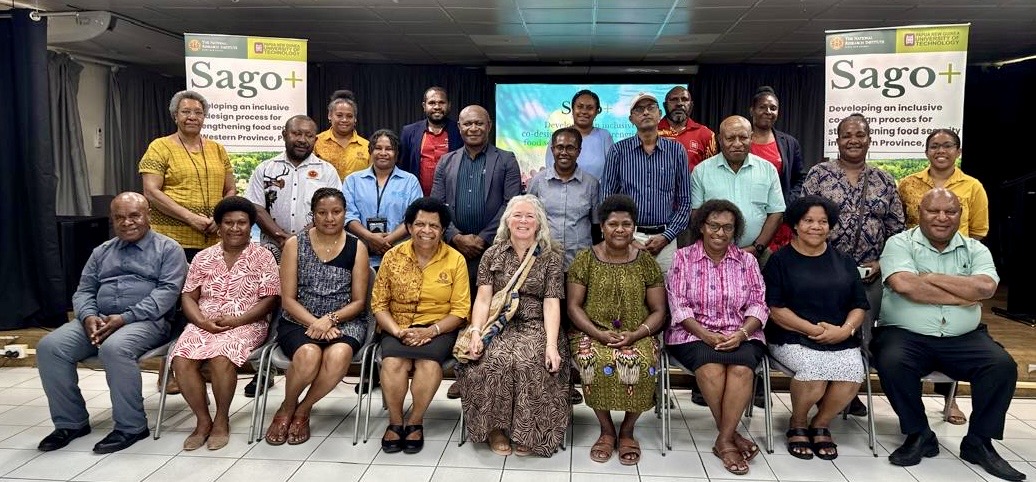
Another new investment will complement this work by strengthening food security systems at the community level. Strengthening food security in Western Province, Papua New Guinea, through inclusive co-design is a 5-year A$3.5 million investment, led by the University of Canberra, in partnership with the PNG National Research Institute (NRI) and the Papua New Guinea University of Technology.
By focusing on a traditional indigenous wild food, sago, the project will document local food practices to identify barriers and enablers in sago food systems. It will integrate traditional and scientific knowledge of food security and co-develop practical tools to strengthen food systems amid climate change.
‘Traditional knowledge is placed on par with technical and scientific expertise, and community members are considered experts, equal partners and leaders,’ said project leader Associate Professor Dr Ann Hill.
‘Our shared goal is that through the co-creation of this program, communities in the Western Province will be partners in the development of food and agriculture programs, leading to sustainable implementation for a program that stands the test of time.’
A long-term commitment to food security
Dr Todd Sanderson, ACIAR Research Program Manager for Social Systems, Policy and Economics spoke about how ACIAR is supporting food security in PNG by helping the country prioritise agriculture as a foundation for development.
‘By combining policy-relevant research for evidence-based decision-making with community-led indigenous practices, ACIAR is helping build resilient food systems and improve livelihoods, nutrition and economic opportunities in PNG,’ he said.




c151b854-7a66-4b4a-9918-30c803dc5199.jpg?sfvrsn=73285b19_2)
