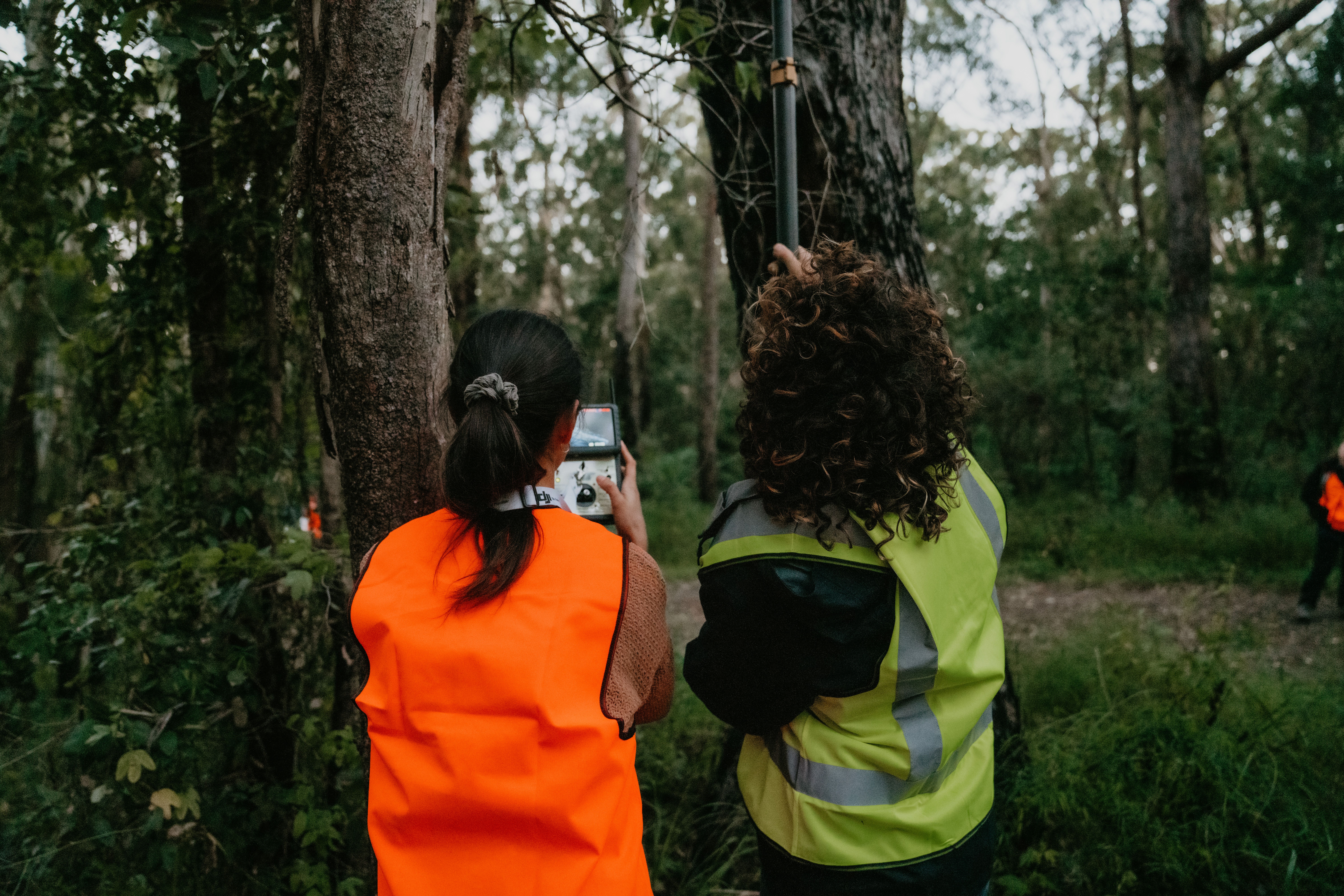
Swarms of drones buzzed over the English countryside, autonomously picking out targets among woodlands as part of the Army Warfighting Experiment 2026.
They were programmed by Australian, United States and British soldiers testing drone-swarming tactics to explore the future of autonomous warfare as part of AUKUS Pillar II.
Lance Corporal Kai Smith, a drone operator from 1st Armoured Regiment, deployed as the section second-in-command with a team of soldiers for the recent activity.
Operating in challenging conditions on Salisbury Plain, they explored how drone swarms could conduct coordinated missions using artificial intelligence.
“We’re using a pretty simple AI software. The drones would go to a location and utilise swarming software to break down that sector, conduct their scan and send images back to the end-user device,” Lance Corporal Smith said.
Operators were assigned areas of interest and mission profiles, launching up to six drones at a time to survey for potential targets.
As missions progressed, AI models were refined through repeated identification and confirmation cycles, improving their ability to correctly spot targets in difficult woodlands.
Despite near-continuous rain throughout, Lance Corporal Smith said the team made great progress, culminating in a series of assessed missions to test operator effectiveness and technical limits.
“The key thing that stood out is that we need to continue progressing these systems and working with partner nations, and scientists domestically, to be able to improve these systems in-house,” he said.
The three-week experiment involved soldiers, scientists and engineers trialling uncrewed systems and data-sharing across national platforms. A shared command hub enabled near real-time exchange of mission data and sensor information between the AUKUS partners.
‘Autonomous systems are no longer experimental, they are moving into the core of how land forces operate, especially in contested environments.’
Hing-Wah Kwok, from Australia’s Defence Science and Technology Group (DSTG), said technical integration across partners was important.
“Being able to leverage and retrain new models in the field and rapidly interchange these models with AUKUS partners through common standards is a real force multiplier,” Mr Kwok said.
“It allows AUKUS partners to leverage each other’s models, building capabilities beyond what each country could achieve alone.”
Embedded DSTG engineers worked with soldiers to evaluate swarming behaviours, improve aided target recognition and enhance collaborative sensing between AUKUS partners.
The activity also built on lessons learned from previous exercises, expanding the complexity of autonomous operations from two to six drones.
Colonel Jake Penley, director of Australia’s Robotic and Autonomous Systems Implementation and Coordination Office, said the pace of technological advancement was reshaping modern warfare.
“Autonomous systems are no longer experimental, they are moving into the core of how land forces operate, especially in contested environments,” Colonel Penley said.
Lance Corporal Smith said it was beneficial to work with AUKUS partners and compare systems, operating procedures and how they integrate scientists into their programs.
“It’s strengthening the Australian Army’s understanding of autonomous systems, how we can operate and utilise the systems we’re getting,” he said.
“It’s going to be constantly evolving throughout the years, but we will be able to identify how we can use it effectively to our aid and keep our soldiers safe.”