Australia has played an important role in building resilient, sustainable and productive food systems through our recent engagement at the 11th APEC Food Security Ministers’ Meeting and Food Security Week 2026 in China.
The Ministers’ Meeting, held in Hangzhou, brought together ministers and senior officials responsible for food security across the Asia-Pacific. Dr Jared Greenville PSM, First Assistant Secretary, Trade and International, represented the Minister for Agriculture, Fisheries and Forestry, the Hon Julie Collins MP.
The Australian delegation contributed to discussions focused on regional food security priorities, opportunities for collaboration and the role of innovation and digitalisation in advancing resilient agrifood systems.
Ministers endorsed new APEC principles to strengthen food systems resilience across the region through innovation and digitalisation.
Dr Greenville said international collaboration remains critical to addressing complex challenges facing agriculture and food systems.
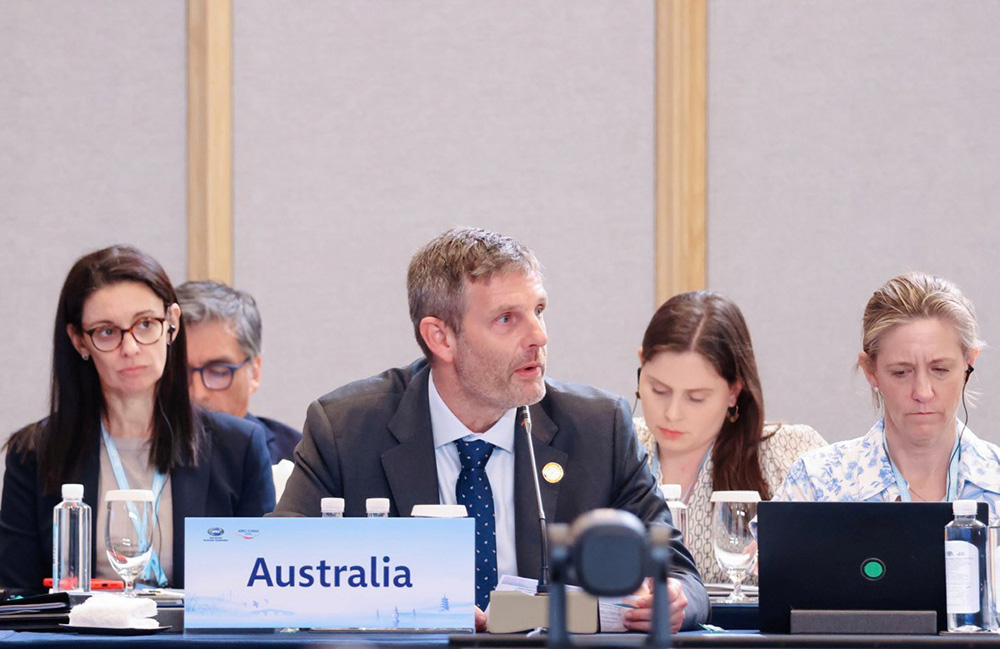
“The outcomes agreed through APEC recognise the reality that challenges such as pest and disease outbreaks, supply chain disruptions and barriers to trade do not stop at national borders,” he said.
“While no single economy can solve these issues alone, countries can work together to share knowledge, improve systems and strengthen the resilience of food and agriculture sectors across the region.”
Australia also participated in Food Security Week 2026 in Dalian, joining government, industry and research representatives from across the region to advance practical solutions to shared food security challenges.
Working alongside representatives from the likes of Artesian Invest and the Grains Research and Development Corporation, Australian delegates showcased Australia’s experience in connecting research, investment and industry to help agricultural innovations move from development into practical use.
Dr Greenville said Australia’s active role at APEC helps ensure regional cooperation delivers outcomes that support both food security and agricultural trade.
“APEC is our region’s premier economic forum, bringing together 21 member economies that account for around 72% of Australia’s agriculture, fisheries and forestry trade,” he said.
“By working closely with our regional neighbours and like-minded partners, APEC provides a forum to shape regional cooperation on food system resilience,” he said.
“The principles established this year develop a shared focus on innovation, digitalisation, stronger biosecurity, more efficient trade, improved food safety and traceability, and better preparedness for future shocks.”
“These are priorities that matter directly to Australian farmers, exporters and agricultural industries, helping to manage shared risks while supporting productivity, growth and exports.”
Australia’s participation in APEC complements work underway through the development of Australia’s National Food Security Strategy and the establishment of the National Food Council. Together, these initiatives will help ensure Australia remains well positioned to respond to future challenges while maintaining a strong, secure and sustainable food system.
As global food systems continue to evolve, multilateral collaboration through forums such as APEC will play an increasingly important role in helping economies respond to emerging challenges and seize opportunities that support food security, economic growth and environmental sustainability for future generations.