
A new institute is bringing together experts from multiple institutions, including Cornell, to tackle a fundamental challenge in quantum computing: developing the materials and manufacturing techniques needed to build quantum processors at scale.
The institute, titled MARQUIS: Manufacturable and Resilient superconducting Quantum Information Systems, is one of eight announced Aug. 25 as part of the National Science Foundation’s Quantum Leap Challenge Institutes program.
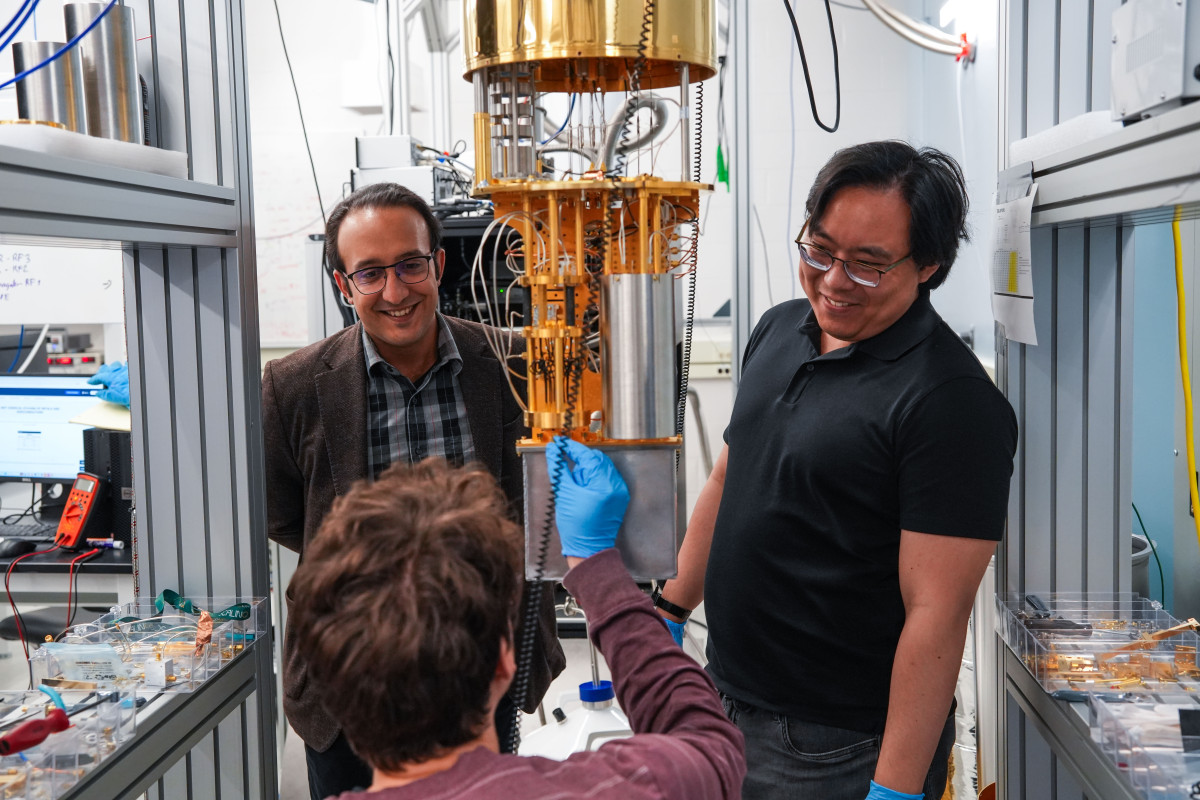
Valla Fatemi, left, assistant professor in the School of Applied and Engineering Physics at Cornell, will serve as deputy director of MARQUIS, one of eight new National Science Foundation Quantum Leap Challenge Institutes.
Led by Princeton University, the institute will devise techniques for fabricating hardware, innovate on materials and nanofabrication, and develop education and workforce training programs that deepen U.S. leadership in quantum science and engineering. Valla Fatemi, assistant professor of applied and engineering physics at the Cornell Duffield College of Engineering, will serve as deputy director.
“The whole community has been using essentially the same materials technology for about a quarter century,” said Nathalie de Leon, a professor of electrical and computer engineering at Princeton, who will direct the new institute. That technology has worked well for experimental prototypes and small-scale systems. But to build quantum computers at a scientifically useful scale, she said, the most basic elements must be reinvented.
The institute will receive $27.9 million in National Science Foundation funding over five years, according to the agency. The research team harnesses expertise from three broad disciplines – materials science, quantum devices, and semiconductor processing – spanning two dozen laboratories across nine research institutions.
“There’s a huge barrier to solving the problem,” Fatemi said. “That’s why we need an institute like this, with all this multi-interdisciplinary expertise to solve it.”
Participating institutions include Princeton, Cornell, the Massachusetts Institute of Technology, University of California at Santa Barbara, Stanford University, Dartmouth College, NY Creates, Michigan State University and the University of Iowa. The organizations represented on the advisory board include Google Quantum AI, NVIDIA, Applied Materials, Oxford Instruments, Bluefors, KU Leuven/Imec and MIT Lincoln Laboratory.
In addition to reinventing the materials systems, the team will also develop methods to validate and compare the performance of various designs and to test them in mid-scale quantum processors – a step between the small systems typically developed in academic labs and the large processors that will one day run useful quantum algorithms.
These test beds will help standardize research efforts across disparate labs and allow experts from other fields to contribute meaningfully to the core challenge, according to the institute leaders. For example, semiconductor fabrication techniques that could prove valuable for quantum computing often involve highly specialized expertise that quantum researchers don’t have.
“That’s one of the reasons I’m excited about being part of this multidisciplinary team,” Fatemi said, “we can learn from each other as part of the process of basic science and invention.”
Fatemi’s main research contributions, along with others, will be developing and characterizing new kinds of Josephson junctions. The Josephson junction typically consists of three metallic layers stacked like a sandwich, with a layer of oxidized metal in the middle that is only a few atoms thick. Pairs of linked electrons quantum tunnel through the thin middle layer, resulting in a critical component for devices that can be manipulated to process information using quantum mechanical rules. Virtually all of today’s superconducting qubits use junctions with aluminum and aluminum oxide that are formed by using a polymer stencil mask, the same approach used in the first superconducting qubits more than 25 years ago. The new institute’s work will focus entirely on finding new approaches to fabricating and characterizing the Josephson junction.
The Cornell team will leverage the advanced capabilities at the Cornell NanoScale Facility, the Cornell Center for Materials Research, and the new quantum facility being development at Duffield Engineering for this research.
“This confluence of facilities at Cornell puts our team in excellent position to impact next generation quantum hardware as part of this new institute,” said Fatemi, who research illustrates the kinds of advances the institute will pursue. In recent work, his group used krypton gas to deposit tantalum on silicon at 200-degrees Celsius, making the process more compatible with semiconductor manufacturing. In another project, Fatemi and colleagues – including Judy Cha, CNF director and the Rick and Betty Tsai Ph.D. 1981 Professor in Materials Science and Engineering who is also involved in the new institute – developed a resist-free method for fabricating Josephson junctions using etched silicon trenches, reducing contamination and opening new possibilities for materials and fabrication.
Nobel laureate Michel Devoret, who first demonstrated how these devices can be used to make “artificial atoms,” has called the decades-long effort to make better superconducting qubits a “graveyard” of ideas for aspiring physicists and engineers. Devoret, a professor at UC Santa Barbara and chief scientist at Google Quantum AI, is one of the new institute’s senior investigators.
“We can see that the materials limitations are going to be one of the next big bottlenecks,” de Leon said. A large research institute creates mechanisms to coordinate the activities of lots of different people, she said. Her idea: Gather that firepower and aim it at one of the oldest obstacles in quantum computing.
“Let’s make a dream team,” de Leon said, “to try to unblock this.”
This article was adapted from a version written by Scott Lyon with permission from Princeton University.




/mental-health-and-substance-use-(msd)/mental-health-(mhe)/mental-health-day-2026.tmb-768v.jpg?sfvrsn=4c607866_1)


