In June 2026, Australia recorded its first cases of the highly contagious H5 bird flu.
As Australia’s national reference laboratory for animal diseases, CSIRO’s Australian Centre for Disease Preparedness (ACDP) plays a critical role in protecting Australia’s valuable livestock and aquaculture industries and the wider community from infectious diseases such as bird flu.
Scientists at ACDP have been conducting testing and genetic analysis to learn more about exactly which strain of the virus has arrived on our shores, and how it is spreading.
All quotes below are available for use by media. Spokespeople quoted:
- Dr Frank Wong, Senior Research Scientist at CSIRO’s Australian Centre for Disease Preparedness. Dr Wong is also a World Organization for Animal Health-designated reference expert on avian influenza
- Dr Matt Neave, Team Leader of Sequencing and Agent Characterisation at CSIRO’s ACDP
- Dr Debbie Eagles, Director of CSIRO’s ACDP.
What is H5N1 and why is it a concern?
Dr Frank Wong:
For the past 5 or 6 years the world has been affected by a bird flu panzootic. This is what we call a pandemic in animals. In this case, because the virus is an avian virus, it has mostly impacted birds around the world.
The clade 2.3.4.4b lineage of H5N1 is a highly pathogenic bird flu virus that emerged around 2020-2021, first spreading across Europe and then moving on to other continents, including Asia and North America.
Along the way it has caused mass mortalities in both domestic poultry as well as many species of wild bird.
H5N1 has been able to spread rapidly across different continents largely due its ability to be sustained in migratory wild birds, like waterfowl such as ducks and geese.
The genotype that we’re talking about for Australia, known as genotype B3.2, arose from reassortment in North America and then spread to South America and the sub-Antarctic islands.
It had a great impact on South American poultry industries as well as wild bird life and marine mammals, so that’s why we’re concerned about the introduction of the virus to Australia.
What does ACDP’s genetic testing show us?
Dr Matt Neave:
Sequencing the virus genome has become really important in disease outbreaks like this one. We’re now able to do it much quicker than in the past and can get a whole influenza genome in around 15 to 26 hours.
From the viral genome we are able to determine several important things, including the exact strain of the virus. Another thing we can do is compare that viral genome to other reference sequences in our database or public databases online. This allows us to determine how closely related our Australian cases are to the sub-Antarctic ones, for example.
Our testing shows us that the sequences from the first two cases in Australia were closely related to ones from Heard Island. From the data we have at hand, it appears Heard Island is the most likely source of the Australian infections.
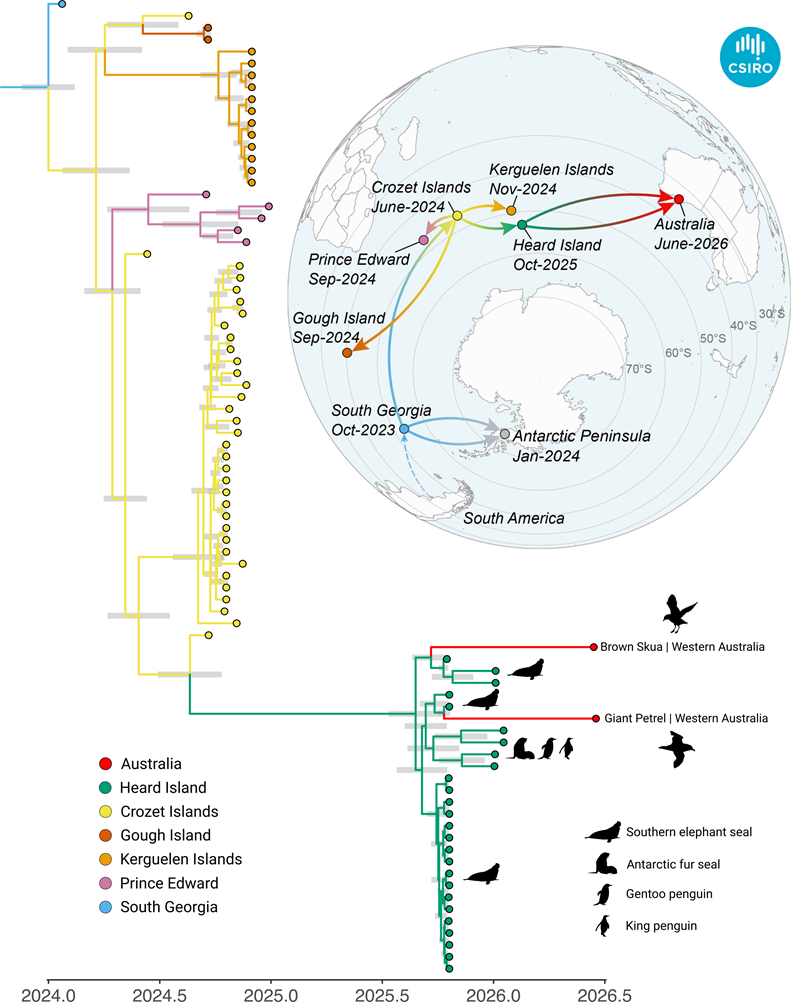
By comparing genetic sequences from virus samples, scientists can trace the relationships between the first Australian H5 bird flu cases and those detected on Heard Island.
What is our current understanding of the number of individual introductions of the virus to Australia?
Dr Matt Neave:
We’ve detected at least 6 or 7 separate introduction events that we think came from Heard Island. Although we call them separate, they are very similar genomes. Of course, this is very likely an underestimate of the true number of incursions we’ve seen in Australia.
However, with South Australia’s crested terns, for example, through sequencing we can see that’s not a separate introduction event because the genomes are so similar to each other. Some of the genomes are actually identical. That’s why we think there is now transmission of the virus in that area.
Can we tell what mammal species might be particularly vulnerable to this strain of the virus?
Dr Frank Wong:
The genotypes that are associated with infections in dairy cattle in the United States are quite specific and have not been detected outside the US to date.
The genotype we now have here in Australia certainly can infect marine mammals. In South America it has impacted colonies of southern elephant seals and sea lions. On Heard Island it had a significant impact on the resident southern elephant seal population.
We should maintain all of the controls and biosecurity that we would do regardless of the strain to protect Australian livestock, but the risk of this genotype infecting our livestock is considered low. You would need an alignment of ecological circumstances for the virus to spill over and impact livestock.
What about the risk to humans?
Dr Debbie Eagles:
The risk to humans is low and that has been consistent internationally since this strain has been circulating since 2021. In most cases, where human infection occurs, the disease is mild.
For more human health information refer to Australia’s Centre for Disease Control .
What do we know about how this strain might behave in Australia, and whether it will become embedded?
Dr Frank Wong:
In terms of its long-term sustenance in Australia, it’s probably too early to tell. But I would say one important aspect in terms of being able to lessen that opportunity would be to keep on top of it as much as possible and not just let the virus spread without continued monitoring and control where circumstances allow, whether though wild animal populations or through livestock or domestic poultry.
Are there specific changes to the virus that you look out for while sequencing?
Dr Matt Neave:
When we do sequencing there are certain parts of the genome that we take a particular interest in.
We want to know if this particular virus constellation that’s come to Australia switches up one of its genes with a local Australian virus. That doesn’t necessarily mean something bad will happen, but that’s a virus we’d want to perhaps test here in the lab.
There are also a couple of mutations in the genes themselves we that we want to look out for, particularly ones that might increase the risk of spread to people.