Scientists from RMIT University and Riga Technical University in Latvia have shown that static change left on surfaces can be controlled, which may have big benefits for companies needing to avoid the little zap in production of common household goods.
The discovery could even one day help stop powders such as protein, chocolate malt powders and coffee from clumping.
Static electricity is usually treated as a hazard to prevent. To reduce it, industry often adds expensive conductive additives as a one-size-fits-all fix. The cost of static discharge is about US$5 billion in the electronics industry alone.
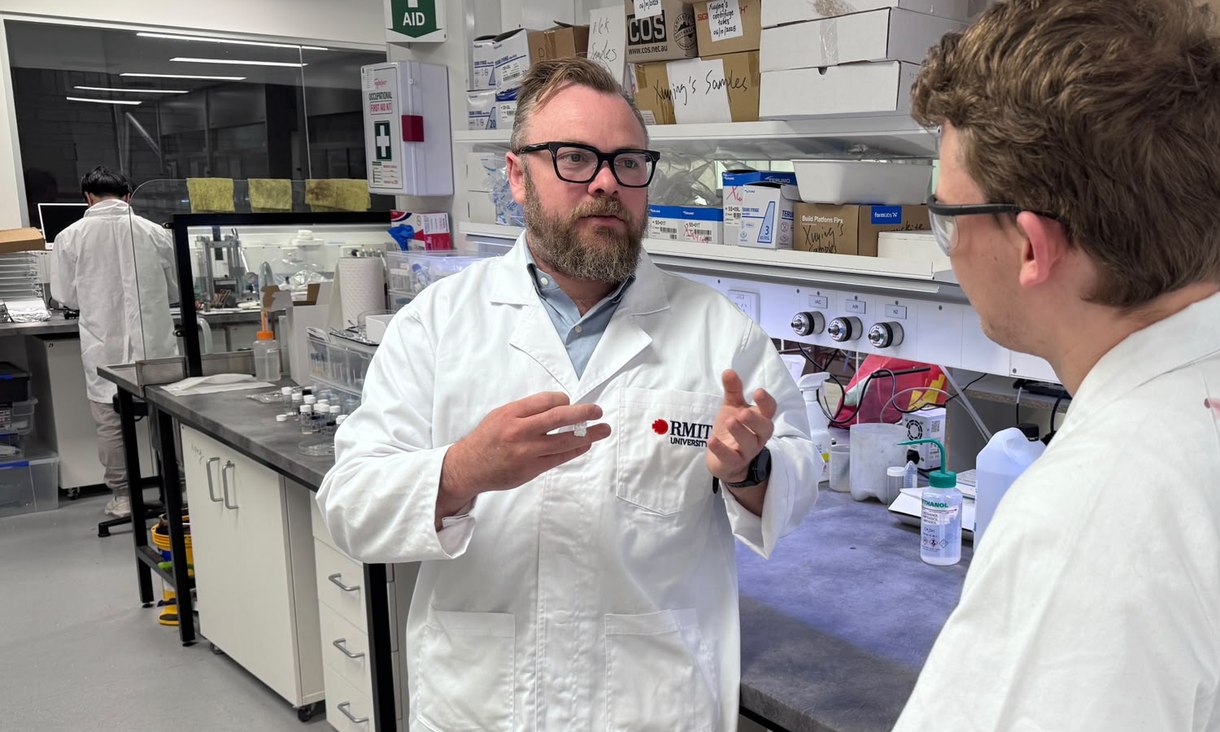 Dr Peter Sherrell from RMIT University’s School of Science explains the team’s findings on programmable static charge in the lab. Credit: Will Wright, RMIT University
The new study findings offer a potential solution to this challenge, pointing to surfaces with static charge formation that could be programmed to suit application requirements.
The study co-led by Dr Peter Sherrell, from RMIT’s School of Science, in collaboration with Riga Technical University, has shown that applying an electric field while two surfaces touch and pull apart controls how much static charge is left behind. It can also control whether that charge is positive or negative – or remove the charge.
The first author and co-corresponding author is Dr Andris Šutka of Riga Technical University, and Professor Amanda Ellis from the University of Melbourne is a co-author. PhD student Dumindu Dassanayaka and Dr Qiang Sun from RMIT are also key contributors to the study.
“For example, if we had a conveyor belt processing or sorting seeds, the static charge would change based on the size or species of the seed,” Dr Sherrell said.
“Our discovery means we could change the electric field around the conveyor belt depending on the species, so there is no risk of a seed getting a static shock.”
Other possible uses include anti-static surfaces for manufacturing and electronics processing, controlling where charged particles or plastics stick and how they assemble, smarter sensors, and smart air and gas filters.
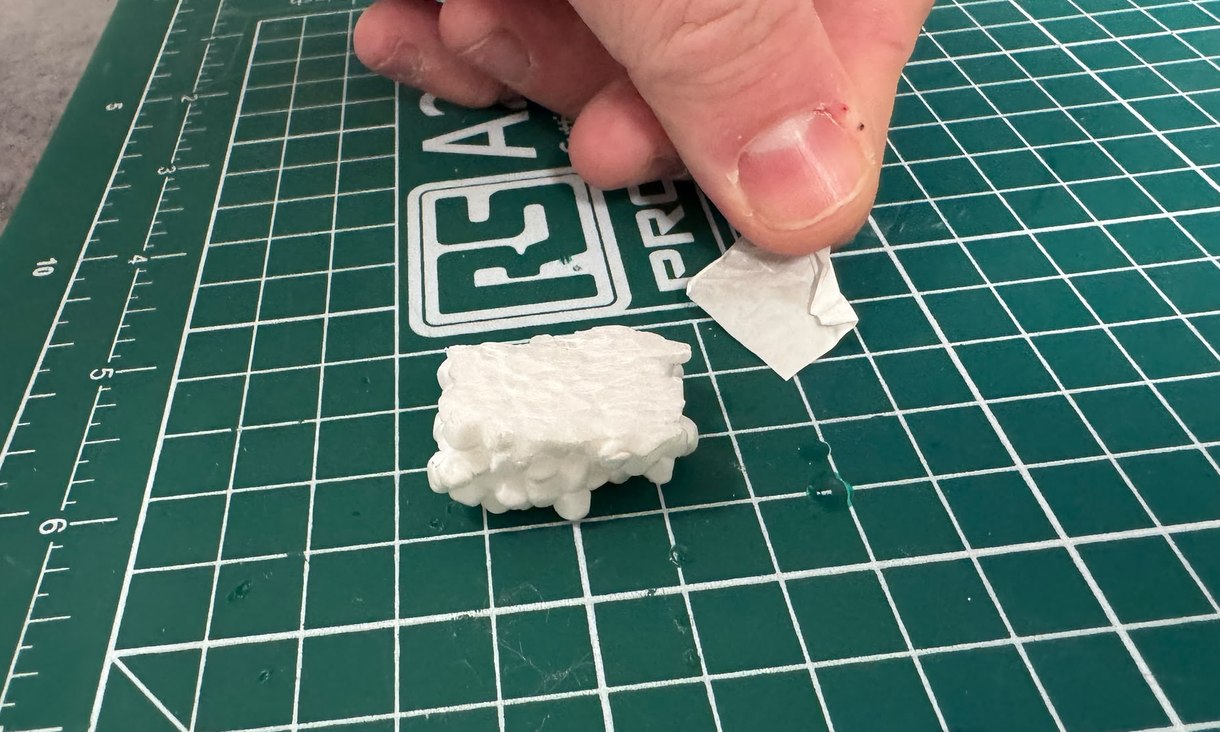 A polystyrene block and a thin polystyrene layer used in the team’s static charge demonstration. Credit: Will Wright, RMIT University
A smoother shake?
Most people have chipped lumps out of a protein shaker or chased a floating clump around a mug of chocolate milk. Few know that static electricity is one of the likely culprits.
As powders rub and tumble during manufacturing, packing and pouring, the grains can pick up static charge and cling to each other.
“In principle, we could apply a small electric field across powders as they move,” Sherrell said.
“That stops them charging up, so they don’t get electrostatically ‘stuck’ to each other.”
The team tested plastics, rather than food products, but the findings of the study are good indicator for how the team’s approach could apply to food powders.
“The next step is to find out how strong the field needs to be, how long to apply it for each powder and where in the process it works best,” Sherrell said.
The team plans to test the approach on real powders and to study programmable surfaces at much smaller scales, so that different parts of the same surface can be programmed in different ways.
Their current grant application with industry partners focuses on removing anti-static additives from fuels by tuning the surfaces the fuels touch, which could make fuel more energy efficient.
Solving a long-standing puzzle
The research also offers evidence on a question scientists have debated for years: what makes charge separate when two materials touch and pull apart?
Computer simulations showed that the electric fields the team applied were similar in strength to those created naturally when rough plastic surfaces press together. This supports the idea that tiny built-in electric fields help drive the separation of charge in everyday static electricity.
How the research was done
The team pressed polystyrene films together and pulled them apart 500 times, while applying external electric fields.
Stronger fields left more charge, and reversing the field from positive to negative reversed the charge. The same behaviour appeared in all of the plastic’s tested.
These results were compared to the computational models to understand what was happening.
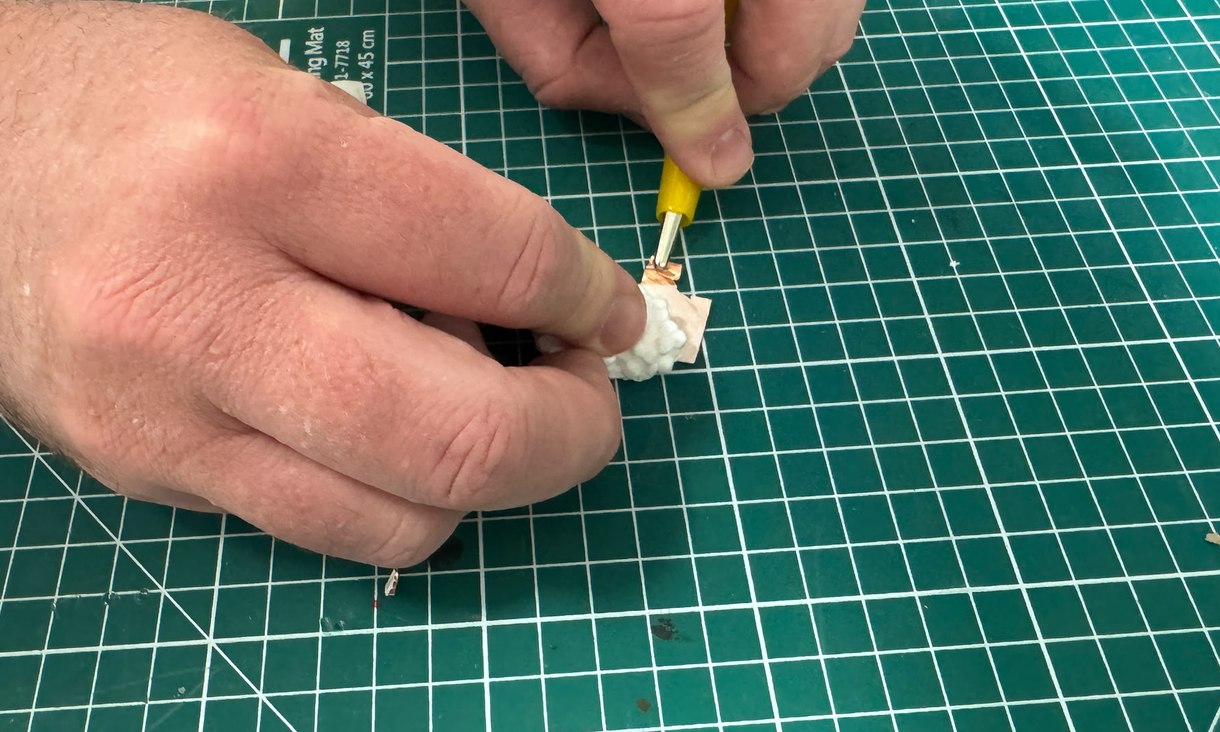 An electrode applies an electric field to a polystyrene layer on a copper sheet, controlling the static charge left on its surface. Credit: Will Wright, RMIT University
Limitations
The scientists did the experiments in the lab on plastic films, mostly polystyrene, with other plastics in the supporting data. Food powders such as protein, malt drink additives and coffee were not tested.
The paper set the charge by applying a field during contact and then measured it afterwards. Switching the charge live, as in the conveyor example, hasn’t been demonstrated.
The simulations use a simplified model, and the approach hasn’t been tested on industrial equipment.
“The science would enable this to happen based on the discovery,” Sherrell said.
‘Electric fields control static charge during contact-friction-separation‘ is published in Nature Communications (DOI: 10.1038/s41467-026-77733-4).
The research was supported by the Latvian Central Finance and Contracting Agency (ERC project TriboCharge) and an RMIT Vice-Chancellor’s Research Fellowship.
Full research paper available: https://rdcu.be/PLh5ckPmYWra