Through his ARC Industry Laureate Fellowship, Professor Phill Cassey is developing multidisciplinary solutions to combat wildlife crime and prevent environmental harm.

ARC Industry Laureate Fellow, Professor Phill Cassey. Image Credit: Supplied.
The illegal trade in Australian wildlife is a multimillion-dollar business that endangers our unique biodiversity and poses significant biosecurity risks. Globally, the growing trade is estimated to generate between $7 and $23 billion every year. The money that can be made from wildlife trafficking makes it increasingly attractive to organised crime, which uses the profits to fund other illicit activities.
Professor Phill Cassey, Director of the Wildlife Crime Research Hub at Adelaide University, is addressing this complex issue in his ARC Industry Laureate Fellowship, Combatting Wildlife Crime and Preventing Environmental Harm. His research recognises the need for a multidisciplinary, multifaceted approach that includes forensic tools, specialized data analysis, and increased public awareness.
The Wildlife Crime Research Hub was established by Professor Cassey, with ARC funding, to work closely with government environment and biosecurity agencies, as well as law enforcement and non-government groups. He is helping to forge novel solutions to thwart a surge in the trade in Australian wildlife.
Working with his key Industry Partner, the Australian Centre for Wildlife Genomics at the Australian Museum, Professor Cassey says, ‘We’re adopting a suite of methods for the rapid real-time detection of trace DNA, particularly for collection of DNA on the packaging and containers used in wildlife trafficking, where you can quickly identify species of highest concern.’
Further work is being conducted to establish the provenance, or origins, of the species identified. ‘The aim is to understand whether these species, particularly highly sought after native reptiles, are wild caught or captive bred, what their level of relatedness is, and to try and get back to individual breeders and disrupt the trafficking at multiple points along the supply chain,’ Professor Cassey says.
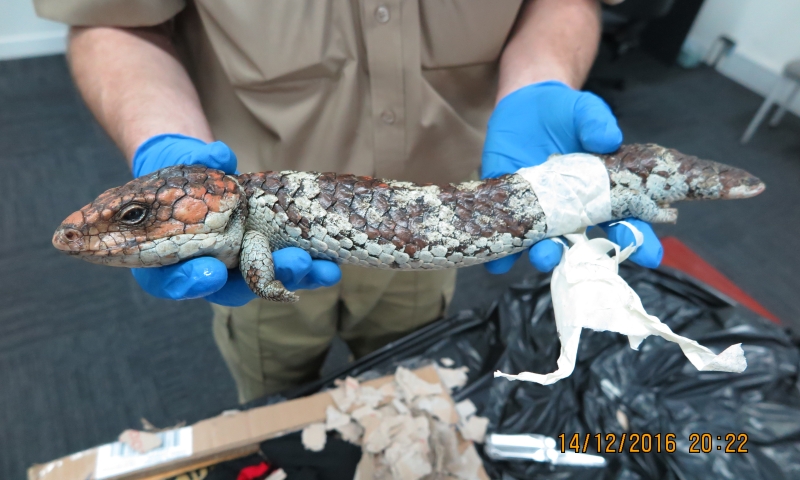
Australian animals, including plants, reptiles, and birds, and increasingly invertebrates (including insects and spiders and scorpions), are highly demanded overseas because they are endemic to Australia, and found nowhere else in the world. Professor Cassey says that even relatively common species, including bluetongue and shingleback lizards, are extremely valued by overseas buyers at ‘thousands and tens of thousands of dollars, many times the price the same species is sold for in Australia.’
Much of the illegal wildlife trade is promoted and facilitated online. Professor Cassey has harnessed the cybercrime capabilities in various Colleges and Schools at Adelaide University to help integrate intelligence on the markets for Australian species.
‘We’ve built a suite of automated tools for e-commerce market surveillance. Web scraping of large online marketplaces, and the associated machine learning models for data extraction, have been a very important capability that we have for revealing the size, value, scale, and scope of the wildlife trade,’ he says.
One of the complexities of this issue are the discrepancies in Australian state and territory legislation governing the breeding, trading and keeping of different species. As part of his environmental stewardship role, Professor Cassey’s team has helped develop a legislative database that allows jurisdictions to easily view each other’s regulations on the keeping and trading of wildlife species.
A further aim of the research program is to boost public awareness of the seriousness of the illegal wildlife trade. The Wildlife Crime Research Hub has partnered with the International Fund for Animal Welfare (IFAW) to deliver an Australian survey on public awareness of wildlife trafficking, the results of which will be used to inform upcoming public awareness campaigns.
In 2025, the Wildlife Crime Research Hub collaborated with Crimestoppers in South Australia to encourage the public to call in evidence of wildlife trafficking. In the same year, a partnership with Adelaide Zoo introduced hundreds of school children to the issue of wildlife trafficking through a ‘Wildlife Crime in Our Backyard’ exhibition and youth art competition WildVoice.
Combatting Wildlife Crime and Preventing Environmental Harm is an example of how ARC funding enables the collaborative, multidisciplinary research needed to address complex and constantly evolving issues such as wildlife trafficking. The project also demonstrates the importance research can have in informing government policy and law enforcement.