New laws making significant changes to the NDIS start taking effect today, Thursday 27 August 2026. Here is what people with disability need to know about the changes happening now and what is coming next.
The Australian Parliament has passed new laws that will make significant changes to the National Disability Insurance Scheme (NDIS).
The changes will affect:
- how people access the NDIS
- how NDIS plans are made and reviewed
- how some NDIS decisions and administrative processes are made
- how some providers operate
- how some types of funding are calculated.
Most of these changes will not happen straight away.
The Bill received Royal Assent on 20 August. This means the Governor-General formally approved it to become law.
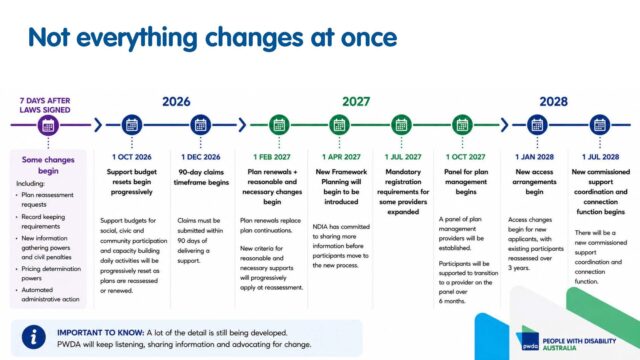
The first changes start today, 27 August 2026. Other changes will be introduced gradually between 2026 and 2028, with some transition arrangements continuing until the end of 2030.
What changes today?
From today, some changes will apply to how NDIS plans and administrative processes work.
Only a participant, their plan nominee or a child representative will be able to ask the NDIA for an unscheduled plan reassessment.
You will still be able to ask for a reassessment if there has been a significant and ongoing change to your:
- functional capacity and support needs
- where or how you live
- education
- work
- informal support from family, friends or others.
You will still be able to ask for a plan variation if there is an emergency, crisis or short-term change in your support needs.
There are also new requirements for participants, plan managers, nominees and providers to keep records about NDIS support payments.
The NDIA will have stronger powers to investigate fraud and non-compliance and to ask for information.
The NDIA will also be able to use computer systems for some administrative actions, such as processing claims and payments. The law includes safeguards around the use of automated systems, including human oversight and human decision-makers for matters requiring judgement.
There is no immediate change to NDIS prices because of these changes.
What do I need to do now?
For most NDIS participants, you do not need to do anything differently right now.
You can continue to use your current NDIS plan and supports as usual.
The NDIA has said it will let participants know before changes that affect them are introduced.
People applying to the NDIS can also continue to apply under the current access process until 1 January 2028.
It is important to remember that plans can still change through the usual NDIS planning processes. A change to someone’s plan does not necessarily mean it has happened because of the new laws.
More NDIS changes are coming
The next major change starts from 1 October 2026.
Changes to some support budgets will begin to apply when a participant receives a new plan or has their plan reassessed.
The Government plans to reduce budget allocations for:
- social, civic and community participation supports by 50 per cent
- capacity building daily activities by 10 per cent.
These changes will happen progressively as plans are reassessed or renewed.
The Government says the reductions will not apply to budgets for critical supports including home and vehicle modifications, supports in the home, personal mobility equipment and transport, consumable products and Specialist Disability Accommodation.
Other changes will follow from December 2026, February 2027, April 2027, July 2027, October 2027, January 2028 and July 2028.
These include changes to NDIS claims, plan renewals, how NDIS plans are made, provider registration, plan management, NDIS access and support coordination.
What is still to be decided?
Passing the legislation does not mean every detail of these changes has been decided.
Further rules, legal instruments, policies and operational processes still need to be developed.
Important areas still being worked through include the new NDIS access assessment, new framework planning, record keeping, appropriate treatment, provider registration and pricing, plan management and support coordination and connection services.
There will be further opportunities for people with disability and disability representative organisations to influence how these changes work in practice.
If something does not seem right
The NDIS changes will start at different times.
If you think a change has been applied to you too early or in a way that does not seem right, you can ask the NDIA to explain:
- why they are contacting you
- what process is happening
- what, if anything, could change.
You can also ask for information in a way that is accessible to you and involve a support person if you need one.
If you are concerned about how a change has been applied, PWDA wants to hear from you.
You can tell us what happened through our NDIS changes feedback form. We will use the information people share with us to understand how the changes are being implemented and identify issues we need to raise in our advocacy.
If the NDIA has made a decision you do not agree with, you may also be able to ask for the decision to be reviewed.
We will keep you updated
The NDIS changes will happen progressively over the coming years.
PWDA will continue to monitor how the changes are implemented and advocate for the rights of people with disability.
For the full timeline of changes and more information about what each change means, read our 2026 NDIS changes: What the new laws mean and what happens next.