The world’s tiniest marsupials, the planigales, have just gained a new species, after extensive genetic and morphological analysis led by QUT ecologists.
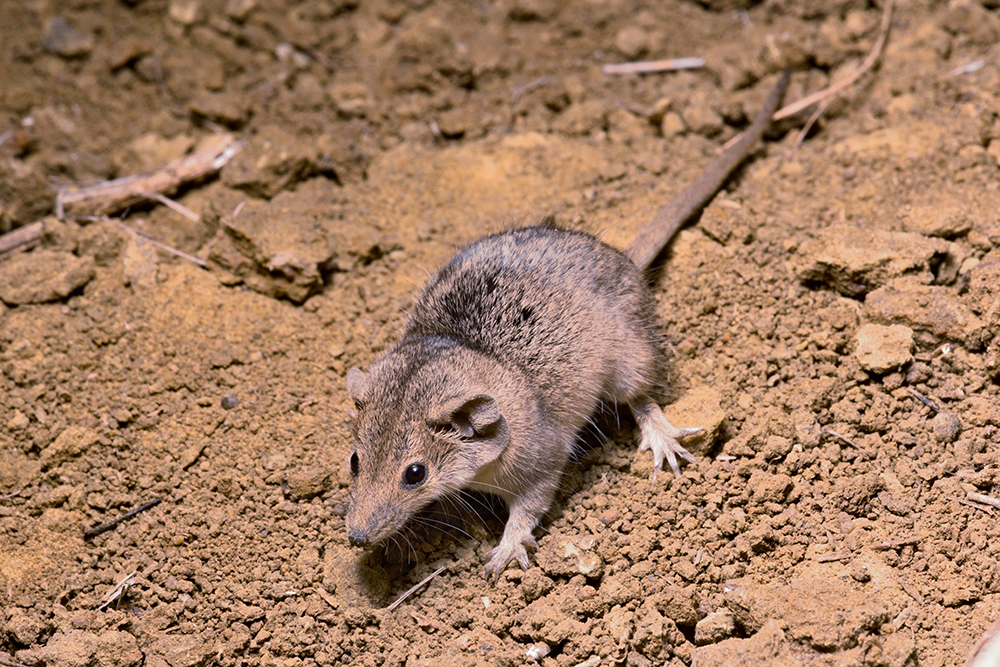
Planigale petrophila, a new distinct species found in the rocky slopes in Kakadu National Park
Planigales now have nine different species – eight found in Australia and one in Papua New Guinea
Genetic and morphological studies put it in a distinct species of its own after being classified as P. ingrami
The discovery of Planigale petrophila, named after the rocky landscapes in Arnhem Land, where it was found, was published in the Zoological Journal of the Linnean Society.
The study’s first author Dr Linette Umbrello, Research Associate at the Western Australian Museum and previously QUT’s School of Biology and Environmental Science, said the researchers had found that what was thought to have been one species, Planigale ingrami, was actually three different species.
“Earlier genetic studies suggested samples of Planigale ingrami, and Planigale maculata could have been wrongly classified because they are difficult to tell apart but had different genetics,” Dr Umbrello said.
“In this study, we used samples from museums across Australia as an invaluable resource that allowed us to recognize species we would never detect in the wild today.
“We conducted comprehensive genetic sampling and morphological (body shape and size) analyses on planigale specimens from museum collections around Australia. “We then combined these two sets of data in a process called integrative taxonomy to work out whether there were distinct species that had previously been classified as one species.”

Dr Umbrello said the researchers had found three unique forms within the P. ingrami specimens.
“We brought back the name P. subtilissima, for planigales found in the Kimberley in Western Australia, which had been lumped in with P. ingrami but are actually a separate species. We also found that the subspecies P. ingrami brunnea was just part of P. ingrami, so we merged it back into its former classification.
“And we discovered a completely new species, P. petrophila,” she said.
“P. petrophila is apparently rare among Australian planigales because, so far, only three specimens have ever been found, and it is known only from a small area of the sandstone plateau and rocky slopes in Kakadu National Park in western Arnhem Land.
“P. maculata has also been recorded in Kakadu National Park and is the only species that overlaps with the known distribution of P. petrophila, although it has not been found on the sandstone plateau but rather in the lowlands and drainage basins that surround it.
“P. petrophila is unique in having a much longer tail than all other planigale species and is larger in all body and skull proportions to its closest genetic relatives.”
Co-researcher Associate Professor Andrew Baker rom QUT’s School of Biology and Environmental Sciencesaid the scarcity of P. petrophila indicated it could be threatened.
“Given the small geographic area where P. petrophila has been found, and the alarming declines in other mammal species from northern Australia, we recommend an urgent full conservation assessment of the species in the Territory,” Professor Baker said.
“This species is known from only three specimens found within 12 km, and it has not been encountered or re-collected since 2004.
“Correct classification and taxonomy are critical in conservation to ensure that management decisions and actions are applied appropriately.
“This information is important when determining an appropriate conservation status for this new mammal species, especially in the context of declines suffered by other native mammals in Kakadu and Australia more broadly.”
The research team comprised: Dr Linette Umbrello (Western Australian Museum/QUT); Dr Andrew Baker, from QUT; Dr Kenny Travouillon, from Western Australian Museum; Dr Mike Westerman La Trobe University; Dr Mark Blacket, from Department of Energy, Environment and Climate Action; Dr Skye Cameron, from Australian Wildlife Conservancy; Dr Eridani Mulder, from Australian Wildlife Conservancy.
The study, Untangling the long-tailed planigale (Dasyuridae: Planigale ingrami) species complex: four species revealed using integrative taxonomy, was published in the Zoological Journal of the Linnean Society.
(Main image, Planigale petrophila. Photo: Pat Woolley)