Key points
- The mobile Mission Operations Centre (MOC), or ‘Space Truck’, has supported space operations ranging from testing on Australian rocket ranges to providing mission control support for Australian National University as part of NASA’s Artemis II Moon-orbit mission.
- It has welcomed more than 11,600 visitors, including over 6,600 students and teachers, through STEM outreach and community engagement activities.
- In its first year of operation, the MOC has travelled more than 26,000 kilometres across Australia.
When Australia’s first mobile Mission Operations Centre (MOC) – affectionately known as CSIRO’s Space Truck – was launched in October 2025 , its mission was clear: support Australia’s growing space sector wherever mission control was needed.
Twelve months on, CSIRO’s MOC facility manager, Craig James, said the Space Truck has done far more than that.
“It’s exceeded expectations of what we hoped it could do, both through space operations and by getting out into regional and under-served communities, delivering an authentic experience of a working space facility,” said Mr James.
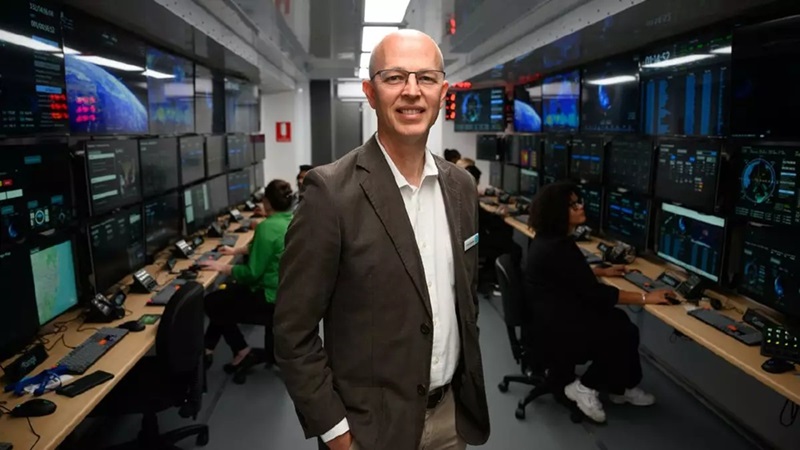
Over the past year, the Space Truck has travelled more than 26,000 kilometres across Queensland, New South Wales, the Australian Capital Territory and South Australia, bringing a real mission operations experience directly to communities.
Along the way, it has contributed to the nation’s access to space and become one of CSIRO’s most powerful tools for connecting Australians with science, technology and the opportunities of the space industry.
“This is my dream!”
Whether it’s a star attraction at science festivals and career expos in Brisbane or Adelaide, or rolling into an outback Australian town, the eye-catching Space Truck grabs attention wherever it goes.
Mr James said one of its greatest impacts has been inspiring young Australians to imagine themselves in future space careers.
“Every time I’ve taken the facility out around regional and metropolitan Australia, seeing the surprise and wonder on people’s faces as they walk through that door for the first time is so rewarding,” said Mr James.
“It reinforces the power of bringing a working space operations facility directly to the community, showing young people that careers in space and STEM are not just possibilities, but aspirations within reach.”
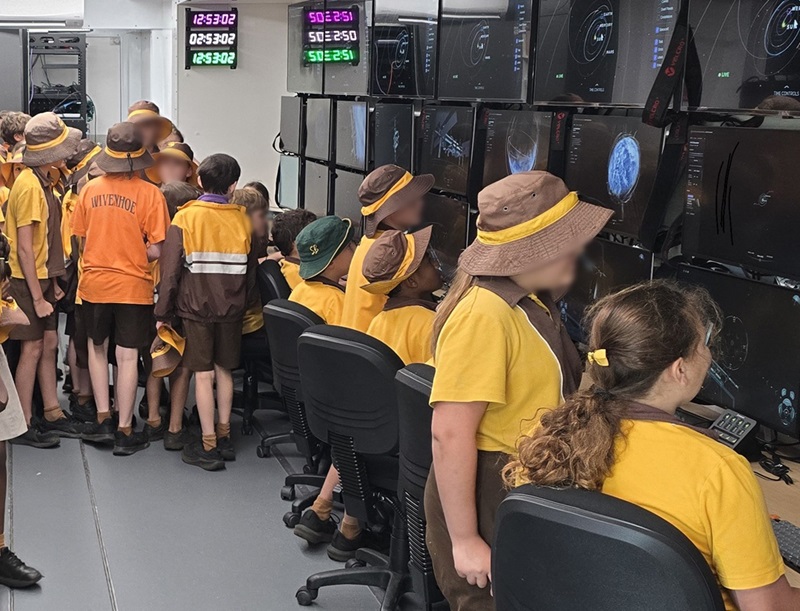
And for one student, that dream became a little more real during a stop in Kingaroy in southern Queensland. Students from the local school were invited aboard to sit down at a workstation and simulate docking a spacecraft with the International Space Station.
“I’ll always remember one Year 5 student, looking up in awe at the screens, saying quietly, ‘this is my dream!’.
“For me, that simple statement was everything the MOC was created to achieve,” said Mr James.
Mission control
The Space Truck is designed to support space operations anywhere in Australia. As a purpose-built, B-double trailer it can be split into two modules – the front ‘A’ Module and the rear ‘B’ module can effectively be in two places at once!
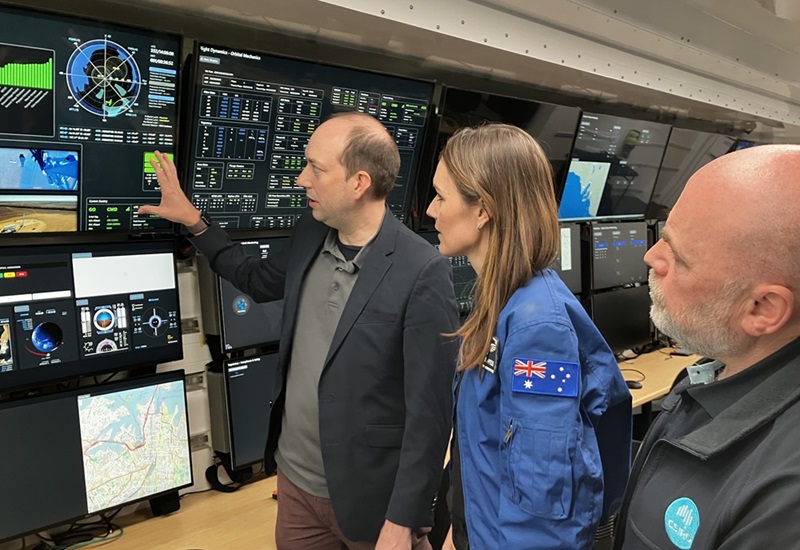
As a fully operational mission control centre, it can accommodate up to 30 operators at multi-monitor workstations equipped with mission-status displays. It can operate off-grid using satellite communications, solar power, batteries and onboard generators. This means mission control can operate from even the remotest location in Australia, where and when it is needed.
Its first operational trials at Southern Launch’s Koonibba Test Range in South Australia tested the Space Truck on a live rocket range, where it successfully demonstrated its power, communications and mission support systems in a demanding operational environment.
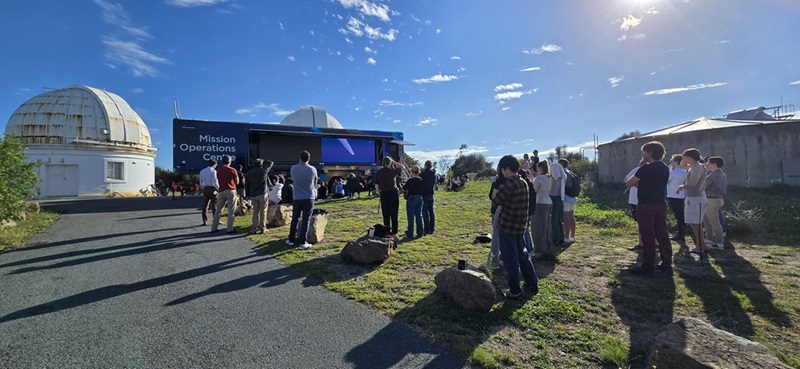
Building on the success of those trials, the MOC went on to support a mission of international significance, with its B Module deployed at Mt Stromlo in Canberra as the mission control facility for the Australian National University (ANU) deep-space optical communications experiment supporting NASA’s Artemis II mission . The live stream shown on the external screens also created an extra buzz of excitement beyond the mission control team.
“It was fantastic seeing that rocket launch on the side of the Space Truck, knowing that over the next 10 days, the facility would be linked to the Orion module as it flew around the Moon. It was a career highlight,” said Mr James.
From a rocket range in regional Australia to helping connect with a spacecraft travelling around the Moon, the MOC has demonstrated the flexibility and capability of Australia’s first mobile space mission control facility.
On the road again
The Space Truck’s first year has shown that science engagement can happen wherever people are.
Whether parked outside a regional school, supporting a science festival in an outback town or contributing to space mission operations, the Space Truck has become a visible symbol of Australia’s growing space ambitions.
“Success for this facility is that it never comes home,” said Mr James.
“It needs to be out on the road doing the job it was designed to do, supporting space missions and helping all Australians engage with space, inspiring future generations for years to come.”
One year and thousands of kilometres later, CSIRO’s Space Truck is still moving towards the next space mission, the next town and the next person who can see a future for themselves in space.
With a packed schedule ahead, keep alert for an opportunity to visit when the Space Truck comes to town.
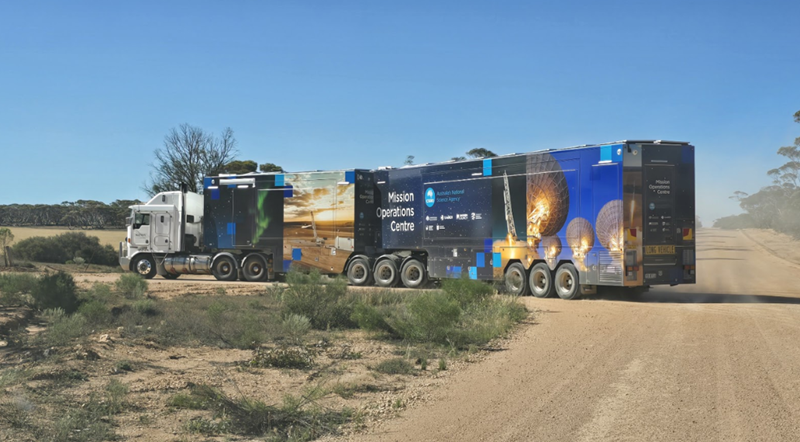
The mobile Mission Operations Control Centre was built as a partnership between CSIRO and the federally sponsored, University of Southern Queensland-led, iLAuNCH Trailblazer University Program, and designed to support Australia’s growing space sector as well as making space exploration more visible and accessible to everyday Australians.