A simple ball-milling process dramatically enhanced the antiviral activity of manganese-based oxides, as reported by researchers from Science Tokyo. The team treated four manganese-containing materials with ball milling in ethanol, which altered their surface chemistry and greatly improved their ability to inactivate an enveloped virus similar to SARS-CoV-2. The findings reveal a promising strategy for designing low-cost, high-performance antiviral materials for coatings and other self-disinfecting surfaces.
Ball Milling Enhances the Antiviral Properties of Manganese (Mn) Oxides
Since the COVID-19 pandemic, developing surfaces that can inactivate viruses upon contact has become an important goal in public healthcare. Ideally, such surfaces would work on their own without needing chemical disinfectants, so they could offer consistent protection in hospitals, public transport, and other shared spaces. This has driven scientists worldwide to search for durable antiviral materials that can be utilized in everyday surfaces.
Although several options have already been developed and studied, they come with important limitations. Antiviral materials based on silver or copper are effective; however, they suffer from discoloration and performance degradation over time, and silver is also costly. Meanwhile, those based on rare-earth elements pose supply and cost risks because the necessary raw materials are unevenly distributed around the world. Thus far, reports of inexpensive yet highly effective materials made from earth-abundant elements have been few and far between.
To address this challenge, a research team led by Professor Akira Nakajima and graduate student Mr. Kotaro Miyazaki from the Department of Materials Science and Engineering, School of Materials and Chemical Technology, Institute of Science Tokyo (Science Tokyo), Japan, investigated whether a simple mechanochemical treatment could improve the antiviral performance of manganese (Mn)-based complex oxides. Their study, published online in RSC Mechanochemistry on July 16, 2026, was conducted in collaboration with the Next-Generation Life Science Technology Development Project at the Kanagawa Institute of Industrial Science and Technology (KISTEC), Japan.
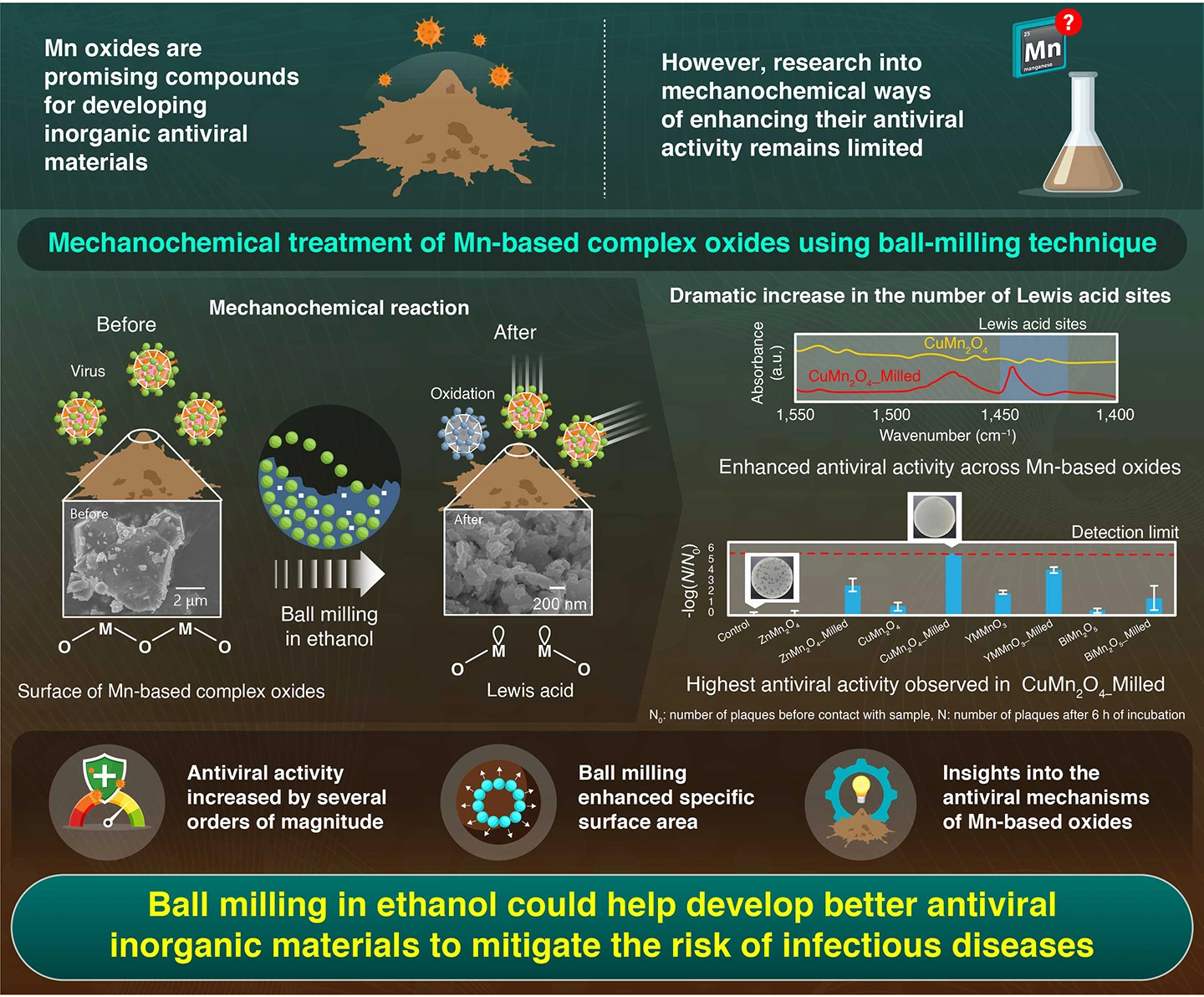
The team first prepared four Mn oxides, each paired with a different common element: zinc, copper, yttrium, and bismuth, obtaining ZnMn2O4, CuMn2O4, YMnO3, and BiMn2O5, respectively. Each material was then ground in a ball mill together with ethanol, a process that breaks particles into much smaller pieces and reshapes their surfaces. The researchers tested how well the milled and pristine materials could inactivate a bacteriophage called Φ6, a virus with an outer envelope similar to those of influenza and SARS-CoV-2.
Milling boosted antiviral performance in every material tested, far beyond what could be explained by the increase in surface area alone. The copper-containing oxide stood out the most, as Nakajima remarks, “CuMn2O4 exhibited an extraordinary increase in antiviral activity per unit surface area, exceeding 5,000 times that of the untreated material.” Detailed analysis showed that milling created new chemically reactive spots on the particle surfaces called Lewis acid sites. These sites are believed to capture viruses by binding to their outer structures, allowing Mn-driven oxidation reactions to more efficiently damage viral surface lipids and proteins. In the case of CuMn2O4, the researchers also found that surface ethoxy groups formed during milling in ethanol further enhanced antiviral performance.
Because Mn is inexpensive and widely available, this approach could support the development of affordable antiviral coatings. “Our findings demonstrate that ball milling in ethanol is an effective method for significantly boosting the antiviral performance of Mn-based complex oxides. Thus, this study presents a new design strategy for the development of low-cost, high-performance inorganic antiviral materials,” concludes Nakajima. Since the treated materials showed no toxicity toward cells, they could offer a practical path toward safer public environments.
Reference
- Authors:
- Kotaro Miyazaki1, Yasuhide Mochizuki1, Toshihiro Isobe1, Satoshi Ishikawa2, Keiichi Kobayashi3, Takeshi Nagai3, Hitoshi Ishiguro3, and Akira Nakajima1*
- Title:
- Mechanochemical activation of Mn-based complex oxides by ball milling for enhanced antiviral activity against enveloped viruses
- Journal:
- RSC Mechanochemistry
- Affiliations:
- 1Department of Materials Science and Engineering, School of Materials and Chemical Technology, Institute of Science Tokyo, Japan
2Materials and Structures Laboratory, Institute of Integrated Research, Institute of Science Tokyo, Japan
3Life Science Technology Project, Kanagawa Institute of Industrial Science and Technology, Japan