Researchers at the University of Würzburg have now solved the mystery of the brighter edges of jets using sophisticated computer simulations. Their findings are published in the journal “Astronomy & Astrophysics”.
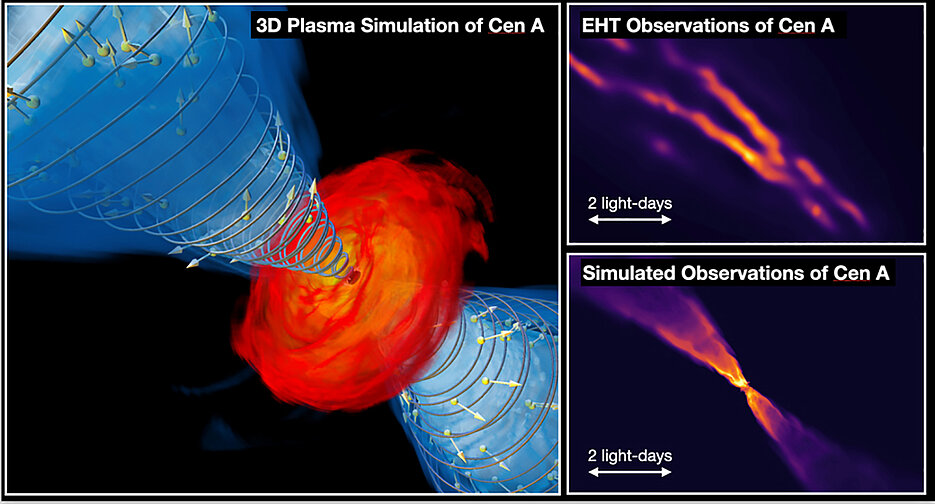
Around 12 million light-years away, the supermassive black hole of the galaxy Centaurus A is hurling two enormous plasma jets into space at nearly the speed of light. These so-called jets are brighter at their edges than at their centre. The reason for this was previously unclear, but has now been solved by a team from the Chair of Astronomy at the University of Würzburg.
Centaurus A is the closest active galaxy to Earth, and its black hole is about 60 million times as massive as our Sun. Precisely because it is so close, astrophysicists can observe its jets in exceptional detail. The galaxy thus serves as a unique laboratory for studying the most extreme conditions in the Universe.
Why do the edges of Centaurus A glow?
In principle, a jet should be brightest at its center. However, observations with the Event Horizon Telescope (EHT) show the opposite: in Centaurus A, it is mainly the edges that glow. This phenomenon has occupied researchers for decades.
The Würzburg team has now found an explanation in the behavior of the plasma – the ionised gas – from which the jets are made. In the jet’s extremely strong magnetic fields, fast electrons move along the field lines. This changes the way in which they emit light: their brightness depends on the orientation of the magnetic field. Because the magnetic field in the jet has a complex structure, bright edges and a comparatively dark core are created-exactly the pattern observed with the EHT.
“Cen A is our closest window into the physics of relativistic jets,” said Felix Glaser, Master’s student at the Chair of Astronomy and lead author of the study. “The fact that our plasma-informed model reproduces the observed edge brightening suggests that we are capturing an important piece of the underlying physics. These processes may not be unique to Cen A, but could be common in relativistic jets throughout the Universe.”
Tiny particles, enormous impact
What is particularly exciting is that the simulations connect processes on the tiny scale of particles with structures extending across several light-days. They not only reproduce the bright edge structure, but also agree exceptionally well with the EHT images taken at a wavelength of 1.3 millimetres.
“What is truly amazing is that microscopic plasma effects can shape structures on vastly larger scales,” said Dr. Christian Fromm, leader of the Computational Astrophysics Group. “Future observations will reveal even more of these plasma signatures, making it increasingly important to include realistic plasma physics in our models already today and to further investigate the highly nonlinear effects of relativistic plasma.”
The study therefore helps us understand how black holes accelerate particles to enormous energies and what radiation is produced in the process. It is also an example of the work of the DFG Research Unit “Relativistic Jets in Active Galaxies” (FOR 5195), which combines observations, simulations and plasma physics.
This result illustrates exactly what we aim to achieve within our DFG Research Unit ‘Relativistic Jets in Active Galaxies’ (FOR 5195),” said Prof. Matthias Kadler, spokesperson of the research unit. “By bringing together expertise in high-resolution observations, numerical simulations, and plasma physics, we are making progress toward understanding how black holes launch powerful jets and how these jets produce the radiation we observe. The new study is an excellent example of this approach.”
Better telescopes for the future
Research into black hole jets is entering a new era. New millimetre telescopes-including the planned Wetterstein Millimeter Telescope on the Zugspitze-will make observations significantly sharper. Major projects such as the next-generation Very Large Array and the Square Kilometre Array will also provide even more detailed insights in the future.
“A black hole and a fusion reactor may sound like completely different worlds-but both are governed by the physics of plasma,” says Professor Karl Mannheim, holder of the Chair of Astronomy at the University of Würzburg. “At Centaurus A, we can study plasma under conditions that cannot be created on Earth. These insights not only help us understand the Universe, but may also contribute to the development of future fusion energy.”
The work paves the way for a new generation of models that will improve our understanding of the Universe’s most powerful particle accelerators.
Original publication
Felix Glaser et al.: Probing anisotropic particle acceleration and limb brightening in Centaurus A’s jet, Astronomy & Astrophysics, 12 October 2026, DOI: 10.1051/0004-6361/202660093