Nanographenes with up to eight helicene units can now be selectively synthesized using a two-step process. Researchers from Science Tokyo have developed a strategy to synthesize multi-helical nanographenes containing up to eight helicene units with controlled handedness. Using a step-by-step process comprising [2+2+2] cycloaddition and the Scholl reaction, the strategy enables selective construction of complex chiral structures with tunable optical properties, including efficient near-infrared emission, offering potential applications in advanced chiroptical materials and optoelectronic devices.
Stereoselective Synthesis of Multi-Helical Nanographenes
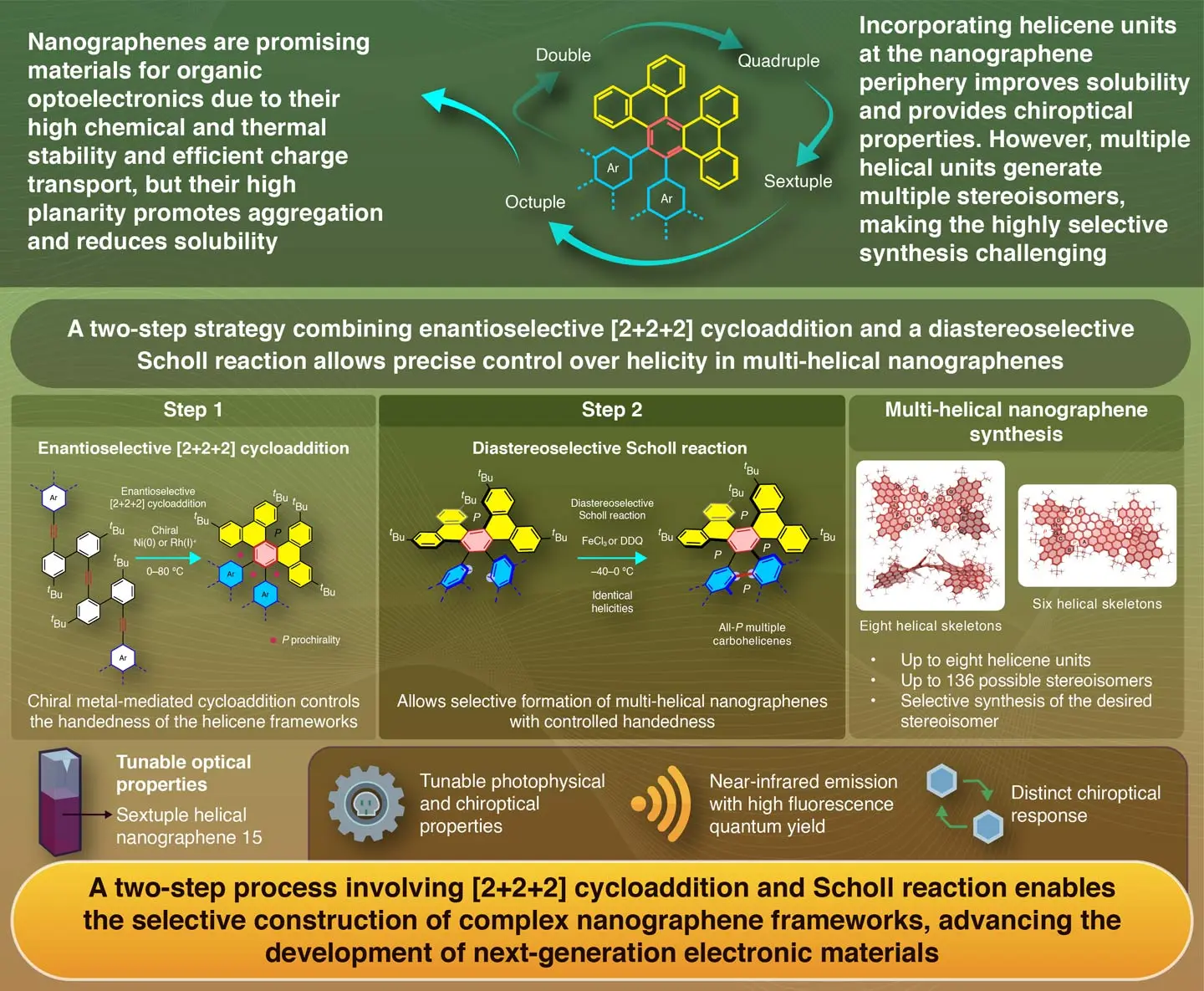
Nanographenes, built from fused aromatic rings arranged in two-dimensional networks, are promising carbon-based materials for next-generation optoelectronic applications. Their extended rigid networks of fused aromatic rings support efficient charge transport and offer high chemical and thermal stability. However, their planar structures also encourage molecular aggregation, which reduces their solubility in organic solvents and can limit their practical applications.
A promising approach to overcome these limitations involves incorporating helicenes, molecules with helical arrangements of fused aromatic rings, along the edges of nanographenes. These helical units can improve solubility while introducing helical chirality and distinctive chiroptical properties, including the ability to interact differently with left- and right-circularly polarized light. However, incorporating multiple helicenes creates numerous possible stereoisomers, making it challenging to obtain molecules with uniformly aligned helicities without laborious separation procedures.
In an effort to overcome these challenges, a research team at Institute of Science Tokyo (Science Tokyo), Japan, has developed a highly stereoselective strategy for synthesizing multi-helical nanographenes containing up to eight helicene units. The team comprises graduate student Ryota Shimizu, Assistant Professor Juntaro Nogami, Dr. Futo Morita (a graduate student at the time of the research, now at Kyoto University), Associate Professor Chihiro Maeda, and Professor Ken Tanaka from the Department of Chemical Science and Engineering, School of Materials and Chemical Technology, Science Tokyo, together with graduate student Yuko Kishida and Professor Hidehiro Uekusa from the Department of Chemistry, School of Science, Science Tokyo. Their study published online in the journal Nature Synthesis on September 22, 2026, demonstrates a method for controlling the three-dimensional arrangement and handedness of these complex molecular structures.
“Highly selective synthesis of nanographene molecules incorporating up to eight helicene units has been achieved. This advancement addresses a longstanding challenge in constructing complex chiral nanomaterials with precisely controlled helicity,” says Shimizu.
The researchers combined two key reactions: an enantioselective [2+2+2] cycloaddition and a subsequent diastereoselective Scholl reaction. The first reaction establishes the initial helical framework and regulates the formation and handedness of additional helicene units, while the second reaction creates new carbon-carbon bonds through oxidative ring fusion, extending the nanographene structure. By adjusting the aromatic substituents and reaction conditions, the team synthesized a range of multi-helical nanographenes with different molecular structures.
The resulting compounds incorporated up to eight helicene units with controlled handedness. Although 136 stereoisomers are geometrically possible for the octuple-helical structure, the researchers obtained the desired stereoisomer with good enantioselectivity. The compounds also exhibited tunable fluorescence ranging from the visible spectrum to the near-infrared region, along with distinct chiroptical responses. Notably, a sextuple-helical nanographene incorporating a nine-armchair graphene nanoribbon framework demonstrated near-infrared emission with a fluorescence quantum yield of up to 50%.
“These findings enable precise control over multiple helicene units while providing a route to chiral materials with efficient near-infrared emission,” says Tanaka.
The findings provide a molecular design platform for developing chiral optoelectronic materials. Such materials could contribute to future optical technologies, including polarization-sensitive devices and near-infrared-emitting systems. Near-infrared properties may also offer opportunities for light-based detection and imaging, although further investigation is needed to establish their practical suitability.
The team’s approach of combining stereoselective synthesis with tunable molecular design advances the construction of complex nanographenes. Additionally, improvements in synthetic efficiency and scalability could expand the range of accessible chiral nanomaterials and support their future development for advanced optoelectronic applications.
Reference
- Authors:
- Ryota Shimizu1, Juntaro Nogami1, Yuko Kishida2, Futo Morita1, Chihiro Maeda1, Hidehiro Uekusa2, and Ken Tanaka1*
- Title:
- Enantio- and diastereoselective synthesis of multi-helical nanographenes
- Journal:
- Nature Synthesis
- Affiliations:
- 1Department of Chemical Science and Engineering, Institute of Science Tokyo, Japan
2Department of Chemistry, Institute of Science Tokyo, Japan
*Corresponding author