A new computation-guided framework for exploring aggregation-induced emission (AIE) luminogens has been developed by researchers from Japan. By combining quantum chemical calculations, organic synthesis, and advanced spectroscopy, the team demonstrated that the introduction of donor and acceptor groups and their substitution positions determine the excited-state potential energy surface and the accessibility of conical intersections in bridged stilbene derivatives. The researchers further showed that AIE behavior can be predicted using a small number of computational descriptors. Their findings provide a rational strategy for exploring and designing luminescent AIE materials for applications such as OLEDs, bioimaging, and sensors.
Certain chemical substances, broadly called luminogens, have an inherent ability to emit light. Most fluorescent molecules emit light in solution but lose their emission in the solid state, where the molecules aggregate. Aggregation-induced emission (AIE) luminogens, or AIEgens, show the opposite behavior: they emit weakly in dilute solution but become strongly luminescent upon aggregation or in the solid state. This unusual property has made AIEgens attractive for a wide range of applications, including organic light-emitting diodes (OLEDs), microbial sensors, bioimaging technologies, and photodynamic therapy.
What are the fundamental factors that govern the emission behavior of AIEgens? Associate Professor Gen-ichi Konishi of the Department of Chemical Science and Engineering at Institute of Science Tokyo, Japan, and his colleagues have proposed that AIE behavior is associated with large structural changes involving substantial reorganization of π-electron systems, including processes accompanied by substantial weakening or cleavage of π bonds in double bonds or aromatic systems. In solution, such structural changes can proceed along reaction pathways that efficiently deactivate the excited state without light emission, whereas in the solid state these processes are suppressed, allowing the molecules to emit light.
These processes can be understood in terms of excited-state potential energy surfaces, particularly through reaction pathways leading to conical intersections (CIs), where excited molecules can rapidly return to the ground state without emitting light. However, accurately calculating and analyzing such complex potential energy surfaces is computationally demanding. Consequently, it has been difficult to identify simple molecular parameters that can be used to predict AIE behavior, and many AIEgens have historically been discovered through empirical trial and error rather than rational molecular design.
Against this backdrop, a research team led by Konishi succeeded in predicting AIE behavior using a small number of descriptors derived from quantum chemical calculations. The team further discovered that the introduction of donor and acceptor groups and, importantly, their substitution positions are key structural factors that determine the excited-state potential energy surface and induce AIE behavior. Their work, published in Advanced Science on June 18, 2026, combined quantum chemical calculations with organic synthesis and experimental spectroscopy to establish a computation-guided framework for understanding and exploring AIE materials.
The team focused on low-lying conical intersections, which are critical regions of a molecule’s excited-state potential energy surface. Acting as “energy funnels,” CIs allow excited molecules to rapidly return to the ground state without emitting light. Because the accessibility of these intersections strongly affects nonradiative excited-state deactivation, the researchers hypothesized that relatively simple structural modifications could control the excited-state potential energy surface and thereby control whether a molecule exhibits AIE.
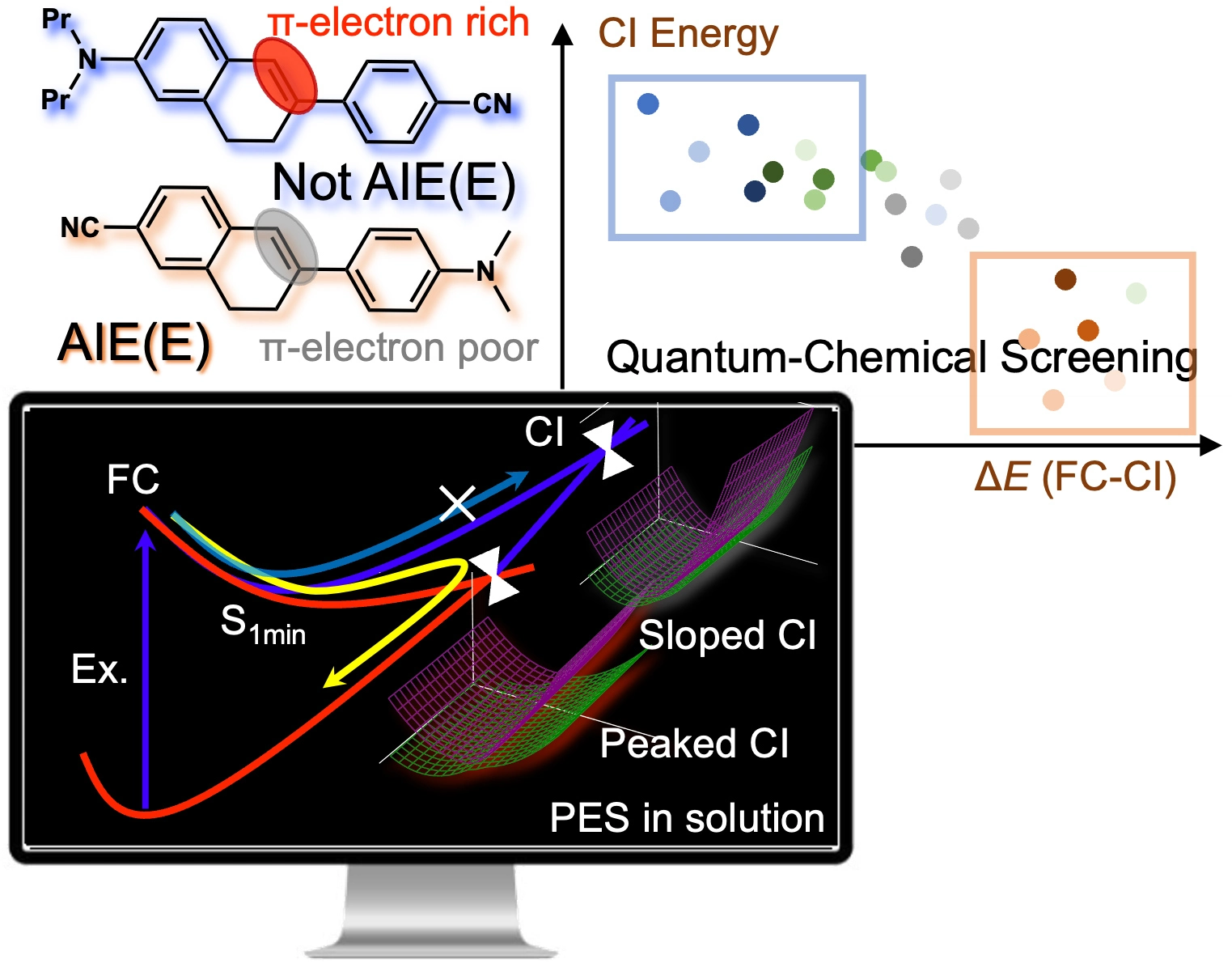
Image credit: Gen-ichi Konishi Laboratory, Institute of Science Tokyo
To test this hypothesis, the researchers selected bridged stilbenes, a well-studied family of photoresponsive molecules, as a model system. They first performed quantum chemical potential energy surface analyses on 30 stilbene derivatives to investigate how bridge size, donor and acceptor substitution, and substitution position affect CI accessibility. From these calculations, they identified a small number of energetic descriptors that could be used to evaluate whether the excited molecule could readily access a CI.
The analyses revealed that the introduction and positioning of donor and acceptor groups strongly alter the energetic relationship between the initially excited Franck-Condon state and the CI, thereby controlling the excited-state potential energy surface and regulating CI accessibility. Importantly, the calculations did more than simply classify molecules as emissive or non-emissive. They provided a mechanistic picture of how relatively small changes in molecular structure redirect excited-state relaxation pathways.
Based on these computational insights, the team designed and synthesized four representative bridged stilbenes. Their photophysical properties were consistent with the behavior predicted from the computational analysis. Ultrafast transient absorption spectroscopy, CI topology analysis, and additional theoretical calculations further revealed that the arrangement of donor and acceptor groups alters the topology and accessibility of the CI, thereby controlling how efficiently an excited molecule can undergo nonradiative deactivation.
“This work represents a significant shift in luminescent material design, moving from empirical trial and error toward rational, computation-guided molecular exploration,” remarks Konishi.
Taken together, the findings provide a mechanistic framework for understanding how molecular structure controls AIE through the excited-state potential energy surface. Rather than relying solely on empirical structural rules, the study shows that AIE behavior can be evaluated using a limited number of physically meaningful computational descriptors linked to conical-intersection accessibility.
Beyond bridged stilbenes, this concept may provide a more general strategy for controlling excited-state dynamics in luminescent molecular systems. “The proposed framework establishes a strategy for controlling excited-state dynamics through molecular structure. We expect it to contribute to the development of high-efficiency OLED materials, fluorescent probes for bioimaging, and sensing materials,” concludes Konishi.
Reference
- Authors:
- Takuya Tanaka1, Satoshi Suzuki2, Hirosato Koyanagi2, Kiyoshi Miyata2, Riki Iwai1, Kazunobu Igawa3, Ken Onda2, Ben Zhong Tang4, and Gen-ichi Konishi1
- Title:
- Computation-Guided Control of Excited-State Deactivation through Modulation of Conical-Intersection Accessibility by Donor-Acceptor Asymmetry in Bridged Stilbene AIE Luminogens
- Journal:
- Advanced Science
- Affiliations:
- 1Department of Chemical Science and Engineering, Institute of Science Tokyo, Japan
2Department of Chemistry, Faculty of Science, Kyushu University, Japan
3Faculty of Advanced Science and Technology, Kumamoto University, Japan
4Guangdong Basic Research Center of Excellence for Aggregate Science, School of Science and Engineering, Shenzhen Institute of Aggregate Science and Technology, The Chinese University of Hong Kong (Shenzhen), China