A beautiful cross-cultural storytelling project facilitated by the University of Newcastle is amplifying the voices of climate-facing communities and deepening understanding of the environmental and cultural significance of wetlands and waterways across the Pacific.
Supported by the Australian Cultural Diplomacy Grants Program (ACDGP) and aligned with the United Nations Sustainable Development Goal 14 (Life Below Water), the project aims to enhance environmental stewardship through knowledge-sharing via visual tools developed by grassroots communities in Samoa and regional New South Wales.
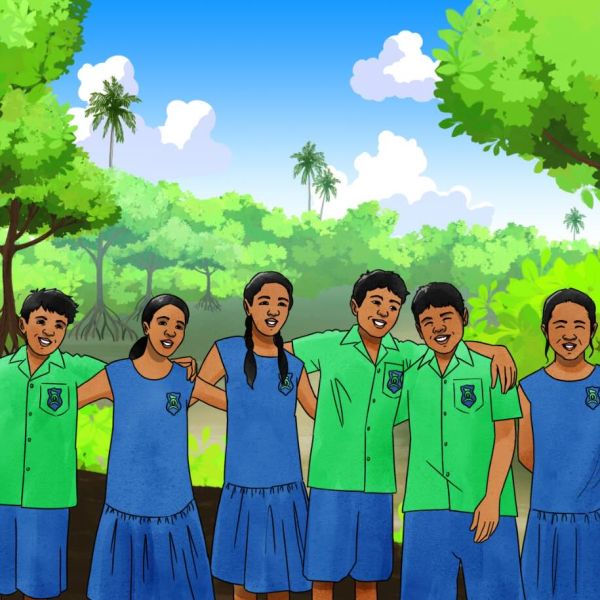
In Samoa, the project has culminated in the production of a vibrant dual-language digital story, produced by Pacific Kids Learning (PKL). The village-led production conceptualised by Moata’a Primary School in Apia, has produced the story titled Togātogo: O Leoleo o le Tuā’oi (Mangroves: Guardians of the Brink).
Written by School Principal Utumapu Vailili Fialua Tito, it celebrates the rich biodiversity and cultural significance of the Moata’a mangrove ecosystem in Samoa. Through the playful voices of marine life, young viewers embark on an educational journey highlighting the vital role mangroves play in nurturing wildlife, supporting local livelihoods, and protecting coastal communities. Rooted in community pride and environmental stewardship, the story reflects the deep village connection between students, teachers, elders and their natural surroundings.
“This project has given local communities a powerful platform to share their connection to place,” PKL Co-founder and Education Director, Theresa Tupuola, said.
“Seeing the teachers at Moata’a Primary School express pride in their wetlands knowledge and knowing their story will be shared across to children of the Pacific via PKL’s digital library, is incredibly meaningful work.”
In Australia, an Aboriginal children’s story centred on wetlands and waterways has been realised as a children’s book, brought to life through artwork created by primary school students at Woodberry Public School.
Reimagined collaboratively by language revitalisation initiative Wiyala Palay and members of the Wonnarua community, the story was carefully developed through community consultation to ensure cultural integrity. The student artwork reflects a strong sense of place and the ongoing significance of wetlands and waterways on Wonnarua Country.
Tammy Hunter of Wiyala Palay said the knowledge exchange was important documentation of the generations of stewardship knowledge held by the Wonnarua people.
“Working with our community and local students to bring this story to life has been incredibly special. It shows how storytelling continues to strengthen our cultural knowledge, our language, and our connection to Country,” Ms Hunter said.
This enactment of reciprocity intentionally delivers on Pacific values and Indigenous practices that centre respect, collective responsibility, and the safe transmission of intergenerational wisdom, celebrating the shared cultural significance of wetlands and waterways across the Oceanic region. It strengthens the relationship across Indigenous communities, ensuring that cultural knowledge is not only preserved, but shared with integrity, guided by those to whom it belongs, and passed on to future generations with care and purpose.
Academic Pacific Program Lead from the University of Newcastle, Associate Professor Angela Page, said the University of Newcastle was well-placed to facilitate such a profound knowledge exchange.
“This project is a beautiful representation of the University of Newcastle’s commitment to our Pacific neighbours and regional communities. We are proud to have played a role facilitating this important exchange to preserve and share Indigenous generational knowledge and enhance future generations’ understanding and capacity to care for Country,” she said.
All completed materials, including the Samoa wetlands animation and the Wonnarua children’s book, will be shared with schools in both Australia and Samoa, supporting ongoing learning and cross-cultural exchange.

/stag-ntd-discussion-illustration.tmb-768v.jpg?sfvrsn=3b2dbfd_2)
/participants-at-advanced-id-workshop-july-2026.tmb-768v.jpeg?sfvrsn=bf1e34a2_2)