When danah boyd first encountered the U.S. Census Bureau, as part of a federal advisory committee in 2016, she – like most of us – had the sense that its job was simply counting everyone in the United States.
She soon found out that it’s much, much more than that.
“I was super naïve,” said boyd, the Geri Gay Professor of Communication in the College of Agriculture and Life Sciences. “I knew that all data projects are complex and messy, but I knew nothing about the long history of politicians trying to mess with the census for partisan gain. I knew that decisions about how to make data are always political, in the sense that they are filled with consequential human decisions.
“But I did not appreciate the various ways in which they would also try to control the methodology or delegitimize the data for their political goals,” boyd said. “Once I started hanging around, it made sense. These data make politics – so politicians want to make these data in their image.”
She eventually went from adviser to ethnographer, and spent eight years “dipping in and out of the Census Bureau watching bureaucrats pull off miracles.”
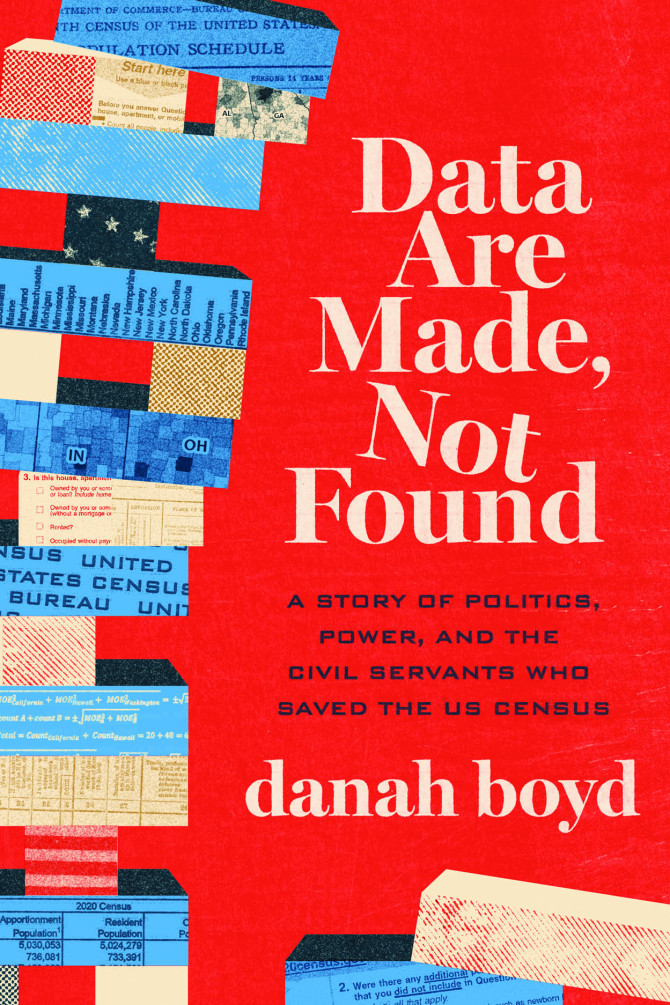
Her new book, “Data Are Made, Not Found: A Story of Politics, Power, and the Civil Servants Who Saved the US Census,” published Sept. 24 (University of Chicago Press), is an insider’s account of the 2020 census, the decade of planning leading up to it, and how the global COVID pandemic – not to mention political forces from left, right and center – threatened to take it down like a Jenga tower.
Jenga, in fact, is a theme she returns to often in the book, as “both well-intended and malevolent actors were putting pressure on the system, as the civil servants were running around with duct tape trying to keep the tower from collapsing,” she said.
boyd is the founder of Data & Society, the independent research institute she was leading at the time she began researching the census. She is also a non-residential fellow at the Center for Democracy & Technology, a trustee of the Computer History Museum, and a member of the Council on Foreign Relations.
boyd spoke with the Chronicle about her new book:
Question: Why did you write this book?
Answer: I’ve long believed that an informed citizenry is a necessary component of democracy. And I believe in democracy. I want the public to understand what all unfolds in this esoteric part of the American project. And I want people to understand that our representatives in Congress have the ability to make – or break – this piece of infrastructure. Finally, this is a love letter to civil servants – the people who serve my country, often without recognition. They deserve our respect and appreciation, especially now when they’re watching their lives be upended by politicians who want to undermine the administrative state.
Q: What spurred you to make the Jenga analogy?
A: It actually started when I was struggling to make sense of what happened whenever politicians thought to introduce new laws and new requirements. I kept thinking about how they were adding pressure to the system. And then I thought about how wobbly the system was becoming. I started hearing about all of the things that were working well that were eliminated, creating instability. And I kept thinking about failure – what does it take for a vital system to fall apart, because it’s always slow, then fast. It dawned on me that I was dealing with a game of Jenga.
Q: Federal workers – many of them career employees, with no political aspirations or motivations – are under constant threat. Do you see the situation getting better as leadership in Washington evolves?
A: No, it’s getting worse. Long before the current administration, civil servants were demonized and mocked, told that they were stupid, incompetent or immoral. And the public has come to believe that civil servants don’t serve them, despite what I saw on the ground. Democrats have worked to outsource the federal government while Republicans have simply aimed to eliminate federal employees and agencies. Despite the critical importance of the administrative state, most college students can’t imagine a career in civil service.
Two of the questions that I keep asking myself is: What will it take for the American public to rise up and invest in the government so that we can all have nice things? And what will it take for Congress to recognize that it is the entity responsible for the census?
Q: What do you hope readers take away from your book?
A: The book is a story of the 2020 census, told through a series of controversies. In my mind, there are three red threads woven throughout the whole thing:
- Data are made, not found, and how they are made matters;
- We are in an era of Jenga politics, and the consequences are mounting. Our systems are becoming more and more brittle; and
- The legitimacy of data is not rooted in some magical formula of quality. Legitimacy is a social process, rooted in social fabrics made up of relationships. If we want to trust our data – and our institutions – we need to invest in the relationships that surround the process.