New antiperovskite-supported cobalt catalyst can produce ammonia from nitrogen and hydrogen under mild conditions without precious metals, as reported by researchers from Science Tokyo. This self-organizing nanostructured material unlocks a novel cooperative mechanism between cobalt, barium, and aluminum that promotes nitrogen activation through the formation of molecular dinitrogen anions (N2)−, outperforming benchmark ruthenium and industrial iron catalysts.
Unlocking Ammonia Synthesis Under Mild Conditions
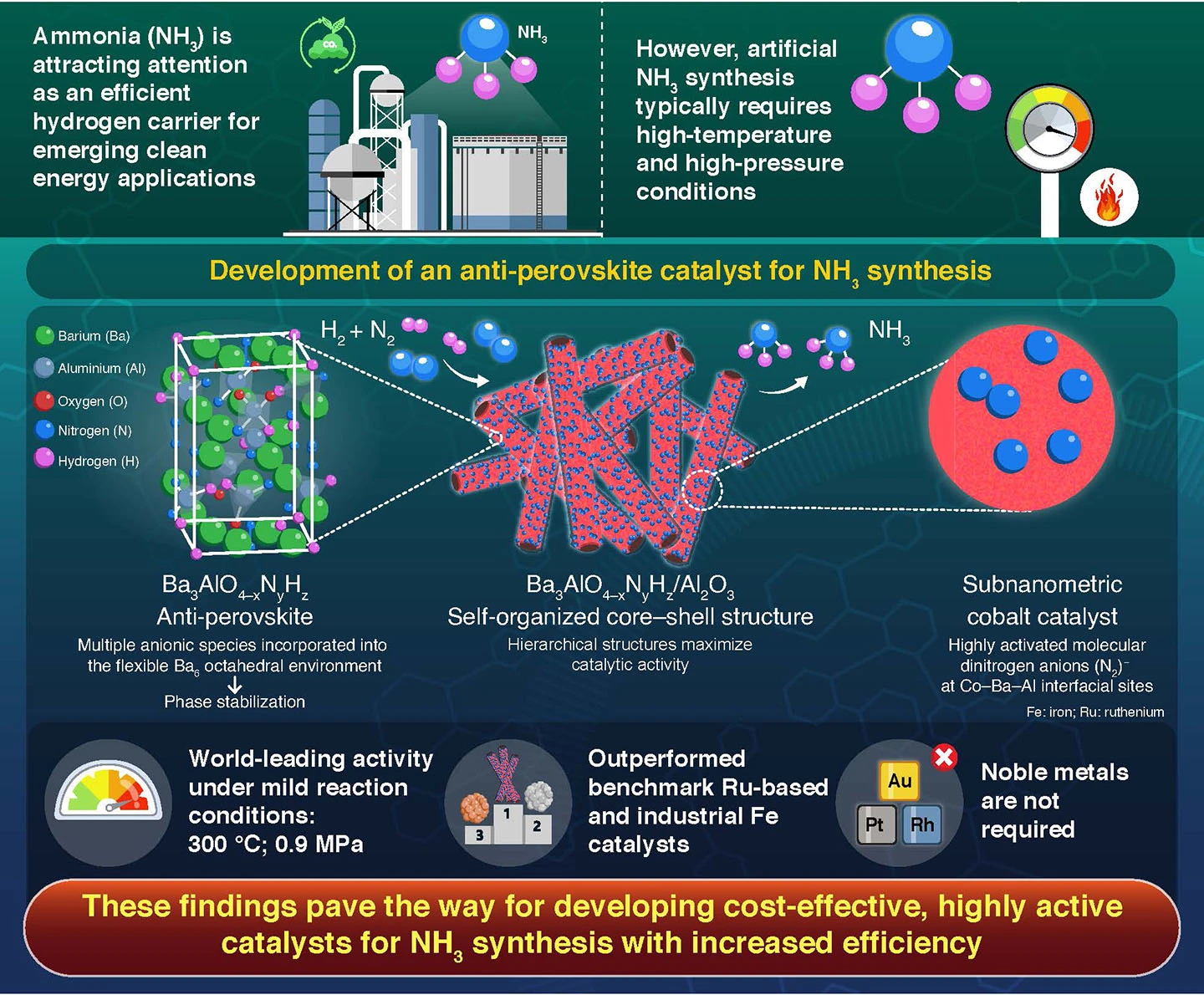
While ammonia (NH3) is best known for its role in fertilizer production, it is quickly attracting attention as a carbon-free hydrogen carrier, potentially offering a practical way to store and transport clean fuel. Despite this promise, NH3 synthesis still depends on high-temperature, high-pressure processes that are difficult to scale up sustainably. The reason behind this is the extremely strong bond between nitrogen atoms in nitrogen gas (N2), which requires a lot of energy to break.
Many scientists are trying to develop catalysts to make NH3 synthesis possible under milder conditions. Although some high-performance catalysts have been reported, they often rely on scarce noble metals, such as ruthenium. Barium (Ba)-based materials could be a cost-effective alternative, but highly active compounds like barium subnitride (Ba2N) are unstable in hydrogen and degrade during NH3 synthesis. How can we design a stable barium-based catalyst that activates nitrogen efficiently?
A research team led by Dr. Yihao Jiang, Professor Hideo Hosono, and Professor Masaaki Kitano from the MDX Research Center for Element Strategy, Institute of Science Tokyo (Science Tokyo), Japan, set out to answer this question. Their latest study, published in the Journal of the American Chemical Society on October 28, 2026, introduces a novel hierarchically structured antiperovskite-supported cobalt for NH3 synthesis.
The researchers synthesized a new material with the formula Ba3AlO4-xNyHz, which features an anti-perovskite structure. This flexible crystal arrangement accommodates several types of negatively charged species, including oxide, nitride, hydride, and molecular dinitrogen anions (N2)−. In this form, the nitrogen atoms are in a highly activated state and have a weakened nitrogen-nitrogen bond, which makes it easier to cleave them.
To boost performance, the team grew this material as an ultrathin shell on aluminum oxide (Al2O3) nanorods, greatly increasing the catalyst’s accessible surface area. They also added cobalt (Co), which self-organized during synthesis into small clusters on the outer shell of the material. This structure was not only remarkably stable but also exhibited an outstanding NH3 synthesis rate of 15.9 mmol per gram of catalyst per hour under mild conditions of 300 °C and 0.9 MPa. “The optimized Co/Ba3AlO4-xNyHz/Al2O3 catalyst achieved NH3 synthesis rates surpassing benchmark ruthenium-based and industrial iron catalysts,” highlights Kitano.
To better understand these results, the team conducted isotope labeling experiments, spectroscopy measurements, and computer simulations. They found that activated (N2)− ions at the interface sites between Co, Ba, and aluminum are central to the reaction. Simply put, Ba-containing sites weaken the nitrogen-nitrogen bond, enabling both easy dissociation of (N2)− and quick replenishment with N2. Meanwhile, Co and aluminum sites assist with the subsequent reaction steps that ultimately lead to NH3.
Overall, this study demonstrates a new strategy for designing stable materials that incorporate activated nitrogen and coordinate the roles of different elements to improve catalytic performance. The study also uncovers a previously unknown NH3 synthesis method mediated by (N2)− ion. It could guide the development of state-of-the-art NH3 production technologies and support future low-carbon energy systems in an emerging hydrogen economy, as Kitano concludes: “The findings of our work open new opportunities for the development of highly active NH3 synthesis catalysts capable of operating efficiently under mild conditions without the use of precious metals.”
Reference
- Authors:
- Yihao Jiang1, Chenyang Zhu1, Jiang Li1, Shun Sato1, Masato Sasase1, Shinya Masuda1, Hideo Hosono1,2*, and Masaaki Kitano1
- Title:
- Hierarchically Structured Anti-Perovskite Oxynitride-Hydride Enabling Ammonia Synthesis via a Cooperative Mechanism Mediated by (N2)− Ions
- Journal:
- Journal of the American Chemical Society
- Affiliations:
- 1MDX Research Center for Element Strategy, Institute of Integrated Research, Institute of Science Tokyo, Japan
2Research Center for Materials Nanoarchitectonics (WPI-MANA), National Institute for Materials Science, Japan