What the research is about
Imagine a field in midsummer. A plant’s leaves are beginning to wilt. By the time people notice such signs, the plant may already be under severe stress.
In fact, plants constantly generate tiny electrical signals when they experience stress caused by drought, heat, or disease. If scientists could “listen” to these signals in real time, it could lead to earlier detection of plant diseases and more efficient farming methods.
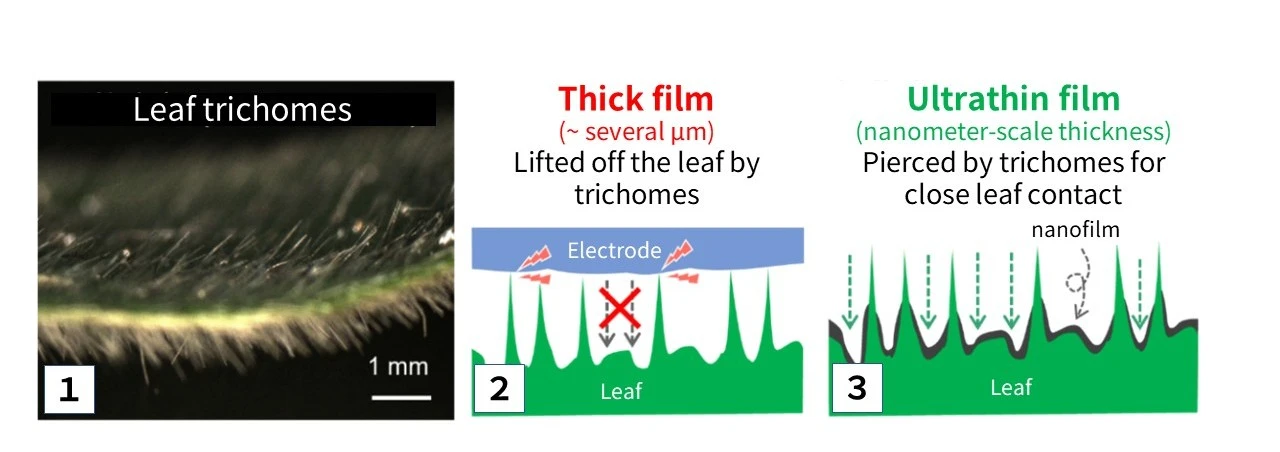
To achieve this, researchers have developed many kinds of electrodes for measuring plant electrical activity. Needle-type electrodes can detect signals with high sensitivity, but they damage plant tissues. Gel-like electrodes can attach gently to leaves, but they are vulnerable to rain and difficult to use outdoors. Thin film electrodes have also been studied, but many crops-including soybeans, eggplants, and pumpkins-have tiny hair-like structures on their leaves called trichomes (Figure 1). These structures prevent the electrode from closely attaching to the leaf surface, making it difficult to accurately detect electrical signals.
To solve this problem, a research team led by Professor Toshinori Fujie of Institute of Science Tokyo (Science Tokyo) developed a new type of ultrathin electrode. The team focused on electrically conductive carbon nanotubes and a soft elastomer, a rubber-like polymer material that supports the nanotubes. The researchers hypothesized that if the electrode could be made extremely thin, the tiny trichomes on the leaf surface might pierce through the film, allowing the carbon nanotube electrode to closely conform to the leaf surface.
Why this matters
One of the most interesting findings of this study is that the researchers demonstrated for the first time that the thickness of the electrode determines how well it attaches to plant surfaces. The team gradually reduced the thickness of the electrode from 480 nanometers-similar to conventional thin-film electrodes-to an ultrathin 70 nanometers, and compared how closely each film attached to leaves. Thick electrodes were pushed upward by the trichomes and floated above the leaf surface (Figure 2). However, when the film thickness reached 70 nanometers, the trichomes pierced through the nanofilm, allowing the electrode to closely attach to the leaf surface (Figure 3).
The new electrode also has several other advantages. Because it is transparent and allows more than 80% of light to pass through, it barely interferes with photosynthesis. In addition, its water-repellent properties prevent it from peeling off even during heavy rain or underwater conditions. Using this electrode, the researchers successfully recorded plant electrical signals continuously for more than two months, and in some cases for up to ten months.
Previous technologies often faced trade-offs: electrodes that attached strongly could damage plants, while softer materials were vulnerable to water. This study is significant because it successfully overcame both problems at the same time.
What’s next
This technology could become an important foundation for future smart agriculture. For example, if plants could signal the moment they begin to experience water shortage or disease, farmers could provide water and fertilizer only where and when they are needed. The researchers have already demonstrated that the system can detect disruptions in photosynthesis caused by herbicides through changes in electrical signals.
As concerns grow over food shortages caused by global population growth and climate change, this technology may help support stable food production. It could be especially useful for monitoring important crops with trichome-covered leaves, such as tomatoes, eggplants, and beans.
Comment from the researcher
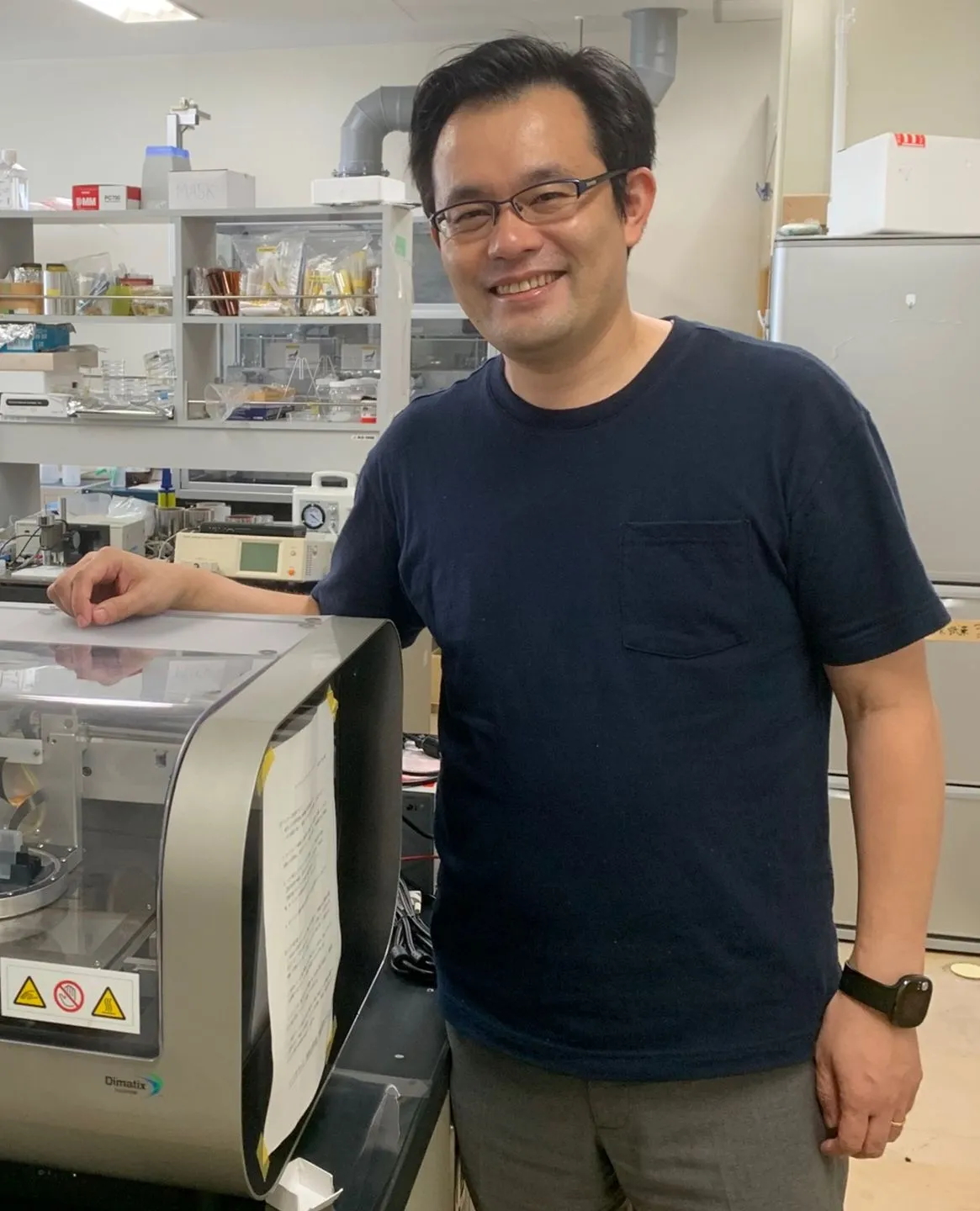
Many people have probably wondered what it would be like if we could hear the voices of plants. This research is a first step toward making that possible. Plants may appear silent, but they constantly respond to environmental changes through electrical signals. Our technology allows us to monitor these tiny changes over long periods without harming the plants. In the future, plants themselves may one day be able to tell us, “I’m healthy,” “I’m stressed,” or “I’m thirsty.”
(Toshinori Fujie, Professor, School of Life Science and Technology, Institute of Science Tokyo)
Dive deeper
Explore more research in Science for All
Science for All showcases cutting-edge research at Science Tokyo and highlights the ideas, people, and possibilities shaping the future.