“Some days my body feels like it is moving through wet concrete, or the world keeps racing ahead. But something unexpected happened when my life slowed down. I started noticing moments I used to miss,” said the 43-year-old dad who was diagnosed with Amyotrophic Lateral Sclerosis – a devastating form of MND – last year.
“Like a lot of parents, I thought being a good father meant providing, organising, achieving. Then ALS forced me to stop running. And in that stillness, my daughter found more of me.”
It’s unfathomable that Ben’s powerful story about the serious impacts on his health and family could also highlight something positive – hope. But his description of how his life filled with peaceful, reflective moments following his diagnosis resonated deeply with guests at the annual MND Gala on 26 June, an event that aims to raise awareness and funds for Macquarie University’s renowned MND research.
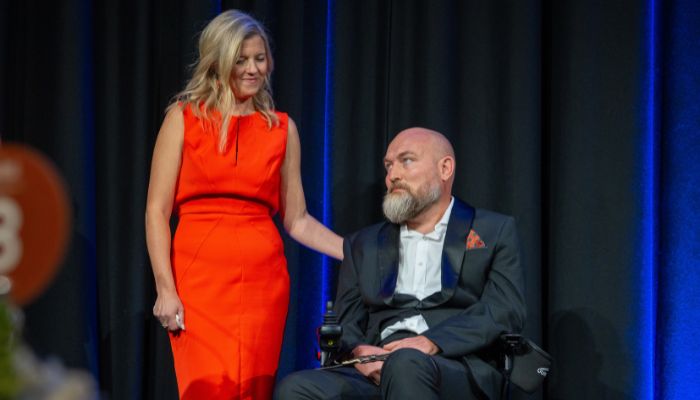
Ben Bruseker spoke at this year’s MND gala. Picture: Chris Barlow
“Now, instead of rushing through bedtime, I stay there longer. We talk longer. We laugh longer. I listen more carefully to the stories that only a six-year-old can tell with complete seriousness. I notice the way her face lights up when she’s proud of herself. The way she reaches for my hand automatically. The way she looks back to make sure I’m keeping up. Ironically, slowing down physically has allowed me to become more emotionally present as a father,” shared Ben.
For people like Ben who are living with MND, the money raised at this year’s MND Gala is what amplifies that hope. With more than $350,000 raised, and the donations still pouring in, funds will support research led by clinical neurologist Professor Dominic Rowe and scientist Dr Carol Lee through the Macquarie University Motor Neuron Disease Research Centre.
Since its inception 13 years ago, the Centre has become the largest and most comprehensive clinical and research program for MND in Australia. Its mission is focused on providing world-class care for people living with MND and to develop effective new therapies for this devastating disease.
The Centre has made seminal contributions to the understanding of MND by demonstrating the significant slowing of the progression of MND in the SPG302 Phase 2 study and commencing the CTX1000 trial, which uses a genomic therapy to treat toxic protein clumps in sporadic MND patients. The Centre is the only site in Australia for the ATLAS study, which aims to prevent or delay the onset of MND in patients who have the SOD1-specific form of Amyotrophic Lateral Sclerosis.
Professor Rowe and his team have also been looking into MND ‘hotspots’ – areas where higher-than-expected rates of the disease may point to environmental, occupational, or genetic risk factors.
After their tireless campaigning, the state government announced last week that NSW will become the first jurisdiction in the world to make MND a notifiable disease. Doctors will now need to report cases of MND as well as patient details like where they live and their occupations.
“A disease killing around 800 Australians a year, that’s unevenly distributed and largely unexplained should command our complete attention,” said Professor Dominic Rowe.
“By making MND a notifiable disease we are ensuring every patient is seen and heard. Patients want an answer to cause. Without cause, we don’t have mechanism, and without mechanism we will not have therapies for everyone with Motor Neuron Disease.
“This new data around the locations and occupations of patients will allow researchers to identify patterns that could otherwise be missed. That work could be critical to understanding not just how MND progresses, but why it emerges in some communities more than others and how future cases might one day be prevented.”
Ben’s story reminds us of the importance of further research and action.
“Research matters. Support matters. Hope matters. When you donate, advocate, volunteer or simply show up, you are helping families hold on to time.” said Ben.
“I think that’s what this fight is really about. Not just extending life, but preserving moments – more birthdays, more bedtime stories, more school concerts, more ordinary Tuesdays that families like mine now understand are actually extraordinary.”
You can add to the MND Gala total by donating here .