What the research is about
Many of the services we use every day-such as digital maps and weather forecasts-depend on satellites orbiting Earth. In recent years, very small satellites, some only about the size of a hand, have begun playing an increasingly important role in space activities.
However, small satellites face a major challenge. To communicate with Earth from space, they need high-performance antennas. The problem is that high-performance antennas are often large, making them difficult to fit onto small satellites. In addition, rockets have strict limits on both weight and storage space. In other words, engineers must achieve the difficult combination of being both small and lightweight while still delivering high performance.
To address this challenge, a research team led by Associate Professor Takashi Tomura and Professor Hiraku Sakamoto of Institute of Science Tokyo (Science Tokyo) focused on antennas made from thin membrane materials. Such membranes can be folded into a compact shape for launch and then unfolded into a much larger structure once in space. A similar concept was used in Japan’s solar sail spacecraft IKAROS, which successfully deployed a large membrane in space.
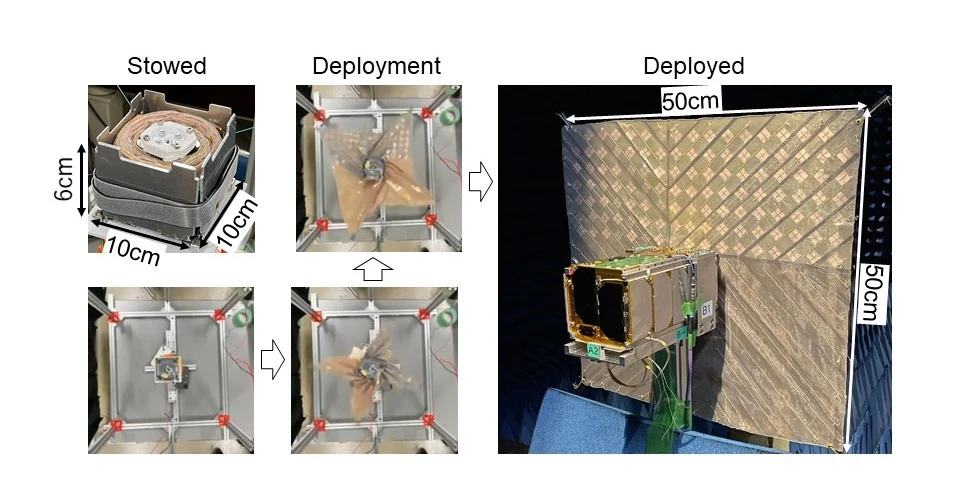
Building on this idea, the Science Tokyo team developed an antenna that can be folded compactly like origami (Figure 1).
Why this matters
The team faced a significant challenge during development. While thin membranes are lightweight, they can easily wrinkle or deform when deployed in space. Even small changes in an antenna’s shape can greatly reduce its performance.
To solve this problem, the researchers adopted an origami-inspired structure called a Flasher pattern. Like a folding umbrella, it can be stored in a compact form and then expanded into a much larger surface area when needed.
In recent years, a growing field known as origami engineering has attracted attention by applying principles of paper folding to engineering design. The Flasher structure can be deployed simply by pulling its four corners, allowing the antenna to remain lightweight while maintaining excellent performance.
Another key achievement of this study is that the team verified, using a real prototype, whether the antenna could truly be used in space. The researchers built a prototype that included not only the antenna itself but also the satellite body and deployment mechanism. They then conducted vibration tests to confirm that the system could withstand the intense shaking experienced during rocket launch, as well as thermal-vacuum tests that reproduced the vacuum and temperature conditions of space. Afterward, they measured the antenna’s radio-wave performance on the ground. The results showed that the antenna can provide the performance needed for stable communication in space. Remarkably, the entire antenna system weighs only 64 grams.
The antenna uses an extremely thin membrane comparable in thickness to a human hair. Because it can be folded into a very compact package, it can make more efficient use of the limited space available inside a rocket, potentially allowing more satellites and equipment to be launched.
What’s next
If this technology is put into practical use, it could significantly advance satellite communications and Earth observation using small satellites. For example, deploying large numbers of small satellites could make it possible to provide broader coverage around the globe. As a result, internet access could become more available in areas where ground-based communication infrastructure is limited, such as mountainous regions and offshore areas.
Until now, high-performance space antennas have generally required large and heavy structures. This research suggests that origami-inspired engineering may offer a new way forward, enabling powerful antennas that are both lightweight and compact.
Comment from the researcher
Antennas used in space require an interesting combination of capabilities: they must fold into a very small package and then expand into a large structure once deployed. In this research, we combined the familiar idea of origami with advanced antenna technology to explore new possibilities for small satellites.
Radio waves are invisible, but they play a vital role in connecting space and Earth. I hope this research helps readers discover how fascinating antennas, space technology, and engineering can be.
(Takashi Tomura, Associate Professor, Department of Electrical and Electronic Engineering, Institute of Science Tokyo)

Dive deeper
Explore more research in Science for All
Science for All showcases cutting-edge research at Science Tokyo and highlights the ideas, people, and possibilities shaping the future.